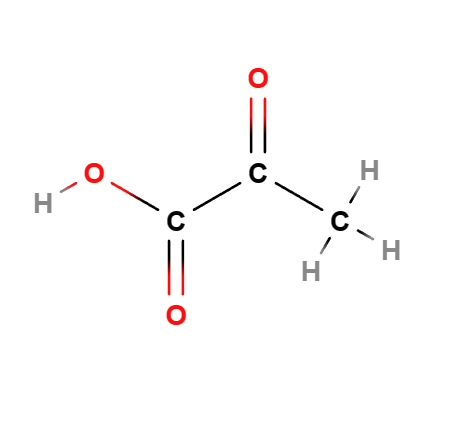
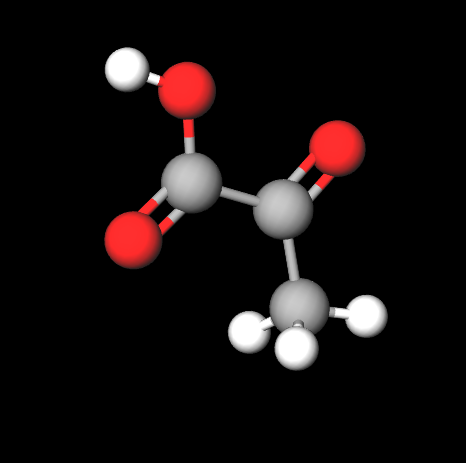
L'acido piruvico è un acido alfa-cheto presente in modo naturale nel corpo umano e in diversi alimenti. Gioca un ruolo cruciale nel metabolismo, dove agisce come un intermediario nel ciclo di Krebs, contribuendo alla produzione di energia.
Il nome definisce la struttura della molecola:
- Acido indica una sostanza chimica che può rilasciare ioni di idrogeno e ha un pH inferiore a 7. Gli acidi sono comunemente usati in chimica per le loro proprietà reattive.
- piruvico significa che è legato al metabolismo energetico delle cellule. Il nome chimico acido piruvico è un composto organico chiave nel ciclo di Krebs, un passaggio fondamentale nella respirazione cellulare.
Processo di produzione industriale (1)
- Selezione. La produzione di acido piruvico può iniziare con la selezione di carboidrati come glucosio o attraverso l'uso di acido tartarico come materiale di partenza.
- Fermentazione. Nel caso del metodo di fermentazione, il glucosio viene convertito in acido piruvico utilizzando ceppi specifici di batteri o lieviti sotto condizioni controllate di temperatura e pH.
- Sintesi. Alternativamente, l'acido piruvico può essere prodotto attraverso la sintesi chimica, che include la decarbossilazione dell'acido tartarico seguita da ulteriori reazioni di purificazione.
- Purificazione. La miscela reattiva ottenuta viene purificata attraverso tecniche come la distillazione sotto vuoto o la cristallizzazione per isolare l'acido piruvico.
- Cristallizzazione. L'acido piruvico purificato è ulteriormente raffinato mediante cristallizzazione per migliorare la purezza e la qualità del prodotto finale.
- Asciugatura. Dopo la cristallizzazione, il prodotto viene asciugato per rimuovere l'umidità residua e ottenere una polvere fine.
- Controllo qualità. Ogni lotto di acido piruvico è sottoposto a rigorosi controlli di qualità per garantire che soddisfi le specifiche di purezza e qualità necessarie per le applicazioni industriali.
A cosa serve e dove si usa
In dermatologia, l'acido piruvico è utilizzato come agente esfoliante e anti-età in trattamenti cutanei. Aiuta a stimolare il rinnovamento cellulare riducendo le imperfezioni, le rughe e migliorando la texture della pelle. L'acido piruvico è anche noto per aiutare nel trattamento dell'acne, delle cicatrici e della pigmentazione, poiché accelera il processo di turnover delle cellule cutanee.
Cosmetica - Funzioni INCI
- Fragranza. Ha un ruolo decisamente importante nella formulazione di prodotti cosmetici in quanto fornisce la possibilità di migliorare, mascherare o aggiungere profumo al prodotto finale aumentandone la commerciabilità. E' in grado di creare un odore gradevole percepibile, mascherare un cattivo odore. Il consumatore si aspetta sempre di trovare un profumo gradevole o particolare in un prodotto cosmetico.
Principali utilizzi e benefici dell'acido piruvico.
Trattamenti Anti-aging. L'acido piruvico stimola la produzione di collagene e elastina, contribuendo a ridurre le linee sottili e le rughe e migliorando l'elasticità della pelle.
Esfoliazione chimica. Utilizzato in peeling chimici, l'acido piruvico aiuta a rimuovere lo strato superiore delle cellule morte della pelle, rivelando uno strato più fresco e più giovane.
Trattamento dell'acne. Ha proprietà antibatteriche e può aiutare a prevenire l'occlusione dei pori, riducendo così la formazione di acne e migliorando la chiarezza della pelle (2).
Riduzione delle cicatrici e delle macchie. È efficace nel ridurre l'aspetto delle cicatrici, inclusa l'iperpigmentazione post-infiammatoria, grazie alla sua capacità di accelerare il rinnovamento cellulare (3).
Miglioramento della texture della pelle. Contribuisce a migliorare la texture complessiva della pelle, rendendola più liscia e uniforme (4).
Altri Acidi. Spesso viene combinato con altri acidi esfolianti per potenziarne l'efficacia e i risultati, specialmente nei trattamenti professionali.
Molecular Formula C3H4O3
Molecular Weight 88.06 g/mol
CAS 127-17-3
UNII 8558G7RUTR
EC Number 204-824-3
DTXSID2021650
Synonyms
Acid Pyruvic
Pyruvate
Bibliografia_____________________________________________________________________
(1) Li Y, Chen J, Lun SY. Biotechnological production of pyruvic acid. Appl Microbiol Biotechnol. 2001 Nov;57(4):451-9. doi: 10.1007/s002530100804.
Abstract. Pyruvic acid is an important organic acid widely used in the chemical and drug, as well as agrochemical, industries. Compared with the chemical method, biotechnological production of pyruvic acid is an alternative approach because of the low cost. An overview of biotechnological production of pyruvate, including direct fermentative production employing eukaryotic and prokaryotic microorganisms, production by a resting cell method and an enzymatic method as well as the recovery of pyruvate, is discussed. A multi-vitamin auxotrophic yeast strain, Torulopsis glabrata. has been used in the commercial production of pyruvate; emphasis is therefore placed on the mechanism and characteristics of pyruvate production by this strain.
Cybulski K, Tomaszewska-Hetman L, Rakicka M, Juszczyk P, Rywińska A. Production of pyruvic acid from glycerol by Yarrowia lipolytica. Folia Microbiol (Praha). 2019 Nov;64(6):809-820. doi: 10.1007/s12223-019-00695-2.
Abstract. The aim of the study was to screen Yarrowia lipolytica strains for keto acid production and determine optimal conditions for pyruvic acid biosynthesis from glycerol by the best producer. The analyzed parameters were thiamine concentration, medium pH, stirring speed, and substrate concentration. The screening was performed in flask cultures, whereas pyruvic acid production was carried out in 5-L stirred-tank reactor with 2 L of working volume. In total, 24 Y. lipolytica strains were compared for their abilities to produce pyruvic and α-ketoglutaric acids. The total concentration of both acids ranged from 0.1 to 15.03 g/L. Ten strains were selected for keto acid biosynthesis in bioreactor. The Y. lipolytica SKO 6 strain was identified as the best producer of pyruvic acid. In the selected conditions (thiamine concentration 1.5 μg/L, pH 4.0, stirring speed 800 rpm, 150 g/L of glycerol), the strain Y. lipolytica SKO 6 produced 99.3 g/L of pyruvic acid, with process yield of 0.63 g/g and volumetric production rate of 1.18 g/L/h. Higher titer of pyruvic acid was obtained during fed-batch culture with 200 g/L of glycerol, reaching 125.8 g/L from pure glycerol (yield 0.68 g/g) and 124.4 g/L from crude glycerol (yield 0.62 g/g). Results obtained for the strain Y. lipolytica SKO 6 proved the suitability of microbial production of pyruvic acid at industrial scale.
(2) Chilicka K, Rogowska AM, Szyguła R, Dzieńdziora-Urbińska I, Taradaj J. A comparison of the effectiveness of azelaic and pyruvic acid peels in the treatment of female adult acne: a randomized controlled trial. Sci Rep. 2020 Jul 28;10(1):12612. doi: 10.1038/s41598-020-69530-w. PMID: 32724156; PMCID: PMC7387545.
Abstract. Chemical peels are widely used as therapeutic agents in dermatology and cosmetology. This study aims to explore the differences in the effectiveness of azelaic and pyruvic acid peels in the treatment of acne vulgaris. Eligibility criteria for participants were: female gender, 18-25 years of age, no dermatological treatment within the last 12 months and mild to moderate papulopustular acne. We treated 120 young women (with a mean age of 22 years old) with six peeling sessions at 2-week intervals. In the parallel clinical study design, one randomized group (n = 60, 50%) was treated using azelaic acid (AA), whereas the second group participated in pyruvic acid (PA) sessions. We evaluated the patients clinically twice (before and after treatment), using the Scale of Hellegren-Vincent Severity Symptoms to assess the acne diagnosis, and the Nati Analyzer to estimate the skin properties (oily skin, desquamation, porosity, and moisture). The clinical evaluation of the patients demonstrated a significant reduction of acne severity symptoms in both the AA and PA groups, after the peeling sessions. An effect was also found in terms of decreasing desquamation and the oiliness of the skin. PA showed a more significant reduction of greasy skin than AA. In conclusion, after the six peeling sessions using AA and PA, all patients showed better skin parameters in term of reduced oiliness and desquamation. Both AA and PA peelings are a safe and efficient treatment for mild acne, however, during the selection of one of the two acids, side effects, skin properties, and patients' preferences should be taken into account. This study was registered in the ISRCTN registry (registration number ISRCTN79716614, 17/01/2020).
(3) Ghersetich I, Brazzini B, Peris K, Cotellessa C, Manunta T, Lotti T. Pyruvic acid peels for the treatment of photoaging. Dermatol Surg. 2004 Jan;30(1):32-6; discussion 36. doi: 10.1111/j.1524-4725.2004.30002.x.
Abstract. Background: Pyruvic acid (CH3-CO-COOH), an alpha-keto-acid, has been recently used as a medium chemical peeling agent in subjects with inflammatory acne, moderate acne scars, greasy skin, actinic keratosis, and warts. Objective: The aim of our study was to evaluate the efficacy and tolerability of 50% pyruvic acid on moderately photodamaged facial skin....Conclusion: Thus, 50% pyruvic acid peeling can be proposed as a safe and efficient treatment for moderate facial skin aging.
(4) Cavallini M, Montanaro F, Papagni M. A Topical Depigmentation Program Against Hyperpigmentation Enhances the Benefits of Previously Performed Chemical Peeling Procedures of the Face. J Cosmet Sci. 2020 Nov-Dec;71(6):385-397.
Abstract. Chemical peeling can reduce skin hyperpigmentation; however, once exhausted its thinning action, the depigmentation process does not continue further. We carried out a monocentric, prospective, noncontrolled study aimed at the evaluation of the efficacy, safety, ease of use, pleasantness, and tolerability of a depigmentation topical treatment program in women submitted to a previous chemical peeling. The topical treatment has been administered daily for 30 days to 16 women submitted to a chemical peeling containing a fixed-dose combination of salicylic acid, pyruvic acid, and retinoic acid within 7 days before study inclusion. Target skin areas have been evaluated for melanin concentration and skin texture before peeling and at study visits 1 (after peeling) and 2 (after the 30-day treatment). The topical treatment program induced a decrease in melanin concentration between study visits 1 and 2 (-4.74%; p = 0.0008). It reduced melanin concentration even further between the prepeeling period and visit 2 (-7.8%; p < 0.0001). Patients rated the depigmentation topical treatment program as "very simple" (87.5%) and "simple" (12.5%) to use and as "pleasant" (56.25%) and "very pleasant" (43.75%). Results support the use of the home-based depigmentation topical treatment program to potentiate the effectiveness of a previous chemical peeling in hyperpigmentation reduction.