Earl Grey is a type of black tea flavored with the essential oil of bergamot, a citrus fruit whose flavor is a unique combination of lemon, orange, and slightly bitter floral notes. This tea is named after the second Earl Grey, a British Prime Minister in the 19th century, and has earned a worldwide reputation for its distinctive and refreshing taste. Earl Grey consists mainly of black tea, sourced from various regions such as India, Sri Lanka, or China, flavored with bergamot oil.
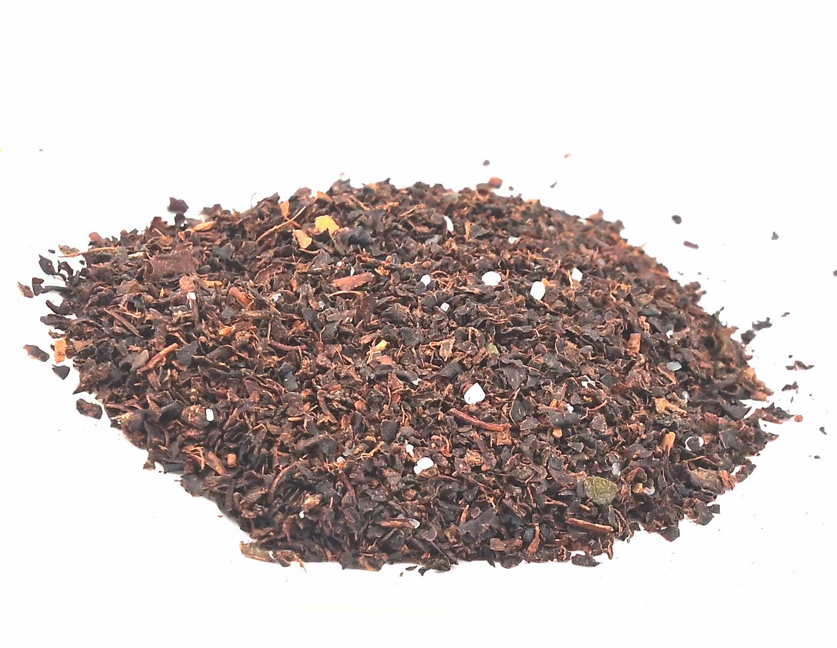
Properties. Beyond its unique aromatic profile, Earl Grey offers health benefits thanks to the antioxidants present in black tea, which can help reduce inflammation and improve heart health.
Preparation. Traditionally, it is prepared by steeping tea leaves in hot water for about 3-5 minutes, depending on the desired strength. It can be enjoyed on its own or with a bit of milk or lemon to enhance its flavor.
Variants. There are several variants of Earl Grey, including teas that use bases other than black tea, such as green tea or white tea, and versions that include additional flavors besides bergamot.
Culture and Tradition. Earl Grey has a long history and holds a special place in tea culture, being a popular choice for the afternoon or morning thanks to its invigorating aroma and balanced taste.
Environmental Considerations. Sustainability in the production of Earl Grey concerns both the cultivation of tea and the production of bergamot oil, with growing interest in practices that respect the environment and promote social responsibility.
Safety
As is often the case with flavored products, polycyclic aromatic hydrocarbons (PAHs) have been found in Earl Grey that can cause health problems (2).
One should not excessively consume them as cases of intoxication from excessive ingestion of Earl grey have occurred (3).
References_____________________________________________________________________
(1) Orth AM, Poplacean I, Fastowski O, Engel KH. Assessment of dietary exposure to flavouring substances via consumption of flavoured teas. Part II: transfer rates of linalool and linalyl esters into Earl Grey tea infusions. Food Addit Contam Part A Chem Anal Control Expo Risk Assess. 2014;31(2):207-17. doi: 10.1080/19440049.2013.866717. Epub 2014 Jan 21. PMID: 24237351.
Abstract. The assessment of dietary exposure via the consumption of flavoured foods is a key element of the safety evaluation of flavouring substances. Linalyl acetate and linalool are the major flavouring substances in Earl Grey teas; the objective of this study was to determine their transfer rates from the tea leaves into the tea beverage upon preparation of a hot water infusion. Spiking experiments revealed a transfer rate of 66% for linalool. In contrast, the transfer rate for linalyl acetate was only 1.9%; in turn, the hydrolysis product linalool (17.0%) and a spectrum (19.9%) of degradation and rearrangement products (monoterpene alcohols, esters and hydrocarbons) were present in the tea beverage. The transfer rates were shown to be proportional to the length of the infusion. The impact of the hot water treatment on the enantiomeric compositions of linalyl acetate and linalool was determined, and structure-dependent experiments were performed by variation of the acyl and the alcohol moiety of the monoterpene ester. Comparative dietary exposure assessments demonstrated the need to take correction factors based on the experimentally determined transfer rates into account. Based on tea consumption data from the UK National Diet and Nutrition Survey (2000/2001), the exposure to linalyl acetate ranges from 0.2 mg day(-1) (average) to 1.8 mg day(-1) (high). The corresponding values for linalool are 4.2 mg day(-1) (average) and 46.6 mg day(-1) (high). The exposure of linalool via consumption of the tea beverage is approximately 26 times higher than that of linalyl acetate, although in the flavoured tea leaves the median content of linalyl acetate is approximately 1.8 times higher than that of linalool.
(2) Adisa A, Jimenez A, Woodham C, Anthony K, Nguyen T, Saleh MA. Determination of polycyclic aromatic hydrocarbons in dry tea. J Environ Sci Health B. 2015;50(8):552-9. doi: 10.1080/03601234.2015.1028832. PMID: 26065515; PMCID: PMC4881431.
Abstract. Twenty-eight different tea samples sold in the United States were evaluated using high-performance liquid chromatography (HPLC) with fluorescence detection (FLD) for their contamination with polycyclic aromatic hydrocarbons (PAHs). Many PAHs exhibit carcinogenic, mutagenic, and teratogenic properties and have been related to several kinds of cancer in man and experimental animals. The presence of PAHs in environmental samples such as water, sediments, and particulate air has been extensively studied, but food samples have received little attention. Eighteen PAHs congeners were analyzed, with percentage recovery higher than 85%. Contamination expressed as the sum of the 18 analyzed PAHs was between 101 and 1337 μg/kg on dry mass and the average contents in all of the 28 examined samples was 300 μg/kg on dry mass. Seven of the congeners were found in all samples with wide ranges of concentrations as follows: fluorene (7-48 μg/kg), anthracene (1-31 μg/kg), pyrene (1-970 μg/kg), benzo(a)anthracene (1-18 μg/kg) chrysene (17-365 μg/kg), benzo(a)pyrene (1-29 μg/kg), and indeno(1,2,3-cd)pyrene (4-119 μg/kg). The two most toxic congeners benzo(a)pyrene and dibenzo(a,h)anthracene were found at high concentrations only in Earl Grey Twinnings, Earl Grey Harney& Sons Fine Teas, and Chai Ultra Spice Black Tea Twinnings. Six PAH congeners are considered as suspected carcinogens (U.S.EPA), formed the basis of the estimation of the toxic equivalent (TEQ), Chai Ultra-Spice Black Tea Twinnings had the highest TEQ (110.9) followed by two grey tea samples, Earl Grey Harney & Sons Fine Tea (57.7) and Earl Grey Twinnings (54.5). Decaffeinated grey teas had the lowest TEQs, decaffeinated Earl Grey Bigelow (9.4) and Green Tea Honey Lemon Decaffeinated Lipton (9.6).
(3) Finsterer J. Earl Grey tea intoxication. Lancet. 2002 Apr 27;359(9316):1484. doi: 10.1016/S0140-6736(02)08436-2. PMID: 11988248.




