Sencha, Ryokucha té: usi e proprietà nascoste
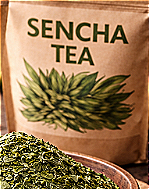
Sencha, noto anche come Ryokucha, è una varietà di tè verde giapponese, il tipo di tè verde più popolare in Giappone e rappresenta circa l'80% del tè verde prodotto nel paese.
Sencha è prodotto senza l'uso di vapore per fermare l'ossidazione delle foglie, a differenza di altri tipi di tè verde giapponesi come il matcha. Dopo la raccolta, le foglie vengono arrotolate, modellate e poi essiccate. Questo processo conferisce a Sencha il suo caratteristico sapore fresco e leggermente amaro.
Processo di produzione industriale
- Raccolta. La produzione di Sencha inizia con la raccolta delle giovani foglie di tè dalla pianta Camellia sinensis. La raccolta avviene in primavera, quando le foglie sono al loro apice di freschezza e qualità.
- Vaporizzazione. Subito dopo la raccolta, le foglie vengono esposte al vapore per un breve periodo. Questo processo, noto come vaporizzazione, serve a inattivare gli enzimi responsabili dell'ossidazione, preservando così il colore verde e le proprietà antiossidanti delle foglie.
- Raffreddamento. Dopo la vaporizzazione, le foglie vengono raffreddate rapidamente e poi asciugate. Questo passaggio è cruciale per fermare qualsiasi processo di fermentazione e per iniziare il processo di essiccazione.
- Arrotolamento. Le foglie asciutte vengono poi arrotolate per rompere le pareti cellulari, facilitando la liberazione dei succhi e degli oli essenziali durante l'infusione. L'arrotolamento conferisce alle foglie la loro forma caratteristica.
- Asciugatura. Le foglie vengono asciugate ulteriormente per ridurre il contenuto di umidità al livello desiderato. Questo passaggio finale assicura la conservazione del tè e ne definisce il sapore.
- Selezione. Dopo l'asciugatura, il Sencha viene selezionato e classificato in base alla qualità, al sapore e all'aspetto. Solo le foglie che soddisfano standard rigorosi vengono confezionate come Sencha.
Habitat e Coltivazione
Il Sencha è coltivato in diverse regioni del Giappone, con le prefetture di Shizuoka, Kagoshima e Uji a Kyoto che sono tra le più note per la produzione di tè di alta qualità. La qualità del Sencha può variare significativamente a seconda del terroir, del metodo di coltivazione e della stagione di raccolta.
Proprietà
Sencha è ricco di antiossidanti (1), in particolare catechine, che hanno dimostrato di avere numerosi benefici per la salute, tra cui la riduzione del rischio di malattie cardiache e di alcuni tipi di cancro (2). Contiene anche L-teanina, un aminoacido che può aiutare a promuovere il rilassamento e il benessere mentale.
Usi
Consumo Tradizionale. Sencha è tradizionalmente gustato da solo, senza aggiunta di latte o zucchero, per apprezzare pienamente il suo sapore.
Cerimonia del Tè. Anche se meno formale del matcha usato nella cerimonia del tè Chanoyu, il Sencha è talvolta utilizzato in occasioni meno formali.
Cucina. Sencha può essere utilizzato anche in cucina, per esempio in ricette per dolci o come ingrediente in piatti salati.
Impatto ambientale
La coltivazione del Sencha, come per altri tè, può avere un impatto ambientale a seconda delle pratiche agricole utilizzate. La coltivazione biologica e sostenibile del Sencha sta diventando sempre più popolare come modo per ridurre tale impatto.
Conservazione
La conservazione adeguata del Sencha è cruciale per mantenere il suo sapore e le sue proprietà benefiche (3). Dovrebbe essere conservato in un luogo fresco e asciutto, lontano dalla luce diretta del sole e da odori forti.
Bibliografia_____________________________________________________________________
(1) Masek, A., Chrzescijanska, E., Kosmalska, A., & Zaborski, M. (2012). Antioxidant activity determination in Sencha and Gun Powder green tea extracts with the application of voltammetry and UV-VIS spectrophotometry. Comptes Rendus. Chimie, 15(5), 424-427.
Abstract. This article presents the electrochemical analysis of the oxidation of rutin and green tea extract solutions and the antioxidative properties of these substances. Flavonoids and other polyphenols contained in green tea have antioxidative properties due to the presence of various numbers of hydroxyl groups in different arrangements. The investigation of the oxidation of green tea extracts was performed to identify the most effective antioxidant. The cyclic and pulse voltammograms show that the extract of Gun Powder (GP) green tea contained rutin and other polyphenols, while the extract of Sencha (S) tea contained other antioxidants that are oxidised at a more positive potential. The GP extract showed slightly better antioxidative properties than did the S extract. The UV-VIS spectra show that, in addition to flavonoids extracts contain chlorophyll. The results obtained demonstrate that the tested tea extracts show very good antioxidative properties and therefore may be considered as potential stabilising agents that are able to reduce the rate of undesirable oxidation processes.
(2) Lu X, Saeed MEM, Hegazy MF, Kampf CJ, Efferth T. Chemopreventive Property of Sencha Tea Extracts towards Sensitive and Multidrug-Resistant Leukemia and Multiple Myeloma Cells. Biomolecules. 2020 Jul 4;10(7):1000. doi: 10.3390/biom10071000. PMID: 32635587; PMCID: PMC7407630.
Abstract. The popular beverage green tea possesses chemopreventive activity against various types of tumors. However, the effects of its chemopreventive effect on hematological malignancies have not been defined. In the present study, we evaluated antitumor efficacies of a specific green tea, sencha tea, on sensitive and multidrug-resistant leukemia and a panel of nine multiple myelomas (MM) cell lines. We found that sencha extracts induced cytotoxicity in leukemic cells and MM cells to different extents, yet its effect on normal cells was limited. Furthermore, sencha extracts caused G2/M and G0/G1 phase arrest during cell cycle progression in CCRF/CEM and KMS-12-BM cells, respectively. Specifically, sencha-MeOH/H2O extracts induced apoptosis, ROS, and MMP collapse on both CCRF/CEM and KMS-12-BM cells. The analysis with microarray and COMPARE in 53 cell lines of the NCI panel revealed diverse functional groups, including cell morphology, cellular growth and proliferation, cell cycle, cell death, and survival, which were closely associated with anti-tumor effects of sencha tea. It is important to note that PI3K/Akt and NF-κB pathways were the top two dominant networks by ingenuity pathway analysis. We demonstrate here the multifactorial modes of action of sencha tea leading to chemopreventive effects of sencha tea against cancer.
(3) Qin, W., Yamada, R., Araki, T., & Ogawa, Y. (2022). Changes in morphological and functional characteristics of tea leaves during Japanese green tea (Sencha) manufacturing process. Food and Bioprocess Technology, 1-10.
Abstract. Japanese green tea (Sencha) is mainly manufactured by six processing steps: steaming, primary rolling, rolling, secondary rolling, final rolling, and final drying. The morphology and microstructure of tea leaves were observed, and total polyphenol content (TPC) and total antioxidant activity indexed by FRAP and DPPH were evaluated in tea leaves and infusions during processing. Folds or wrinkle-like microstructures on the tea leaf surface increased during processing, particularly during the primary rolling (PR) step. Leaf shape also mainly collapsed during the PR step. In tea leaves, the values of TPC, DPPH, and FRAP during processing ranged from 189 to 283 mg GAE/g dry matter (DM), 2670–4363 μmol FeSO4/g DM, and 1519–2327 μmol TE/g DM, respectively, whereas in the hot water extraction as a tea infusion decreased and ranged from 14 to 135 mg GAE/g, 391–2961 μmol FeSO4/g DM, and 219–1049 μmol TE/g DM, respectively. These functional attributes increased mainly from steaming (ST) to rolling (RL) steps. The results indicated that the processing conditions at each step, especially at the steps for ST, PR, and RL, influenced the apparent quality of the final tea leaf products and the functional properties of tea leaves and infusions.




