



FD&C Blue No. 2 lake also known as Indigotine or Indigo Blue, is a synthetic dye derived from indigo, a natural colorant substance.
The name describes the structure of the molecule.
- FD&C indicates that the color is approved by the United States Food and Drug Administration (FDA) for use in foods, drugs, and cosmetics. (1987)
- BLUE #2 refers to a particular blue color, also known as Indigotine or Indigo Blue, which is a synthetic dye.
- lake indicates that the color has been combined with a substance (often a calcium or aluminum salt) to make it water-insoluble, often used in products that are not meant to dissolve immediately in water.
Description of raw materials used in production.
- Indigotine can be both synthetically produced and extracted from plants of the Indigofera genus. The synthetic version, which is more commonly used, is often derived from aniline-based compounds.
Step-by-step summary of industrial production process.
- Preparation of Aniline. Aniline is prepared through a process involving the nitration of benzene, followed by a reduction to produce aniline.
- Production of Indoxyl. The aniline is converted into indoxyl, which is the direct precursor of Indigotine.
- Oxidation to Indigotine. The indoxyl is then oxidized to produce the characteristic blue color of Indigotine.
- Purification. The dye is then purified through various methods, including precipitation, filtration, and washing.
- Drying and Granulation. The purified Indigotine is dried and then processed to produce a powder or granules, depending on the specifications of the final product.
Indigotine is a disodium salt, synthetic blue dye also called Acid Blue 74, CI 73000, Indigo carmine and others. It is produced by the condensation of 2-formylbenzenesulphonic acid and aniline with a subsequent oxidation process. Mixed with tartrazine (E102) it can produce various shades of green.
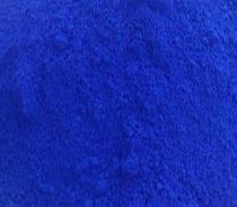
It appears as a blue powder
A cosa serve e dove si usa
Food
Ingredient included in the list of European food additives as E132, dye.
The EFSA Panel on Food Additives and Nutrient Sources added to Food concluded that Indigo Carmine is poorly absorbed by the human body and does not raise genotoxicity concerns. No adverse effects were identified in subacute, chronic, reproductive and developmental toxicity studies, and no changes in haematological and biological parameters were identified in chronic toxicity studies at doses less than or equal to 500 mg/kg body weight/day (1).
The Panel confirmed the ADI of 5 mg/kg bw/day for Indigo Carmine of at least 93% purity manufactured using the same or equivalent manufacturing process resulting in material tested in Borzelleca et al. studies. Given the uncertainties in the database, the Panel was not able to conclude whether this ADI should apply to Indigo Carmine with lower purity manufactured using these same processes or material manufactured using a different but not equivalent process. Furthermore, the Panel concluded that the current specifications should be revised in order to restrict the Indigo Carmine (E 132) permitted as food additive to that for which the ADI is applicable. The Panel concluded that at the maximum permitted level of use, exposure estimates of Indigo Carmine (E 132) would exceed the ADI for toddlers and children at the high level. Exposure estimates using the available usage and analytical data did not show an exceedance of the ADI for any population groups.The Panel noted that the three main contributing food categories for age-groups where MPL scenario estimates exceeded the ADI showed high number of analytical data far below MPL or had no use level reported combined with no detection in limited analytical data. The Panel therefore considered that it is not likely that the ADI will be exceeded (1).
Medical
It is used in medicine in intravenous administration to examine sections of the human body to be explored with endoscopic probes, is usually biologically safe and inert and can rarely cause adverse reactions, except in rare exceptions (2).
For more information: Indigotine studies
| Appearance | Blu powder |
| Melting Point | >300°C |
| Density | 1.01 g/mL at 20°C |
| PSA | 189.36000 |
| LogP | 3.06060 |
| Refraction Index | n20/D 1.335 |
| Water Solubility | 1 g/100 mL (25 ºC) |
| Safety |  |
 |  |
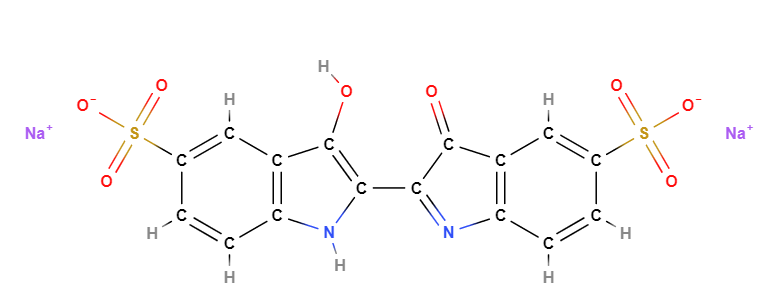 | 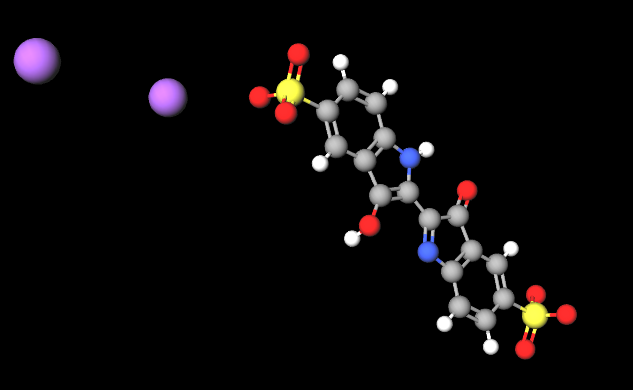 |
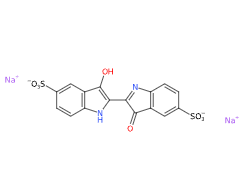
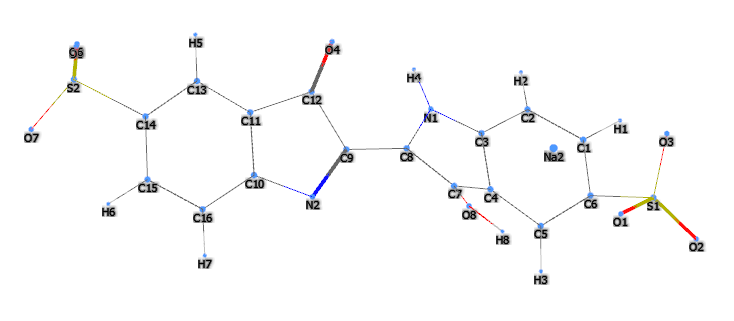
- Molecular Formula C16H8N2Na2O8S2
- Molecular Weight 466,346
- Exact Mass 465.951752
- CAS 860-22-0
- UNII D3741U8K7L
- EC Number 212-728-8
- DSSTox Substance ID DTXSID1020190 DTXSID0044288 DTXSID6044224
- IUPAC disodium;2-(3-hydroxy-5-sulfonato-1H-indol-2-yl)-3-oxoindole-5-sulfonate
- InChI=1S/C16H10N2O8S2.2Na/c19-15-9-5-7(27(21,22)23)1-3-11(9)17-13(15)14-16(20)10-6-8(28(24,25)26)2-4-12(10)18-14;;/h1-6,17,19H,(H,21,22,23)(H,24,25,26);;/q;2*+1/p-2
- InChl Key JFVXEJADITYJHK-UHFFFAOYSA-L
- SMILES C1=CC2=C(C=C1S(=O)(=O)[O-])C(=C(N2)C3=NC4=C(C3=O)C=C(C=C4)S(=O)(=O)[O-])O.[Na+].[Na+]
- MDL number MFCD00005723
- PubChem Substance ID 24847997
- ChEBI 31695
- Colour Index Number 73015
- Beilstein 4103904
- RTECS DU3000000
- NACRES NA.47
- NCI C83799
Synonyms :
- Sodium indigotindisulfonate
- disodium;2-(3-hydroxy-5-sulfonato-1H-indol-2-yl)-3-oxoindole-5-sulfonate
- (delta(sup 2,2')-Biindoline)-5,5'-disulfonic acid, 3,3'-dioxo-, disodium salt
- FD C Blue 2
- Sachsischblau
- Murabba
- Indigotine Lake
- Indigo Extract
- Indigo carmine
- Acid Blue 74
- Indigo carmine
- Indigocarmin
- Indigotine
- C.I. ACID BLUE 74
- Indigotindisulfonate sodium
- FD&C Blue No. 2
- Food Blue No. 2
- C.I. Food Blue 1
- C.I. Natural Blue 2
- Amacid Brilliant Blue

