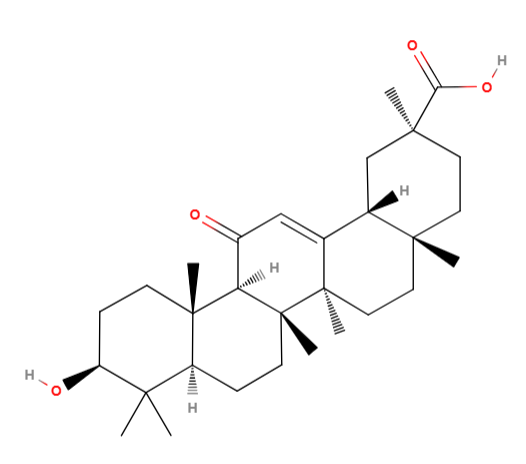
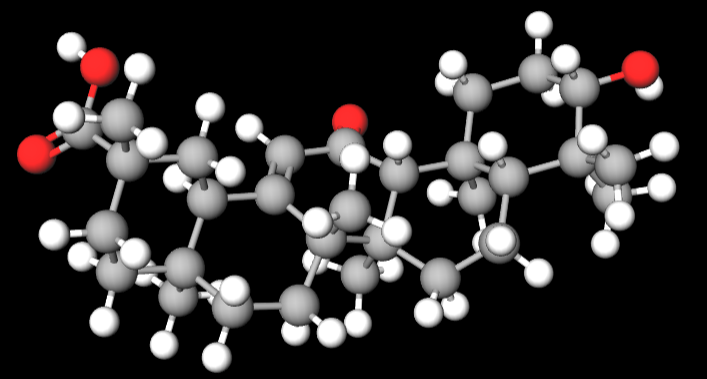
Glycyrrhetinic Acid is a pentacyclic triterpenoid, the main metabolite of glycyrrhizin, obtained from the root of the licorice plant, Glycyrrhiza glabra, botanical family Leguminosae.
The name describes the structure of the molecule
- "Glycyrrhetinic" comes from "Glycyrrhiza" which is the generic name for licorice and signals that the acid is a component derived from the licorice plant.
- "Acid" indicates that the substance has acidic properties.
Description of raw materials used in production
- Glycyrrhiza glabra root - The part of the plant from which glycyrrhetinic acid is extracted.
- Solvent - For example, water, alcohol, or other organic solvents used to extract the acid from the root.
Step by step industrial extraction process
- Harvesting and Preparation - Glycyrrhiza glabra roots are harvested, cleaned, and chopped.
- Extraction - The chopped roots are steeped in the solvent for a determined period, allowing the glycyrrhetinic acid to diffuse into the solvent.
- Filtration - After extraction, the solution is filtered to remove any residual solid particles.
- Isolation - Glycyrrhetinic acid is separated from other constituents through methods like chromatography.
- Purification - Further processes can be used to further purify the acid.
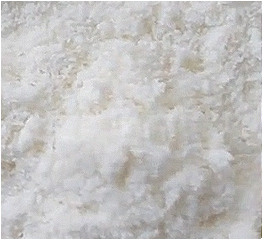
It appears in the form of a white powder.
What it is for and where
Medical
The scientific literature has highlighted the anti-inflammatory, antioxidant, and antimicrobial properties of glycyrrhetinic acid, but also its toxicity to normal cell lines (1). Other studies report interesting cytotoxic effects and possible applications of this acid as an anticancer agent (2).
Cosmetics
Skin conditioning agent. It is the mainstay of topical skin treatment as it has the function of restoring, increasing or improving skin tolerance to external factors, including melanocyte tolerance. The most important function of the conditioning agent is to prevent skin dehydration, but the subject is rather complex and involves emollients and humectants that can be added in the formulation.
- Molecular Formula C30H46O4
- Molecular Weight 470.7 g/mol
- CAS 471-53-4
- UNII P540XA09DR
- EC Number 207-444-6
- DTXSID9020669
- Nikkaji J5.943I
Synonyms:
References_____________________________________________________________________
(1) Kowalska A, Kalinowska-Lis U. 18β-Glycyrrhetinic acid: its core biological properties and dermatological applications. Int J Cosmet Sci. 2019 Aug;41(4):325-331. doi: 10.1111/ics.12548. Epub 2019 Jun 28. PMID: 31166601.
Abstract. Recently, attention has been focused on identifying natural herbal compounds with high biological activity, especially antioxidative, anti-inflammatory and antimicrobial properties, for preventing and controlling various skin conditions, including inflammation-related diseases such as atopic dermatitis and UV-induced skin photoaging. One key active plant ingredient is 18β-glycyrrhetinic acid (GA), the main metabolite of glycyrrhizin (GL), obtained from licorice root. The review examines the valuable biological properties of GA, particularly those playing key roles in the treatment of various dermatological disorders in humans. The review highlights the key anti-inflammatory, antioxidant and antimicrobial properties of GA and its toxicity towards normal cells lines. It also examines the physicochemical properties of GA and presents methods of increasing its penetration through the stratum corneum and bioaccumulation with the use of modern delivery systems such as liposomes and nanoemulsions. © 2019 Society of Cosmetic Scientists and the Société Française de Cosmétologie.
(2) Hussain H, Ali I, Wang D, Hakkim FL, Westermann B, Ahmed I, Ashour AM, Khan A, Hussain A, Green IR, Shah STA. Glycyrrhetinic acid: a promising scaffold for the discovery of anticancer agents. Expert Opin Drug Discov. 2021 Dec;16(12):1497-1516. doi: 10.1080/17460441.2021.1956901.
Abstract. Introduction: Oleanane-type pentacyclic triterpenes named glycyrrhetinic acids (GAs) featuring a C-30 carboxylic acid group, are extracted from the licorice (Glycyrrhiza uralensis). Numerous biological properties of GA have been reported and have attracted researchers from all over the world in recent years due to the peculiar GA scaffold-based semisynthetic cytotoxic effects. Areas covered: This review represents the applications of semisynthetic derivatives of GA for the development of future cancer treatments. Included in the review are important structural features of the semisynthetic GAs crucial for cytotoxic effects. Expert opinion: Numerous semisynthetic GA derivatives illustrated excellent cytotoxic effects toward various cancer cells. Notably the C-3(OH) at ring A along with C30-CO2H at ring E as vital structural features, make GA very appealing as a lead scaffold for medicinal chemistry, since these two groups permit the creation of further chemical diversity geared toward improved cytotoxic effects. Furthermore, numerous GA derivatives have been synthesized and indicate that compounds featuring cyanoenone moieties in ring A, or compounds having the amino group or nitrogen comprising heterocycles and hybrids thereof, illustrate more potent cytotoxicity. Furthermore, GA has a great capability to be conjugated with other anticancer molecules to synergistically enhance their combined cytotoxicity.