



E435: properties, uses, pros, cons, safety
E435 is best known as Polysorbate 60, a non-ionic surfactant from the polysorbate family, also known as polyoxyethylene (20) sorbitan monostearate (“Tween 60”). It is used mainly as an O/W emulsifier and solubilizer in cosmetics, and it is authorised as the food additive E435 with an emulsifier/stabilizer function (category and conditions of use depend on the product).
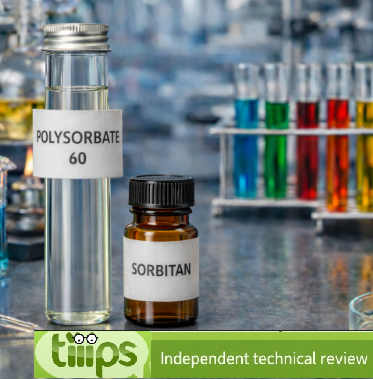
Synonyms: Tween 60; polyoxyethylene (20) sorbitan monostearate; polysorbate 60.
Definition
Polysorbate 60 is a UVCB-type material (variable composition) broadly attributable to ethoxylated sorbitan fatty-acid esters (predominantly stearate). In practice, the “60” designation is associated with the average level of ethoxylation, resulting in a more hydrophilic behaviour and the ability to stabilize oil-in-water emulsions and solubilize fragrances/essential oils in aqueous systems. Practical performance (solubilization, rheology, electrolyte tolerance) depends on grade and supplier specifications.
Polysorbate 60 is known for its excellent ability to stabilize oil-in-water emulsions, enhancing the texture and even distribution of insoluble ingredients. This emulsifier is particularly useful in formulas containing both an oil phase and a water phase, such as moisturizing creams, lotions, and hair care products. It ensures that products remain homogeneous during use, preventing ingredient separation and improving the feel on the skin. Polysorbate 60 is also used in foods as a texturing agent and to increase shelf life.
Main uses
Food.
It is authorised in the EU as the food additive E435 (polyoxyethylene sorbitan monostearate / polysorbate 60), typically functioning as an emulsifier and stabilizer. Actual use is regulated by category and conditions of use; operationally it is used to improve stability and texture in certain complex matrices.
Cosmetics.
Widely used in emulsions and aqueous systems to improve compatibility between water and oil phases and to stabilize the formulation over time. It is also used as a solubilizer for fragrances and essential oils in water-based products, and as a dispersion aid in make-up and cleansing formulas.
INCI functions
Surfactant - Emulsifying agent. Emulsions are thermodynamically unstable and are used to soothe or soften the skin and emulsify, so they need a specific, stabilising ingredient. This ingredient forms a film, lowers the surface tension and makes two immiscible liquids miscible. A very important factor affecting the stability of the emulsion is the amount of the emulsifying agent. Emulsifiers have the property of reducing the oil/water or water/oil interfacial tension, improving the stability of the emulsion and also directly influencing the stability, sensory properties and surface tension of sunscreens by modulating the filmometric performance.
Surfactant - Cleansing agent. Cosmetic products used to cleanse the skin utilise the surface-active action that produces a lowering of the surface tension of the stratum corneum, facilitating the removal of dirt and impurities
Identification data and specifications
| Characteristic | Value |
|---|---|
| INCI name | polysorbate 60 |
| common name | polysorbate 60 / Tween 60 |
| chemical name (descriptive) | polyoxyethylene (20) sorbitan monostearate |
| CAS number | 9005-67-8 |
| EC/EINECS number | 500-020-4 |
| E number (EU, foods) | E435 |
| INS (Codex) | 435 |
| molecular formula | C64H126O26 (indicative; grade-dependent) |
| molecular weight | ~1311.7 g/mol (indicative; grade-dependent) |
| nature | UVCB / mixture (variable composition) |
Physico-chemical properties (indicative)
| Characteristic | Value | Note |
|---|---|---|
| appearance | viscous liquid / amber-yellow paste | grade-dependent |
| HLB | ~14.9 | favours O/W emulsions |
| water solubility | good | typical of non-ionic surfactants |
| alcohol solubility | good | useful for co-solubilization |
| oil solubility | low / insoluble | commonly stated in technical data |
| melting point | ~45–50 °C | often requires heating during processing |
| density | ~1.1 g/cm³ (20 °C) | indicative, grade-dependent |
| pH (solution) | ~5.5–7.7 (50 g/L, 25 °C) | indicative, depends on specifications |
Functional role and practical mechanism of action
In formulation, Polysorbate 60 reduces interfacial tension between water and oil and promotes micellar/aggregate structures that improve dispersion and stability. In O/W emulsions it supports system robustness (together with co-emulsifiers and structuring agents), while in aqueous products it acts as a solubilizer, helping maintain clarity or controlled opalescence with fragrances and essential oils, within the loading limits compatible with the system.
Formulation compatibility
It is generally compatible with most cosmetic O/W bases, but performance can vary with electrolyte load, the type of rheology polymers, alcohol presence, and the oil-phase profile. In demanding systems (high fragrance load, high oil phase, high viscosity), synergy with co-emulsifiers may be required to avoid instability or sensory drift. From a quality standpoint, as an ethoxylated derivative, management of traceable impurities (e.g., 1,4-dioxane/ethylene oxide at specification levels) depends on grade and supplier controls.
Use guidelines (indicative)
In cosmetics, many grades are typically used around 1–10% as an emulsifier/co-emulsifier, with real ranges depending on oil phase, viscosity target, and synergy with other emulsifiers. For solubilization of fragrances/essential oils in water-based systems, the optimal ratio is highly formula-dependent and should be determined via clarity/stability trials and stress tests (temperature, heat/cool cycles, accelerated shelf-life).
In food, use as E435 must comply with authorised categories and applicable conditions of use.
Quality, grades, and specifications
Quality drivers include: identity (IR/characteristic values), average ethoxylation profile, acid value, hydroxyl value, moisture, color/odor, and limits for traceable impurities. Pharmacopeial grades (e.g., Ph. Eur./NF) exist and are useful when a project requires tighter specifications and higher standardization.
Safety, regulatory, and environment
In cosmetics, the polysorbate family has been reviewed in safety assessments with a general conclusion of safety as used under reported practices, while recognizing that real safety is always that of the finished product (concentration, use pattern, population). In food, Polysorbate 60 is authorised as E435 and classified as an emulsifier/stabilizer; compliance depends on food category and applicable conditions.
For industrial management, implementation of GMP (good manufacturing practice; benefit: reduces variability and contamination) and, in food, a HACCP approach (hazard analysis and critical control points; benefit: strengthens preventive control of critical points) supports robust quality across the supply chain.
In predisposed subjects it could give allergy (1), but it is not considered dangerous. An ADI of 25mg/kg has been established (2)
Formulation troubleshooting
Phase separation or emulsion instability.
Typical cause: unbalanced emulsifier system or an overly “difficult” oil phase. Action: retune emulsifier/co-emulsifier ratio, viscosity, and oil-phase profile; validate with stress tests.
Opalescence or loss of clarity in fragranced solutions.
Typical cause: fragrance/essential-oil load beyond solubilization capacity or interference from electrolytes. Action: reduce load, introduce compatible co-solvents, or change the solubilizer/emulsifier pairing.
Conclusion
Polysorbate 60 is a widely used non-ionic surfactant as an O/W emulsifier and solubilizer in cosmetics, and as the food additive E435 for emulsification/stabilization. The key points for formulators are: grade selection, emulsifier-system balancing, stability control (including organoleptic stability), and compliance with specifications (including impurity limits) depending on market and application channel.
Mini-glossary
Micelles: surfactant aggregates in water that entrap lipophilic components, improving dispersion and stability.
HLB: hydrophilic-lipophilic balance index that helps predict emulsification tendency (higher values favour O/W).
UVCB: substances of unknown or variable composition, complex reaction products, or biological materials.
GMP: good manufacturing practice; benefit: improves quality control and reduces contamination/variability.
HACCP: hazard analysis and critical control points; benefit: strengthens prevention and control of critical process points.

