Aluminium sulfate: properties, uses, pros, cons, safety
Aluminium sulfate (Aluminum sulfate) – inorganic aluminum salt of sulfuric acid, available in anhydrous form and in multiple hydrated forms (commonly referred to as “alum” in technical contexts, with possible terminology ambiguity)
Synonyms: aluminum sulfate, aluminium sulphate, alum (technical usage), cake alum, filter alum, papermaker’s alum
INCI / Functions: antiperspirant, astringent, deodorant
Definition
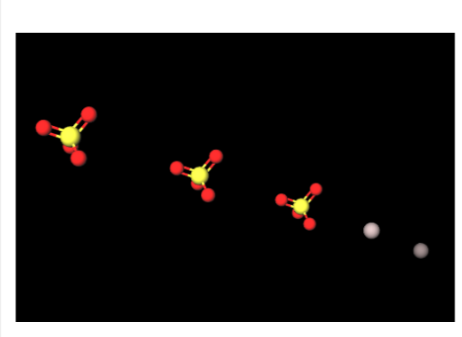
Aluminum sulfate is an inorganic salt with the formula Al₂(SO₄)₃, commercialized both as anhydrous and as hydrated material (for example with roughly 14–18 waters of hydration per formula unit, depending on grade). In aqueous solution it behaves as an “acidifying” salt: aluminum(III) tends to hydrolyze and, under suitable pH and alkalinity conditions, forms hydrolyzed species and precipitates (e.g., Al(OH)₃) that underpin its effectiveness as a coagulant/flocculant.
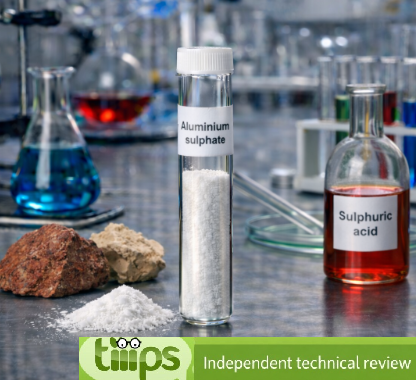
It is important to distinguish aluminum sulfate from other historical “alums” (for example potassium alum, potassium aluminium sulfate): in industrial practice, the term “alum” can be used non-uniquely, so it is good practice to reference CAS, EC, and the chemical formula to avoid procurement or dossier errors.
From a production standpoint, industrial grades are typically obtained by reacting aluminum-based raw materials (e.g., hydroxides/oxides or suitable mineral fractions) with sulfuric acid, followed by adjustment of hydration state and key specifications (iron, insolubles, metals, residual acidity), depending on the target application (drinking water, wastewater, paper, etc.).
Main uses
Food.
Aluminum sulfate belongs to the E 520–E 523 group (“aluminium sulphates”) as an additive authorized in the EU in specific categories. In current practice, food use tends to be limited and tightly constrained by authorized conditions and purity requirements: where relevant to a project, it should be managed with a strictly regulatory approach (category, level, purity, contaminants) and with documentation specifically aligned to a food-grade material.
Cosmetics.
In cosmetics it appears as Aluminum Sulfate (INCI) with declared functions astringent, deodorant, and antiperspirant. Operationally, when included in topical formulas, it behaves as an inorganic salt with potential impact on pH and ionic strength: this means use must be compatible with finished-product tolerability and matrix stability (haze/precipitation if pH is not suitable or in the presence of complexing anions). In most cases, correct management is based on: pH control, vehicle selection, compatibility with polymers and salt-sensitive actives, and verification of the sensorial profile (perceived astringency).
Pharmaceutical.
It is not among the most common excipients in standard dosage forms; however, it may be considered in specific contexts where an astringent/acidifying salt or technical component is useful, subject to grade, specifications, and dossier alignment with the intended use.
Industrial use.
This is the most significant use sector:
Drinking water and wastewater treatment: coagulant for the removal of turbidity, colloids, and part of the organic load, forming flocs and improving sedimentation/filtration.
Pulp and paper: historically and technically used for charge/pH control and to support retention and sizing processes (depending on the adopted technology and mill conditions).
- Main chemical used to kill trout parasites.
Other technical uses: textile (mordanting/processing aid), leather treatment, and processes where coagulation/precipitation chemistry or controlled acidification is required.
Identification data and specifications
| Identifier | Value |
|---|---|
| INCI name | Aluminum Sulfate |
| Formula (anhydrous basis) | Al₂(SO₄)₃ |
| Molecular weight (anhydrous) | 342.15 g/mol |
| CAS number (anhydrous) | 10043-01-3 |
| EC/EINECS number (anhydrous) | 233-135-0 |
| Common hydrated form | Al₂(SO₄)₃ · 14–18 H₂O (grade-dependent) |
| CAS number (octadecahydrate, often listed) | 7784-31-8 |
| Typical commercial appearance | crystalline solid/powder; or solution (grade-dependent) |
Chemical-physical properties (indicative)
| Property | Value | Note |
|---|---|---|
| Water solubility | high | solutions are typically acidic |
| pH (aqueous solution) | acidic | depends on concentration and grade |
| Behavior vs pH | hydrolysis/precipitation | at higher pH the risk of Al(OH)₃ formation and haze increases |
| Role in water treatment | coagulant/flocculant | charge neutralization and “sweep flocculation” via hydroxides |
Functional role and practical mechanism
| Function | What it does in formula/process | Technical note |
|---|---|---|
| Coagulant (water) | destabilizes colloids and promotes floc formation | efficacy depends on pH, alkalinity, turbidity, and mixing |
| Acidifying / pH control (technical) | shifts pH toward more acidic values | may require alkalinity correction in water |
| Astringent (cosmetics) | contributes to a “tightening”/astringent feel | depends on vehicle and concentration |
| Deodorant/antiperspirant (cosmetics) | supports reduction of odor/moisture perception | must be evaluated on the finished product and claims |
Formulation compatibility
Aluminum sulfate is a multivalent salt: in any matrix (cosmetic or technical) the key variable is pH, because it governs solubility and aluminum speciation. In practice:
pH window. In near-neutral or alkaline environments, the likelihood of haze and precipitation (aluminum hydroxides) increases, with loss of clarity and possible rheology instability.
Ionic interactions. It may interact with anions (phosphates, carbonates) and with certain salt-sensitive polymers/gellants, altering viscosity and stability.
Process (water). In water treatment, performance depends on: alkalinity (buffering capacity), mixing energy (flash mix + flocculation), temperature, and particulate/organic load. Proper management includes jar testing and operational pH control.
Cosmetics. If used in cosmetics, it is recommended to validate compatibility with preservatives, fragrances, and polymers, and to perform accelerated stability and thermal cycling to detect haze and viscosity drift.
INCI Functions: • Antiperspirant, Astringent, Deodorant
Use guidelines (indicative)
| Application | Typical range | Technical note |
|---|---|---|
| Water treatment (coagulation) | 5–200 mg/L (as hydrate; difficult cases up to ~500 mg/L) | actual dose depends on turbidity, pH, alkalinity, and target |
| Paper mill process waters (clarification/coagulation) | order of g/L (case-by-case) | depends on “white water” load and retention system |
| Pulp and paper (sizing/retention) | order of kg/ton | strongly mill-dependent; control pH and contaminants (Fe) |
| Cosmetics | variable and grade-dependent | define based on function, tolerability, and finished-product stability |
Quality, grades, and specifications
| QC parameter | What to check |
|---|---|
| Identity | INCI/CAS/EC alignment and form (anhydrous vs hydrated) |
| Assay | actual content and calculation basis (anhydrous vs hydrated) |
| Iron and metals | impact on color/impurities (critical for paper and some uses) |
| Insolubles | risk of deposits and plant/product issues |
| Free acidity | influences corrosivity and pH control |
| Use compliance | correct grade (drinking water/food/technical) and documentation |
Safety, regulatory, and environment
The risk profile of aluminum sulfate is driven mainly by its nature as an acidic salt and by the presence of aluminum(III) in solution. Key operational hazards are irritation (eyes/skin) and safe handling of powders/concentrated solutions; in industrial settings, PPE, spill-response procedures, and materials compatibility (corrosion under acidic conditions) are central.
On the food side, use as E520 is constrained by authorized conditions and purity specifications; available safety evaluations indicate generally low exposure limited to permitted categories, but adherence to the regulatory framework and specifications remains decisive.
In cosmetics, safety is assessed on the finished product (use scenario, concentration, target population). It is appropriate to consider the astringent effect and potential impact on pH and tolerability, particularly for sensitive areas.
In manufacturing, applying GMP (Good manufacturing practice, buone pratiche di fabbricazione) reduces variability and operational risks; benefit: improved repeatability and process control. In food and drinking-water chains, HACCP (Hazard analysis and critical control points, analisi dei rischi e controllo dei punti critici) is a core reference; benefit: preventive risk management at critical points.
Formulation troubleshooting
| Problem | Possible cause | Recommended intervention |
|---|---|---|
| Haze/precipitate | pH too high, presence of phosphates/carbonates | lower pH, review salts/anionic components, verify addition order |
| Ineffective coagulation (water) | off-target dose, insufficient alkalinity, inadequate mixing | jar test, optimize flash mix/flocculation, correct alkalinity/pH |
| High consumption and excess sludge | overdosing or non-optimal conditions | retune dose, evaluate coagulant aids, optimize operating pH |
| Corrosion/plant attack | overly acidic solutions or unsuitable materials | verify materials, dilution practices, handling procedures |
| Color/product variability (paper) | impurities (Fe), inconsistent quality | tighten specs, control metals, qualify supplier |
Conclusion
Aluminum sulfate is an inorganic salt with a well-established technical role as a coagulant in water treatment and as an aid in several industrial processes (notably pulp and paper). Effective and safe management hinges on pH, alkalinity, and grade quality, because these factors govern solubility, floc formation, and stability. In cosmetic applications, where it may be present as an astringent/deodorant/antiperspirant, the primary focus remains matrix compatibility and finished-product evaluation.
Mini-glossary
Coagulation/flocculation: processes that destabilize colloidal particles and form settleable/filterable flocs.
Jar test: comparative lab test used to optimize coagulant dose and operating conditions.
Hydrolysis: reaction with water that forms hydroxylated species; for aluminum it affects solubility and precipitation.
GMP: Good manufacturing practice, buone pratiche di fabbricazione; benefit: reduces variability and operational risks.
HACCP: Hazard analysis and critical control points, analisi dei rischi e controllo dei punti critici; benefit: strengthens prevention and control in regulated chains.
Safety
EFSA's Scientific Panel on Food Additives provided a scientific opinion reviewing the safety of aluminium sulphates (E520-523) and sodium aluminium phosphate, acid (E541) as food additives and concluded that there is no concern regarding genotoxicity and carcinogenicity. The Panel concluded that aluminium sulphates (E520-523) and sodium aluminium phosphate, acid (E541) are of no safety concern in current authorised uses and use levels (1).
However, the risk of cumulative intake of aluminium, which may pose a danger to human health, cannot be excluded as this ingredient can be found in widely consumed food products such as bread, various bakery products (2).