



Sodium alginate is a chemical compound, a linear unbranched amorphous copolymer, the sodium salt of alginic acid, a natural polysaccharide usually extracted from brown algae. It is biodegradable and biocompatible.
The name defines the structure of the molecule:
- Sodium is a chemical element with the symbol Na (from the Latin "Natrium") and the atomic number 11. It is a soft, silvery-white, highly reactive metal and is an alkaline metal.
- Alginate refers to a type of polysaccharide derived from algae. Alginates are known for their ability to form gels and are often used as thickeners, stabilizers or emulsifiers.
The synthesis process takes place in several stages:
- Collection. Brown algae are harvested from the ocean and the species of algae used may vary, but often include types such as Laminaria, Ascophyllum and Macrocystis.
- Washing and drying. Seaweed is thoroughly washed to remove salt, sand and other marine debris and dried to reduce water content.
- Alkaline treatment. Dried seaweed is treated with an alkali, usually sodium carbonate. This breaks the cell walls of algae and releases alginate.
- Extraction. The algae are then heated in an alkali solution. This causes the alginate to dissolve in the solution, forming a dense, viscous liquid.
- Precipitation. The alginate solution is precipitated using an acid, usually hydrochloric acid or sulfuric acid. This causes the alginate to solidify and separate from the solution.
- Conversion. The precipitated alginate is converted into its sodium salt form by treating the alginate with sodium carbonate.
- Purification. Sodium alginate is purified to remove any remaining impurities. This usually involves dissolving the alginate in water, filtering the solution and subsequent precipitation of the alginate.
- Drying. In the last step, the purified sodium alginate is dried and ground into a fine powder suitable for use.
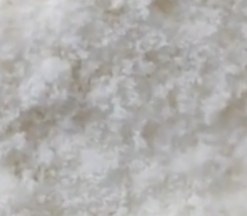
It appears as a white powder.
What it is used for and where
Food
Ingredient on the European food additives list as E401 with various functions: thickener, gelling agent, emulsifier.
In the food industry, it is also used as a preservative to reduce microbial spoilage in certain foods (1).
Safety
EFSA: Following a request from the European Commission, the Panel on Dietetic Products, Nutrition and Allergies provided a scientific opinion on 'sodium alginate and Ascophyllum nodosum' in relation to the reduction of post-prandial glycaemic responses. The Panel considers that sodium alginate with an M/G ratio of 1.50 is sufficiently characterised in relation to the effects attributed. The question is: can "alginate reduce the activity of digestive enzymes and reduce glucose absorption"? The panel of experts believes that the reduction in post-prandial glycaemic responses (provided post-prandial insulinemic responses are not disproportionately increased) may be a beneficial physiological effect (2).
Medical
In the pharmaceutical industry, it's used to help form gels in the production of drugs and in wound dressings.
Sodium alginate is used in the treatment of heartburn, peptic ulcer and to counteract gastro-oesophageal reflux. It is also used to prevent crystallisation of pills or tablets by acting as a plasticising agent. (3).
Cosmetics
Sodium alginate is used not in its pure form, but as ALGIN, SODIUM ALGINATE SULFATE, SODIUM ALGIN SULFATE, SODIUM/TEA-UNDECYLENOYL ALGINATE and others. Functions vary, but are generally humectant.
Other uses
- Polyelectrolyte used as an aqueous binder in sodium ion batteries.
- In textile printing, it's used as a thickener for the paste containing the dye.
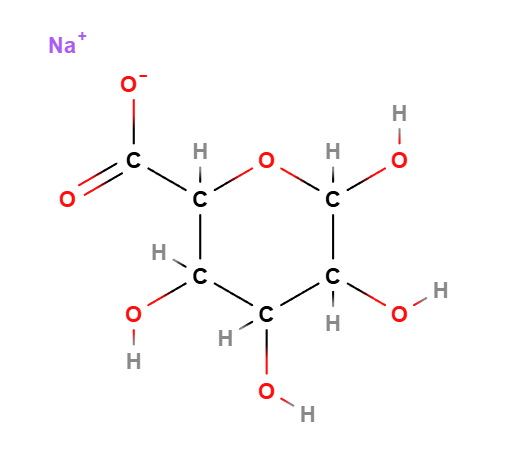 | 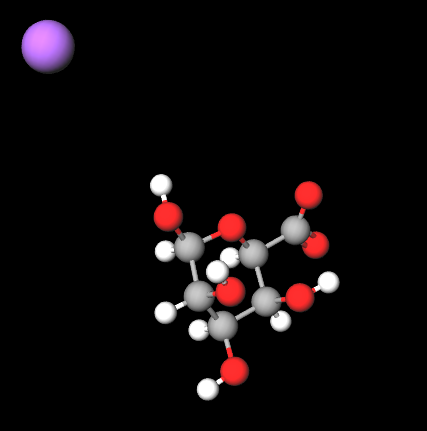 |
Formula molecolare C6H9NaO7
Peso molecolare 216.12
CAS 9005-38-3
UNII C269C4G2ZQ
EC Number 618-415-6
IUPAC sodium;(2S,3R,4S,5R)-3,4,5,6-tetrahydroxyoxane-2-carboxylate
InChl=1S/C6H10O7.Na/c7-1-2(8)4(5(10)11)13-6(12)3(1)9;/h1-4,6-9,12H,(H,10,11);/q;+1/p-1/t1-,2+,3+,4-,6?;/m0./s1
InChl Key MSXHSNHNTORCAW-KSSASCOMSA-M
SMILES C1(C(C(OC(C1O)O)C(=O)[O-])O)O.[Na+]
MDL number MFCD00081310
FEMA 2015
NACRES NA.21
RTECS AZ5820000
NCI C84148
RXCUI 56446
Nikkaji J2.064.428A.

