



E392 (Rosemary extract): properties, uses, pros, cons, safety
(Salvia rosmarinus, syn. Rosmarinus officinalis; Lamiaceae)
E392 is a food additive consisting of standardized rosemary extracts designed for an antioxidant function. It is intended primarily to protect the lipid fraction of foods from oxidation (rancidity and color/odor changes), with composition and specifications defined by purity criteria and analytical parameters. In cosmetics, rosemary extracts (under relevant INCI names) may be used as antioxidants and as stability-support ingredients, but E392 is framed primarily as a food additive.
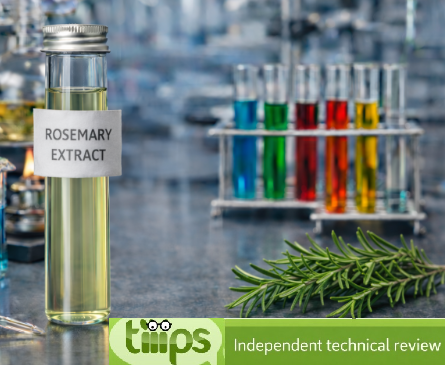
Synonyms: extracts of rosemary; rosemary leaf extract (antioxidant, descriptive); rosemary extract (EN).
Definition
E392 is an extract obtained from rosemary leaves and defined as a mixture containing several compounds with antioxidant activity, mainly attributable to phenolic classes (in particular phenolic diterpenes). For identification and standardization purposes, the reference compounds are carnosic acid and carnosol, and European specifications distinguish different manufacturing types (for example acetone extraction, supercritical CO₂ extraction with a small amount of ethanol as an entrainer, deodorized ethanolic extracts, and two-step processes using hexane/ethanol for decolorized and deodorized extracts). In practice, the functional “signature” of E392 is the minimum content of the reference antioxidants (expressed as total carnosic acid + carnosol) and control of residual solvents and contaminants.
In application, the ingredient works “where it matters”: in the lipid phase or close to the fat fraction, reducing the oxidation rate and improving stability over time, especially in matrices rich in unsaturated fatty acids that are sensitive to oxygen, light, and heat.
Main uses
Food.
It is authorized in the EU as E392 with an antioxidant function. Use is regulated by food categories and maximum limits; operationally it is selected when oxidative stability of the fat fraction is critical. In some categories (e.g., processed meat and processed fish products) use may be expressed “on a fat basis” and may include specific levels even for low-fat products, to ensure a minimum technological efficacy threshold.
Cosmetics.
This is not the primary framing of an E-number, but rosemary extracts under INCI names are used as antioxidants and to support the stability of oils and lipid phases, with additional cosmetic functions depending on extract type (grade, carrier, deodorization).
INCI functions (within the cosmetics chapter).
For rosemary extracts used as cosmetic ingredients, commonly associated functions include antioxidant and skin conditioning; some extracts/derivatives may also show deodorant/perfuming functions depending on residual volatile fractions and the extract type.
Cultivation
Rosemary (Salvia rosmarinus) is a Mediterranean aromatic species cultivated in temperate areas. For E392, agriculturally driven variability (chemotype, season, pedoclimatic conditions) is managed industrially through extraction, deodorization/decolorization where applicable, and especially through standardization of carnosic acid and carnosol content to specification.
Key constituents
The functional reference constituents are carnosic acid and carnosol (phenolic diterpenes), accompanied by other phenolic fractions and a controlled share of volatile compounds (which can be reduced via deodorization). The final composition depends on extraction technology and commercial grade, but antioxidant performance is practically correlated with the assay expressed as (carnosic acid + carnosol).
Nutritional use note and bioactive compounds
E392 is not a “nutritional” ingredient in a functional-food sense (such as fiber or micronutrients), but a technological additive. The relevant bioactive compounds are the reference antioxidants (carnosic acid and carnosol), treated as quality/efficacy parameters rather than nutrition claims. Labeling follows additive rules (E-number or name) depending on the application and market context.
Identification data and specifications
| Characteristic | Value |
|---|---|
| Common name | Rosemary extracts (E392) |
| English name | Extracts of rosemary |
| Botanical source | Salvia rosmarinus (syn. Rosmarinus officinalis) |
| Botanical family | Lamiaceae |
| CAS number | 84604-14-8 (rosemary extract; UVCB) |
| EC/EINECS number | 283-291-9 |
| Molecular formula | not applicable (UVCB/mixture) |
| Molecular weight | not applicable as a single value (UVCB/mixture) |
| Typical commercial form | fine powder or liquid (grade-dependent) |
| Solubility (general indication) | insoluble in water (typical for lipophilic antioxidant grades) |
Physico-chemical properties (indicative)
| Characteristic | Value | Note |
|---|---|---|
| Chemical nature | mixture/UVCB | variable composition, standardized on markers |
| Antioxidant markers | carnosic acid + carnosol | analytical and performance reference |
| Minimum marker assay | ≥5% to ≥13% (w/w) as (carnosic acid + carnosol) | depends on extract type defined in specifications |
| Antioxidants/volatiles ratio | ≥15 (as ratio between markers and reference volatiles) | quality-control parameter in specifications |
| Residual solvents (limits) | acetone ≤500 mg/kg; hexane ≤25 mg/kg; ethanol ≤500 mg/kg or ≤2% | depends on extraction type |
| Loss on drying | <5% | purity criterion |
| Metals (limits) | As ≤3 mg/kg; Pb ≤2 mg/kg | purity criteria |
| Oxidative stability in use | high efficacy in fatty matrices | depends on dose, matrix, packaging, and processing |
Functional role and practical mechanism of action
E392 acts as an antioxidant by limiting radical and oxidative reactions that degrade lipids and other sensitive components. Practically, it helps reduce rancidity, loss of organoleptic notes, and color changes associated with oxidation. The outcome depends on correct technological dose, proper distribution in the fat phase, and the severity of oxidative stress (oxygen, light, temperature, presence of pro-oxidant metals).
Formulation compatibility
In foods and premixes, compatibility is matrix-driven: the extract is intended to work close to the lipid fraction, so incorporation mode (into oil, into the fat phase, or via a carrier) is a key determinant. Thermal processing and exposure to oxygen/light must be managed because the antioxidant does not “eliminate” stress; it reduces it. In cosmetics (for analogous INCI extracts), use is typically oriented toward stabilizing oils and lipid systems, with verification of residual odor, color, and compatibility with fragrances and actives.
Use guidelines (indicative)
In food applications, use must comply with authorized categories and maximum limits; dose selection should be based on fat content and composition, processing conditions, and target shelf-life. For certain categories (processed meat and processed fish products), maximum levels may be expressed both on a fat basis and as specific values for low-fat products to ensure minimum efficacy. In development, it is good practice to validate via oxidative-stability testing and benchmarking against reference systems, using the final packaging.
Quality, grades, and specifications
Quality is centered on: marker assay (carnosic acid + carnosol), volatiles profile (especially for deodorized grades), control of residual solvents and contaminants, and batch-to-batch repeatability. Industrially, consistent specifications are essential because different extraction technologies yield grades with different behaviors (odor, color, efficacy in specific matrices).
Safety, regulatory, and environment
As a food additive, E392 is authorized and subject to purity criteria and conditions of use defined by EU legislation. Practically, risk management is primarily qualitative and regulatory: selecting a compliant grade, controlling residual solvents and contaminants, and using within category-specific limits. In cosmetics, rosemary extracts are assessed “as used” within typical concentration ranges and in the context of the finished product.
Implementation of GMP (good manufacturing practice; benefit: reduces variability and contamination) aligns with managing extractive ingredients. In food, a HACCP approach (hazard analysis and critical control points; benefit: strengthens preventive control of critical points) is standard practice to ensure compliance and safety along the process.
Formulation troubleshooting
Lower-than-target shelf-life efficacy.
Typical cause: insufficient dose for the severity of oxidative stress or suboptimal distribution in the fat phase. Action: retune dose within regulatory limits, optimize addition point, and reduce oxygen/light exposure (process and packaging).
Residual odor or color perceived in the finished product.
Typical cause: selection of a grade not adequately deodorized/decolorized, or interactions with matrix and processing. Action: select a more suitable grade (deodorized/decolorized), verify matrix compatibility, and validate sensorially on pilot batches.
Conclusion
E392 (rosemary extract) is an antioxidant additive designed to improve oxidative stability of the lipid fraction in foods, with technical specifications centered on the markers carnosic acid and carnosol and strict limits on residual solvents and contaminants. For effective use, the key points are: grade selection, correct incorporation into the lipid phase, shelf-life validation, and full compliance with applicable conditions of use. In cosmetics, rosemary extracts under INCI names are often used with a similar rationale to support antioxidant performance and stability, with dedicated verification of odor and formulation compatibility.
Mini-glossary
UVCB: substances of unknown or variable composition, complex reaction products, or biological materials.
Antioxidant: a substance that reduces or slows oxidation processes (e.g., of lipids), improving stability and shelf-life.
Carnosic acid/carnosol: phenolic diterpenes used as functional markers for the antioxidant activity of rosemary extract.
GMP: good manufacturing practice; benefit: improves quality control and reduces contamination/variability.
HACCP: hazard analysis and critical control points; benefit: strengthens prevention and control of critical process points.
Studies
In the phytochemical analysis, 18 components were identified, namely 13 flavones, two organic acids and three diterpenes. A total of 82 components were found in the volatile fractions, including hydrocarbon monoterpenes and 1,8-cineole, camphor, borneol and verbenone as dominant components, α-pinene and camphene among the oxygenated monoterpenes (1).
Among the polyphenolic components present in rosemary, carnosic acid has antioxidant and antimicrobial properties and rosmarinic acid has neuroprotective and anti-inflammatory properties.
Rosmarinic acid also has anti-oxidative properties.
Rosemary extract exerts a relaxing action on the muscles of the trachea and intestines and has therapeutic potential in the prevention of various diseases including cataracts, atherosclerosis, peptic ulcer disease, and cardiovascular disorders (2).
Rosemary essential oil obtained from leaves or flowers is used in dermatology to treat wounds and minor skin eruptions, in gastrointestinal disorders as an anti-dispeptic, diuretic and antispasmodic in renal colic (3), in neurology for headaches and circulation problems, in pneumology as an expectorant.
Cosmetics
This oil is included in cosmetic formulations as an emollient and as a fragrance and can activate, through the flavonoids it contains, different pharmacological effects useful in cosmetics such as antimicrobial action, skin relaxing. disinfectant.
Food
Used as a spice and seasoning in foods and as a natural preservative in the food industry

