



Riboflavin also known as Vitamin B2 was discovered in 1879 in milk in the form of a yellow pigment. It is an essential organic compound that plays a crucial role in numerous biological processes. It is a water-soluble vitamin and part of the B-vitamin complex, which is essential for energy production and general cellular function.
Chemical Composition and Structure
Riboflavin has the chemical formula C17H20N4O6. It is composed of a ribitol side chain and a flavin ring system. The compound's structure includes a complex aromatic ring and several hydroxyl groups, contributing to its stability and reactivity.
Physical Properties
Riboflavin typically appears as a yellow to orange-yellow crystalline powder. It is slightly soluble in water and ethanol but more soluble in dilute alkaline solutions. Riboflavin exhibits strong fluorescence, especially under ultraviolet light, which is often used as a characteristic identification property.
Biological Importance
- energy production with carbohydrate conversion.
- processing of amino acids and fats.
- activation of folic acid and vitamin B6 functions.
- controls proper functioning of the intestines, skin and mucous membranes.
Energy Production: Riboflavin is a precursor of the coenzymes flavin mononucleotide (FMN) and flavin adenine dinucleotide (FAD). These coenzymes are crucial for the oxidative phosphorylation process, where ATP is produced in mitochondria, supplying energy to cells.
Antioxidant Function: Riboflavin plays a significant role in maintaining the body's antioxidant defense system. It helps in the metabolism of glutathione, an important antioxidant that protects cells from oxidative stress.
Metabolism of Other Nutrients: Riboflavin is essential for the metabolism of carbohydrates, fats, and proteins. It assists in the conversion of these macronutrients into energy, supporting overall metabolic functions.
Cellular Growth and Function: Riboflavin is vital for normal cell growth, development, and function. It supports skin health, maintains mucous membranes, and is essential for the health of the eyes, nerves, and liver.
Dietary Sources and Supplementation
Riboflavin is found in various foods, including dairy products, eggs, lean meats, green leafy vegetables, nuts, and legumes. Due to its water-soluble nature, it is not stored in significant amounts in the body and must be consumed regularly through diet or supplements.
Chemical Industrial Synthesis Process
Preparation of reagents. The main raw materials include thioaniline and concentrated sulfuric acid.
Synthesis of thioindigoid intermediate. The production of CI 73385 begins with the reaction of thioaniline with concentrated sulfuric acid to form a thioindigoid intermediate.
Condensation. The thioindigoid intermediate is condensed with additional aromatic derivatives under controlled conditions to form the basic structure of the thioindigoid dye.
Oxidation. The condensed structure is oxidized using an oxidizing agent, such as hydrogen peroxide, to form the thioindigoid chromophore, which is responsible for the coloring properties of CI 73385.
Purification. The crude CI 73385 product is purified using techniques such as crystallization, filtration, and chromatography to remove impurities and achieve a high-purity colorant.
Stabilization. The purified CI 73385 is stabilized to ensure its stability during transportation and storage, preventing degradation and oxidation.
Quality control. The CI 73385 undergoes rigorous quality testing to ensure it meets standards for purity, color intensity, and safety. These tests include chemical analysis, spectroscopy, and microbiological testing.
Industrially it appears in the form of a water-soluble, thermostable, brown-colored powder.
What it is used for and where
Medical
It is widely used in medicine for the treatment of:
- Migraine (1)
- Cataracts
- Cornea (2)
- Rheumatoid arthritis
- Some skin diseases
- Lack of Complex II , a rare disease (3)
- Cancer prevention (4)
- Parkinson's disease (5)
Food
In the food industry it is labeled with the number E101 in the list of European food additives, a food additive whose function is to color foods deep yellow.
Cosmetics
Restricted cosmetic ingredient as IV/145 a Relevant Item in the Annexes of the European Cosmetics Regulation 1223/2009. Substance or ingredient reported:
- Riboflavin. Wording of conditions of use and warnings: Purity criteria as set out in Commission Directive 95/45/EC (E101)
Cosmetics - INCI Functions
- Colorant. This ingredient has the function of colouring the solution in which it is inserted in a temporary, semi-permanent or permanent manner, either alone or in the presence of the complementary components added for colouring.
- Skin conditioning agent - Miscellaneous. This ingredient has the task of modifying and improving the condition of the skin when it is damaged or dry, reducing flaking and restoring its elasticity.
Riboflavin is sometimes included in cosmetic formulations for its beneficial effects on skin health. It helps maintain healthy skin and can be found in various skin care products.
The most relevant studies on this vitamin have been selected with a summary of the contents:
Safety
Does not cause toxicity. Riboflavin is generally considered safe and is not associated with toxicity at typical dietary intake levels. Excess riboflavin is excreted in the urine, giving it a bright yellow color, which is a harmless side effect. As an environmentally friendly compound, riboflavin poses no significant risk to ecosystems or human health when used appropriately.
This is the opinion of EFSA :
The EFSA ANS Panel provides a scientific opinion re-evaluating the safety of riboflavin (E 101(i)) and sodium riboflavin-5′-phosphate (E 101(ii)), which are authorised as food additives in the EU and had previously been evaluated by JECFA and the SCF. JECFA allocated an ADI for riboflavin and sodium riboflavin-5′-phosphate of 0–0.5 mg/kg bw/day. The SCF considered that the use of sodium riboflavin-5′-phosphate as a food colour should not significantly alter the average daily intake of riboflavin, for which no ADI had been established. The Panel was not provided with a newly submitted dossier and based its assessment on previous evaluations, additional literature that had become available since then, and data made available following a public call for data. The Panel considered that sodium riboflavin-5′-phosphate is rapidly dephosphorylated to free riboflavin in the intestinal mucosa and is then metabolised through normal metabolic pathways. The Panel noted that no adverse effects were observed in two 90-day studies in rats and that riboflavin and riboflavin-5′-phosphate do not raise concerns with respect to genotoxicity. The Panel also noted that limited data are available from clinical studies in which no significant adverse effects were reported. The Panel considered that the use of riboflavin as a food additive would result in exposure above that from the regular diet and that the available database is not sufficient to assess whether high potential intakes from all combined sources may or may not have adverse effects. Due to the absence of chronic/carcinogenicity toxicity studies and the lack of relevant reproductive and developmental toxicity studies, the Panel considered that it was not appropriate to allocate an ADI. Despite the uncertainties in the database, the Panel concluded that riboflavin (E 101(i)) and sodium riboflavin-5′-phosphate (E 101(ii)) are not of safety concern at the currently authorised uses and use levels as food additives (6).
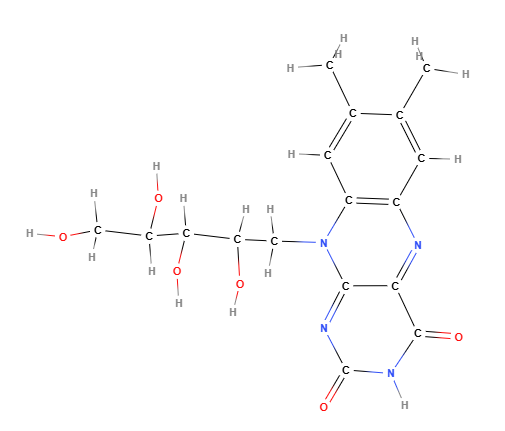 | 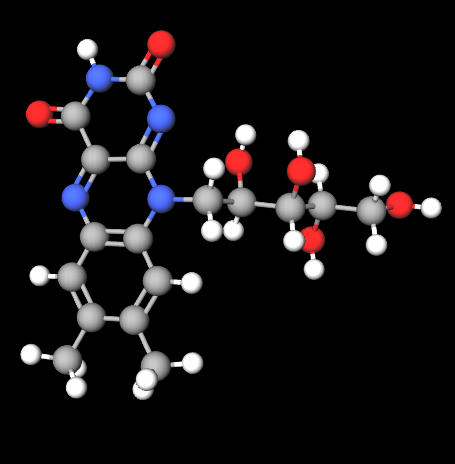 |
Molecular Formula C17H20N4O6
Molecular Weight 376.369 g/mol
CAS 83-88-5 13123-37-0
EC number: 201-507-1
UNII TLM2976OFR
DTXSID8021777
Synonyms:
- Lactoflavin
- Riboflavine
- Riboflavin
- Vitamin B2
- Food Yellow 15
- C.I. Food Yellow 15
- 7,8-Dimethyl-10-(D-ribo-2,3,4,5-tetrahydroxypentyl)isoalloxazine
- D-Ribitol, 1-deoxy-1-(3,4-dihydro-7,8-dimethyl-2,4-dioxobenzo(g)pteridin-10(2H)-yl)-
- Isoalloxazine, 7,8-dimethyl-10-(D-ribo-2,3,4,5-tetrahydroxypentyl)-
- 1-Deoxy-1-(3,4-dihydro-7,8-dimethyl-2,4-dioxobenzo[g]pteridin-10(2H)-yl)-D-ribitol
- Ovoflavin

