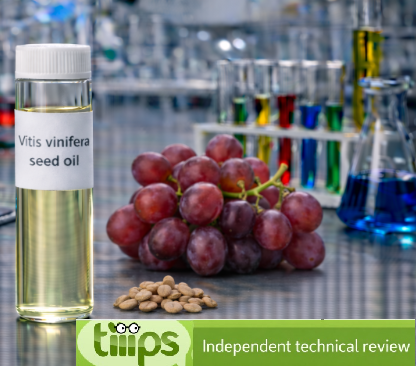
Vitis Vinifera Seed Oil is extracted from the seeds of the grapevine (Vitis vinifera) and is valued for its nourishing and moisturizing properties. This oil is rich in essential fatty acids, antioxidants, and vitamins, making it an excellent ingredient in cosmetic formulations. Vitis Vinifera Seed Oil is primarily used for its skin-conditioning and emollient properties, helping to hydrate and soften the skin while providing a protective barrier against environmental stressors.
Chemical Composition and Structure
Vitis Vinifera Seed Oil contains:
- Essential Fatty Acids: Such as linoleic acid and oleic acid, which are crucial for maintaining skin barrier function and hydration.
- Vitamin E: An antioxidant that helps protect the skin from oxidative stress and improves overall skin health.
- Phenolic Compounds: Providing additional antioxidant benefits and promoting skin health.
- Triglycerides: Contributing to the oil's emollient properties, making it effective for softening and smoothing the skin.
The oil consists of a complex mixture of bioactive compounds that work synergistically to enhance skin health and provide protection against environmental stressors.
It should be borne in mind that the quantity of the constituents depends on various factors such as extraction methods and techniques.
Physical Properties
Appearance: Typically a clear to pale yellow liquid.
Solubility: Soluble in oils and organic solvents; insoluble in water.
pH: Generally neutral, around 5-7, depending on the formulation.
Odor: Mild, characteristic of grape seeds, often nutty.
Stability: Stable under normal storage conditions; should be kept away from light and moisture.
Production Process
Harvesting: Grape seeds are collected during the winemaking process as a byproduct.
Cold Pressing: The seeds undergo cold pressing to extract the oil while preserving its beneficial properties.
Filtration: The oil may be filtered to remove any solid particles and ensure clarity.
Formulation: Purified Vitis Vinifera Seed Oil is incorporated into various cosmetic products to enhance their moisturizing and emollient properties.
Applications
Medical: Occasionally used in topical formulations for its soothing and nourishing effects.
Cosmetics: Commonly found in creams, lotions, serums, and hair care products for its skin-conditioning and emollient benefits. It helps improve the overall health and appearance of the skin.
INCI Functions:
Skin conditioning agent. It is the mainstay of topical skin treatment by restoring, increasing or improving skin tolerance to external factors, including melanocyte tolerance. The most important function of the conditioning agent is to prevent skin dehydration, but the subject is rather complex and involves emollients and humectants.
Skin conditioning agent - Emollient. Emollients have the characteristic of enhancing the skin barrier through a source of exogenous lipids that adhere to the skin, improving barrier properties by filling gaps in intercorneocyte clusters to improve hydration while protecting against inflammation. In practice, they have the ability to create a barrier that prevents transepidermal water loss. Emollients are described as degreasing or refreshing additives that improve the lipid content of the upper layers of the skin by preventing degreasing and drying of the skin. The problem with emollients is that many have a strong lipophilic character and are identified as occlusive ingredients; they are oily and fatty materials that remain on the skin surface and reduce transepidermal water loss. In cosmetics, emollients and moisturisers are often considered synonymous with humectants and occlusives.
CAS 85594-37-2 84929-27-1
EC number 287-896-9 284-511-6
Food: May be utilized in food supplements for its health benefits, although it is not typically used in food products.
Industrial Uses: Can be employed in formulations requiring natural oils with beneficial properties.
Environmental and Safety Considerations
Vitis Vinifera Seed Oil is generally regarded as safe for use in cosmetics when applied according to recommended guidelines. It is well-tolerated by most skin types, including sensitive skin.
Responsible sourcing and formulation practices are essential to ensure that the ingredient is free from harmful contaminants and produced sustainably.
Studies
In addition to vitamins B1, B6, C and K, grape also contains polyphenols that, with their antioxidant activity, perform various protective actions: increase in gene expression or antioxidant protein, attenuation of stress signaling of the endoplasmic reticulum, blockage of pro-inflammatory cytokines or endotoxin-mediated kinases and transcription factors involved in metabolic diseases, suppression of inflammation (1). These actions can reduce obesity-mediated chronic inflammation by multiple mechanisms, thus preventing metabolic diseases.
In addition, it seems established an effect of stimulation of memory in older people through an integration of grape juice that has produced a reduction in vascular disease in people with cardiovascular disease (2)
Piceatannol (trans-3,4,3',5'-tetrahydroxystilbene) , a polyphenol of grape, regulating the expression of proteins involved in the migration of cancer cells, would appear to be able to counteract their migration in the prostate (3).
Vitis rotundifolia extracts produced an anti-cancer action against a particularly aggressive tumour, triple-negative breast cancer. The positive action can be traced back to the antitumor and antioxidant activity carried out by the phenolic content and flavonoids present in this type of grape (4).
Resveratrol (3,5,4'-trans-trihydroxystilbene) is present in the skin and seeds of the grape. It is a polyphenolic component belonging to the stilbene family that protects plants from stress, infections and other diseases. Resveratrol has a wide range of biological properties with anti-inflammatory, neuroprotective, anticancer, anti-aging (5).
Grape studies
References___________________________________________________________________________
(1) Chuang CC, McIntosh MK. Potential mechanisms by which polyphenol-rich grapes prevent obesity-mediated inflammation and metabolic diseases. Annu Rev Nutr. 2011 Aug 21;31:155-76. doi: 10.1146/annurev-nutr-072610-145149.
Abstract. Obesity and metabolic disease-related health problems (e.g., type 2 diabetes, atherosclerosis, and hypertension) are the most prevalent nutrition-related issues in the United States. An emerging feature of obesity and type 2 diabetes is their linkage with chronic inflammation that begins in white adipose tissue and eventually becomes systemic. One potential strategy to reduce inflammation and insulin resistance is consumption of polyphenol-rich foods like grapes or their by-products, which have anti-inflammatory properties. Polyphenols commonly found in grape products have been reported to reduce inflammation by (a) acting as an antioxidant or increasing antioxidant gene or protein expression, (b) attenuating endoplasmic reticulum stress signaling, (c) blocking proinflammatory cytokines or endotoxin-mediated kinases and transcription factors involved in metabolic disease, (d) suppressing inflammatory- or inducing metabolic-gene expression via increasing histone deacetylase activity, or (e) activating transcription factors that antagonize chronic inflammation. Thus, polyphenol-rich grape products may reduce obesity-mediated chronic inflammation by multiple mechanisms, thereby preventing metabolic diseases.
(2) Krikorian R, Nash TA, Shidler MD, Shukitt-Hale B, Joseph JA. Concord grape juice supplementation improves memory function in older adults with mild cognitive impairment. Br J Nutr. 2010 Mar;103(5):730-4. doi: 10.1017/S0007114509992364.
Abstract. Concord grape juice contains polyphenol compounds, which have antioxidant and anti-inflammatory properties and influence neuronal signalling. Concord grape juice supplementation has been shown to reduce inflammation, blood pressure and vascular pathology in individuals with CVD, and consumption of such flavonoid-containing foods is associated with a reduced risk for dementia. In addition, preliminary animal data have indicated improvement in memory and motor function with grape juice supplementation, suggesting potential for cognitive benefit in ageing humans. In this initial investigation of neurocognitive effects, we enrolled twelve older adults with memory decline but not dementia in a randomised, placebo-controlled, double-blind trial with Concord grape juice supplementation for 12 weeks. We observed significant improvement in a measure of verbal learning and non-significant enhancement of verbal and spatial recall. There was no appreciable effect of the intervention on depressive symptoms and no effect on weight or waist circumference. A small increase in fasting insulin was observed for those consuming grape juice. These preliminary findings suggest that supplementation with Concord grape juice may enhance cognitive function for older adults with early memory decline and establish a basis for more comprehensive investigations to evaluate potential benefit and assess mechanisms of action.
(3) PKwon GT, Jung JI, Song HR, Woo EY, Jun JG, Kim JK, Her S, Park JH. Piceatannol inhibits migration and invasion of prostate cancer cells: possible mediation by decreased interleukin-6 signaling. J Nutr Biochem. 2012 Mar;23(3):228-38. doi: 10.1016/j.jnutbio.2010.11.019. Epub 2011 Apr 15. PMID: 21497499.
(4) Darwish AG, El-Sharkawy I, Tang C, Rao Q, Tan J. Investigation of Antioxidant and Cytotoxicity Activities of Chocolate Fortified with Muscadine Grape Pomace. Foods. 2023 Aug 22;12(17):3153. doi: 10.3390/foods12173153.
Abstract. Muscadine grape pomace and mixed products with chocolate extracts from three muscadine genotypes exhibiting different berry skin colors (black and bronze) were investigated for total phenolic content (TPC), total flavonoid content (TFC), DPPH, FRAP antioxidant activity, and anticancer activity using MDA-MB-468 (MM-468; African American) breast cancer cells. Muscadine berry extracts and mixed products showed cytotoxicity activities of up to 70% against MM-468 breast cancer cells. Cell growth inhibition was higher in 'macerated Floriana' with an IC50 value of 20.70 ± 2.43 followed by 'Alachua' with an IC50 value of 22.25 ± 2.47. TPC and TFC in macerated MGP powder were (1.4 ± 0.14 and 0.45 ± 0.01 GAE/g FW, respectively), which was significantly higher than those in cocoa powder. Data analysis showed a high association between DPPH, FRAP antioxidant activities, and TPC content and a positive high correlation between anticancer activity and antioxidant capacity and between TPC and anticancer activity. The anticancer and antioxidant effects of muscadine grape pomace and chocolate extracts are attributed to the TPC of extracts, which showed a stronger positive correlation with growth inhibition of African American breast cancer cells. This study would be of great value for food industries as well as other manufacturers who are interested in new food blends.
(5) Galiniak S, Aebisher D, Bartusik-Aebisher D. Health benefits of resveratrol administration. Acta Biochim Pol. 2019 Feb 28;66(1):13-21. doi: 10.18388/abp.2018_2749. PMID: 30816367.
Abstract. Resveratrol is a polyphenol that is abundant in grape skin and seeds. Food sources of resveratrol include wine, berries, and peanuts. This compound has many properties, including activity against glycation, oxidative stress, inflammation, neurodegeneration, several types of cancer, and aging. Because resveratrol is generally welltolerated, it is believed to be a promising compound in preventing many diseases, such as diabetes and its complications. Unfortunately, this compound exhibits low bioavailability and solubility. The aim of this review is to summarize the latest information on the multiple effects of resveratrol on health and the benefits of its intake, based on in vitro and in vivo studies in animals and humans.
de la Lastra CA, Villegas I. Resveratrol as an anti-inflammatory and anti-aging agent: mechanisms and clinical implications. Mol Nutr Food Res. 2005 May;49(5):405-30. doi: 10.1002/mnfr.200500022.
Abstract. Resveratrol is a phytoalexin polyphenolic compound found in various plants, including grapes, berries, and peanuts. Multiple lines of compelling evidence indicate its beneficial effects on neurological, hepatic, and cardiovascular systems. Also one of the most striking biological activities of resveratrol soundly investigated during the late years has been its cancer-chemopreventive potential. In fact, recently it has been demonstrated that this stilbene blocks the multistep process of carcinogenesis at various stages: tumor initiation, promotion, and progression. One of the possible mechanisms for its biological activities involves downregulation of the inflammatory response through inhibition of synthesis and release of pro-inflammatory mediators, modification of eicosanoid synthesis, inhibition of activated immune cells, or inhibiting such as inducible nitric oxide synthase (iNOS) and cyclooxygenase-2 (COX-2) via its inhibitory effects on nuclear factor (kappa)B (NF-(kappa)B) or the activator protein-1 (AP-1). More recent data provide interesting insights into the effect of this compound on the lifespan of yeast and flies, implicating the potential of resveratrol as an anti-aging agent in treating age-related human diseases. It is worthy to note that the phenolic compound possesses a low bioavailability and rapid clearance from the plasma. As the positive effects of resveratrol on inflammatory response regulation may comprise relevant clinical implications, the purpose of this article is to review its strong anti-inflammatory activity and the plausible mechanisms of these effects. Also, this review is intended to provide the reader an up-date of the bioavailability and pharmacokinetics of resveratrol and its impact on lifespan.




