



Punica granatum callus culture extract (Punica granatum): properties, uses, pros, cons, safety
Punica granatum callus culture extract is an extract obtained from an in vitro callus culture (undifferentiated plant tissue) of Punica granatum (family Lythraceae). In cosmetics it is used mainly as a skin-conditioning ingredient, with a use profile aimed at supporting skin comfort, sensoriality and—depending on the grade—a potential antioxidant contribution linked to the pomegranate polyphenolic fraction.
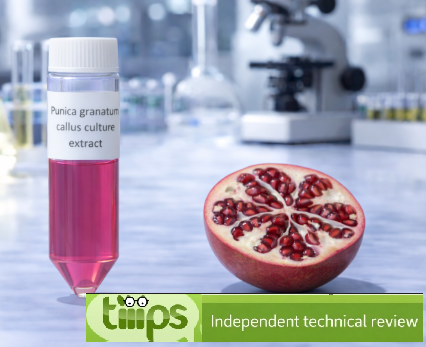
Definition
A “callus” is undifferentiated plant tissue produced under sterile conditions on a culture medium. The extract is therefore produced starting from callus biomass (not from the whole fruit), with the advantage of greater process standardization compared with traditional agricultural variability. The main cosmetic function typically reported in ingredient databases is skin conditioning.
Production process and key constituents
How it is produced (in brief)
A typical industrial process involves:
initiating a callus culture from selected plant tissue and growing it in controlled culture systems/bioreactors (sterility, light, nutrients, growth regulators)
harvesting the biomass and performing solvent extraction (often water/glycols and/or hydroalcoholic mixtures, depending on grade)
filtration, clarification and standardization (solids, polyphenol profile, color, preservation), with controls for contaminants and microbiological parameters
Key constituents (representative, by category)
Ellagitannins (2–3 compounds)
Punicalagin
Punicalin
Phenolic acids (2–3 compounds)
Ellagic acid
Gallic acid
Flavonoids (2–3 compounds)
Quercetin
Kaempferol
Technical note: the real profile depends on the culture system (nutrients/elicitors), extraction solvent and supplier standardization. For cosmetic grades, quality is managed via specifications (markers, chromatography, solids, microbiology).
Main uses
Cosmetics
Typical use in leave-on and rinse-off formulas designed to:
support the feel of “skin in good condition” (skin conditioning)
support a “botanical/biotech” positioning based on a cell-culture-derived extract
integrate systems with antioxidant or barrier-supportive actives, when consistent with the concept and with grade documentation
INCI functions
Skin conditioning agent. It is the mainstay of topical skin treatment by restoring, increasing or improving skin tolerance to external factors, including melanocyte tolerance. The most important function of the conditioning agent is to prevent skin dehydration, but the subject is rather complex and involves emollients and humectants.
Safety
It is considered a safe ingredient.
Industrial use
Primarily personal care as a functional/marketing-technical (cell culture) ingredient, with use driven by technical data sheets and claims allowed in the target market.
Identification data and specifications
| Characteristic | Value | Note |
|---|---|---|
| INCI name | Punica granatum callus culture extract | Cosmetic denomination |
| Botanical source | Punica granatum (family Lythraceae) | Callus culture |
| Preparation type | extract (solvent extract) | Grade-dependent |
| CAS number | 84961-57-9 (reported as “generic” in some assessments) | Verify in supplier SDS |
| EC number (EINECS) | not always reported in consumer databases | Verify in supplier SDS |
| Molecular formula | not applicable (mixture) | Complex mixture |
| Molecular weight | not applicable (mixture) | Distribution, not a single value |
| Main function | skin conditioning | Declared cosmetic function |
Chemical-physical properties (indicative)
| Characteristic | Indicative value | Note |
|---|---|---|
| Physical state | liquid (solution/extract) or powder (spray-dried) | Grade-dependent |
| Color | pale yellow to amber/light brown | Batch- and process-dependent |
| Odor | mild / characteristic | Usually not dominant |
| Water solubility | variable | Often good if in aqueous/glycol base |
| Oil solubility | low | Unless specifically carried |
| Stability | good if properly stored | Light/oxygen sensitive if polyphenol-rich |
| pH use range | grade-dependent | Follow supplier TDS/SDS |
Functional role and mechanism of action
The action is mainly cosmetic and may manifest through:
skin-conditioning contribution (improved perceived comfort and sensory quality of the surface film)
potential formula-level antioxidant support linked to the polyphenolic fraction (this should be treated conservatively and validated on the finished product, as it is highly dependent on concentration and stability)
Formulation compatibility
It generally integrates well into: O/W emulsions, aqueous gels, serums, toners and mild cleansers, subject to:
pH (some polyphenols are more sensitive outside a defined range)
preservative system (possible interactions with polyphenols)
metal ions (chelants may be useful where needed)
thermal processing (avoid prolonged heat stress when aiming to preserve the polyphenol profile)
Pros and cons
Pros
Callus-culture origin: good repeatability and standardization versus conventional agricultural extracts.
“Botanical biotech” positioning consistent with innovation claims (within permitted limits).
Relatively easy integration into many aqueous bases, depending on grade.
Cons
Real performance depends on markers and standardization: supplier documentation (TDS/COA) is necessary.
Potential sensitivity to oxidation/light: may require appropriate formula and packaging management.
Antioxidant/photoprotective claims require finished-product evidence and are not automatically transferable from the ingredient to the cosmetic.
Safety, regulatory, and environmental aspects
Safety must be assessed on the finished product (concentration, area of use, frequency and format). For cell-culture-derived ingredients, quality control is also relevant for: microbiological contamination, process residues and culture traceability.
Allergen.
It is not a single “fragrance allergen”; as with many plant extracts, irritation cannot be excluded in predisposed individuals, especially on highly reactive skin or in formulas rich in actives.
Formulation troubleshooting
Color/odor instability over time.
Action: improve packaging barrier, reduce headspace, limit light exposure, evaluate formula antioxidants and chelants.
Loss of perceived efficacy.
Action: verify dose, preservative compatibility and pH; request updated markers and COA from the supplier.
Preservative compatibility issues.
Action: run preservative screening at target pH; evaluate alternatives or preservation strategies consistent with the matrix.
Conclusion
Punica granatum callus culture extract is a callus-culture-derived extract from Punica granatum used mainly for skin conditioning. Its formulation value lies in the standardizability of “cell culture” sourcing and in the possible presence of representative polyphenolic fractions (grade-dependent). Quality and performance depend on supplier documentation and on managing stability and compatibility in the final system.

