Trimethylsiloxyamodimethicone: properties, uses, pros, cons, safety
Trimethylsiloxyamodimethicone is an amino-functional silicone (from the “amodimethicone” family) of synthetic origin, used mainly in haircare products as a hair conditioning agent. In practical terms, it is a siloxane polymer modified with amino groups (which provide a certain affinity for the hair fiber) and trimethylsiloxy end groups, designed to deliver slip, frizz reduction, improved combability, and a more uniform cosmetic film on hair.
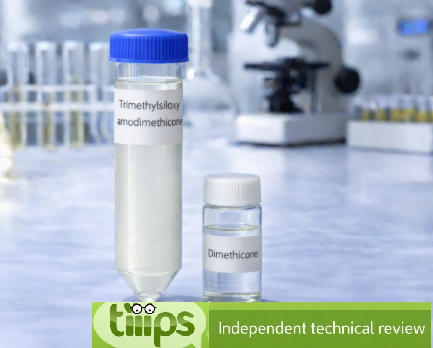
It is a siloxane polymer built on a Si–O–Si backbone with amino functionalities along the chain and trimethylsiloxy end groups. From a formulation standpoint:
the amino portion tends to promote selective deposition (especially on more damaged/porous areas of the hair),
the silicone portion provides low surface tension and slip,
the overall effect is a light film that reduces friction and improves sensory performance.
Main uses
Cosmetics
Primary use in hair products: conditioners, masks, leave-in treatments, anti-frizz products, heat-protection products, and some shampoos/2-in-1 products (when the base is designed to manage deposition). In these formulas it is used to:
improve wet and dry combability;
reduce static and flyaways;
increase shine and the perception of “smoother hair”;
contribute to a film that can reduce the perception of dryness and protect the fiber from mechanical stress (brushing, blow-drying).
INCI functions
Hair conditioning agent. A large number of ingredients with specific purposes can co-exist in a hair shampoo: cleansers, conditioners, thickeners, mattifying agents, sequestering agents, fragrances, preservatives, special additives. However, the indispensable ingredients are the cleansers and conditioners as they are necessary and sufficient for hair cleansing and manageability. The others act as commercial and non-essential auxiliaries such as: appearance, fragrance, colouring, etc. Hair conditioning agents have the task of increasing shine, manageability and volume, and reducing static electricity, especially after treatments such as colouring, ironing, waving, drying and brushing. They are, in practice, dispersing agents that may contain cationic surfactants, thickeners, emollients, polymers. The typology of hair conditioners includes: intensive conditioners, instant conditioners, thickening conditioners, drying conditioners.
Industrial use
Primarily cosmetic (personal care). More broadly, functionalized silicones are used as performance additives to modulate wetting, friction, and surface films in compatible matrices.
Identification data and specifications
| Characteristic | Value | Note |
|---|
| INCI name | Trimethylsiloxyamodimethicone | Cosmetic denomination |
| Origin | synthetic | Man-made polymer |
| Class | amino-functional silicone (amodimethicone type) | Functionalized siloxane polymer |
| Main function | hair conditioning | Cosmetic use function |
| CAS number | to be verified in SDS/supplier documentation | Often not handled uniquely across commercial grades |
| EC number (EINECS) | to be verified in SDS/supplier documentation | Depends on material classification |
| Molecular formula | not applicable (polymer) | Polymeric structure |
| Molecular weight | not applicable (polymer) | Distribution, not a single value |
Chemical-physical properties (indicative)
| Characteristic | Indicative value | Note |
|---|
| Physical state | viscous fluid or component in a blend/emulsion | Depends on commercial grade |
| Color | colorless to pale yellow | Batch/carrier-dependent |
| Odor | mild / characteristic | Usually not dominant in the finished product |
| Water solubility | very low / insoluble | Typical of silicones |
| Oil-phase compatibility | variable | Depends on phase polarity and carrier |
| Deposition on hair | favored (vs. dimethicone) | Linked to amino functionality |
| Chemical stability | high | Criticalities are more often tied to compatibility and build-up |
Functional role and mechanism of action
The action is mainly physical: the polymer deposits on the cuticle and forms a cosmetic film that reduces friction between fibers. The presence of amino groups can increase anchoring to the hair surface, improving the persistence of the conditioning effect. In well-balanced formulas, this can translate into reduced combing breakage, greater slip, reduced frizz, and improved optical alignment (shine).
Formulation compatibility
Performance depends on the matrix:
in conditioners and masks (often cationic systems or rich in fatty alcohols) it is generally easier to obtain consistent deposition and sensory outcomes;
in shampoos or strongly anionic systems, a specific formulation approach may be required (e.g., delivery via suitable emulsions/dispersion systems) to avoid instability and achieve controlled deposition;
excessive deposition can weigh hair down, especially on fine hair or with repeated use without adequate cleansing.
Pros and cons
Pros
Strong conditioning: improved combability, slip, and reduced static.
Deposition often more efficient on damaged hair compared with non-functionalized silicones.
Can improve shine and “discipline” (anti-frizz) with a noticeable effect even at low use levels, depending on the commercial grade.
Cons
Risk of build-up: on some hair types it can accumulate, reduce volume, or create a “weighed-down” feel.
Non-universal compatibility: in unsuitable bases it can cause instability, haze, or inconsistent sensory performance.
Environmental aspect: like many silicones, it shows high stability and potential persistence; assessment depends on structure, life cycle, and the possible presence of volatile species as impurities in the commercial grade.
Safety, regulatory, and environmental aspects
In cosmetics, substituted methicone-type siloxane polymers are generally considered to have low dermal bioavailability; safety should still be assessed on the finished product (concentration, application area, use pattern). For spray/aerosol products, practical attention concerns potential incidental inhalation exposure, which requires specific evaluation of both formula and format.
Dimethicone ((polydimethylsiloxane) is a chemical compound, a high molecular weight polymer derived from silicone, a chemically inert mixture of linear methylated siloxane polymers. The term 'dimeth' denotes two methyl groups bonded to the silicone molecule that provide the formation of dimethicone. It possesses a pronounced viscoelasticity characteristic and is hydrophobic, thus adding shine and slipperiness when applied to hair or skin. It forms a kind of barrier that prevents exogenous substances from entering the stratum corneum and at the same time prevents water loss. It is also UV-resistant, non-greasy and cost-effective. At low concentrations it is considered by the US FDA (Food and Drug Administration) to be a skin protector with a good degree of safety.
It is therefore considered safe when formulated to be non-irritating in cosmetic products as, given its high molecular weight, it is poorly absorbed by the skin or scalp.
Allergen.
It is not typically a classic “fragrance allergen”; reactions are more often related to the overall formula and individual sensitivity (fragrance, preservatives, surfactants).
Contraindications (brief).
On very reactive skin or in leave-on products with high deposition, carefully evaluate tolerability and dosage. In sprays/aerosols, consider incidental inhalation exposure depending on the format.
Formulation troubleshooting
Hair feels “weighed down” or volume loss.
Action: reduce dosage; use a less depositing grade; balance with a more effective cleansing system or a periodic “clarifying” approach in the regimen.
Instability (haze/separation) in shampoos or aqueous systems.
Action: review the delivery system (emulsion/dispersion), compatibility with surfactants and electrolytes, and order of addition.
Insufficient conditioning effect.
Action: optimize the cationic/conditioning system; verify that the polymer is in the correct phase and that deposition is promoted; evaluate synergy with quats and fatty alcohols.
Conclusion
Trimethylsiloxyamodimethicone is an amino-functional silicone designed for hair conditioning, useful for improving combability, slip, and frizz control. Its main advantages are strong deposition and high sensory payoff; the most common limitations are build-up risk and the need for an appropriate base formula to achieve stable and repeatable performance.
Mini-glossary
Siloxane. A structure based on Si–O–Si bonds typical of silicones, associated with low surface tension and good chemical stability.
Amino-functional. Presence of amino groups that can increase affinity for charged/porous surfaces (e.g., damaged hair) and improve deposition.
Build-up. Progressive accumulation of surface film with potential loss of volume or a weighed-down feel.




