



Disiloxane: properties, uses, pros, cons, safety
The term Disiloxane is one of those cases where the same word can refer to two different substances, depending on context (pure chemistry vs cosmetics/INCI). This ambiguity is exactly why PubChem can show a different molecular formula and molecular weight compared with what is commonly meant in cosmetics.
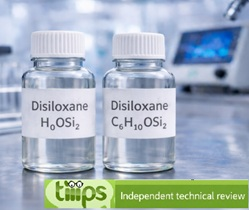
Ambiguity 1: “Disiloxane” as the base chemical compound
In chemistry, disiloxane can mean the unsubstituted disiloxane, i.e., the minimal Si–O–Si structure with terminal hydrogens:
Molecular formula: H₆OSi₂
Molecular weight: 78.22 g/mol
Typical synonyms: oxybis(silane), hexahydrodisiloxane
This substance is more “fundamental chemistry/lab” and is not the volatile sensory silicone most commonly used in cosmetics.
Ambiguity 2: “Disiloxane” as a cosmetic ingredient (INCI / CosIng)
In INCI/cosmetic language, “Disiloxane” is very often used for the volatile silicone hexamethyldisiloxane (HMDSO), i.e., a methylated disiloxane widely used in formulations:
CosIng structural formula (condensed/structural notation): (CH₃)₃Si–O–Si(CH₃)₃
Equivalent molecular formula: C₆H₁₈OSi₂
Molecular weight: 162.38 g/mol
Common chemical synonyms: bis(trimethylsilyl) ether, (TMS)₂O
So, when a formulator says “Disiloxane” in a cosmetic formula, in most cases they mean HMDSO, not the H₆OSi₂ compound.
Technical report (cosmetics): Disiloxane interpreted as HMDSO
Below is the complete report assuming the most common cosmetic/INCI meaning: Disiloxane = hexamethyldisiloxane (HMDSO). The ambiguity is kept explicit so the document remains defensible from a documentation standpoint.
Definition
Disiloxane (HMDSO) is a volatile organosiloxane with low viscosity, featuring a Si–O–Si bond and terminal methyl groups. It is used as a “sensory” ingredient because it improves slip, spreadability, and a dry-touch finish, with relatively fast evaporation after application.
Production process
It is produced via organosilicon synthesis involving formation of the siloxane bond, followed by purification (often distillation). For cosmetic use, critical parameters include purity, control of impurities (including volatile residues), and consistent volatility and odor.
Key constituents
The main component is HMDSO. Trace components (within specification) may include other light siloxanes or process residues, depending on grade. Performance depends mainly on purity, surface tension, and evaporation profile.
Identification data and specifications
| Characteristic | Value | Note |
|---|---|---|
| INCI name (cosmetic use) | Disiloxane | often corresponds to HMDSO |
| Common chemical name | hexamethyldisiloxane (HMDSO) | methylated disiloxane |
| CAS number | 107-46-0 | HMDSO |
| EC number (EINECS) | 203-492-7 | HMDSO |
| Structural formula (CosIng) | (CH₃)₃Si–O–Si(CH₃)₃ | structural/condensed notation |
| Molecular formula (equivalent) | C₆H₁₈OSi₂ | molecular formula |
| Molecular weight | 162.38 g/mol | HMDSO |
| Calories | 0 kcal | not relevant in cosmetics |
| Typical functions | skin conditioning, antifoaming | per ingredient repertories |
Physicochemical properties (indicative)
| Characteristic | Indicative value | Note |
|---|---|---|
| Physical state | liquid | low viscosity |
| Volatility | high | supports rapid dry-down |
| Water solubility | very low | typical of siloxanes |
| Miscibility | good with silicones and many oil phases | useful carrier |
| Odor | slight | depends on purity |
| Flammability | possible | depends on grade SDS classification |
| Compatibility | good in anhydrous systems and many emulsions | verify with specific polymers/surfactants |
| Sensory effect | high slip and reduced tack | lightweight feel |
Functional role and mechanism of action
As skin conditioning, it improves film distribution and reduces friction during application, increasing slip and reducing perceived stickiness. Its volatility supports a drier after-feel because part of the carrier evaporates, leaving the non-volatile emollients/actives on skin.
As antifoaming, it can reduce foam formation during manufacturing and, in some products, limit bubbles and entrapped air that can worsen aesthetics and stability.
Main uses
Cosmetics
Typical in:
sensory primers and serums (silky feel, fast dry-down)
sunscreens and “dry touch” products
make-up (improves spreadability and comfort)
formulations where foam control is needed (process or finished product), case-by-case
selected lightweight haircare where reduced heaviness and improved slip are desired
INCI functions
Antifoaming agent. The constituent factors for foam stabilisation are the concentration of nanoparticles and hydrophobicity. Foam, even when used in separation operations such as fractionation or flotation, can cause a decrease in density and a deterioration in quality in cosmetic products. The defoaming agent (non-polar oil, silicone oils, hydrophobic solid particles or mixtures of both) is strongly influenced by viscosity and, to an almost directly proportional extent, concentration. However, defoamers can carry an irreversible source of contamination.
Skin conditioning agent. It is the mainstay of topical skin treatment by restoring, increasing or improving skin tolerance to external factors, including melanocyte tolerance. The most important function of the conditioning agent is to prevent skin dehydration, but the subject is rather complex and involves emollients and humectants.
Pros and cons
Pros
Lightweight feel with high slip and lower tack.
Supports a drier finish thanks to volatility.
Useful as a carrier to improve oil-phase distribution.
Can help with foam control in process or specific formulas.
Cons
Not ideal when a very persistent film is desired (concept-dependent).
In spray/aerosol formats, attention is needed regarding inhalation exposure.
Potential flammability and safety management in production/storage.
In “clean/green” positioning, volatile silicones may be less accepted by some markets.
Safety, regulatory, and environmental aspects
Safety profile (practical)
Safety management is mainly a function of concentration and product format. Key practical points are avoiding eye/mucosal contact, considering use in sprays (inhalation of aerosols), and following the supplier SDS for flammability and handling/ventilation requirements.
Allergen
Not a typical fragrance allergen. Any discomfort is more often irritative or related to the overall formula.
Contraindications and cautions
Use caution in the periocular area and in spray products. During development: verify stability, compatibility, and comply with SDS guidance for the commercial grade.
Conclusion
The word Disiloxane is ambiguous: in chemistry it can mean H₆OSi₂ (78.22 g/mol), whereas in cosmetics/INCI it very often refers to HMDSO ((CH₃)₃Si–O–Si(CH₃)₃, equivalent to C₆H₁₈OSi₂, 162.38 g/mol). Once this is clarified, Disiloxane (HMDSO) is a valuable ingredient to achieve a silky and dry-touch sensory profile, with use as a carrier and sometimes an antifoaming agent, to be handled carefully in spray formats and with attention to safety aspects linked to volatility/flammability.

