



Magnesium hydrogen phosphate: properties, uses, pros, cons, safety
Magnesium hydrogen phosphate (synonyms: dibasic magnesium phosphate, dimagnesium phosphate) is a magnesium salt of phosphoric acid used in foods as the additive E343(ii). In practice, it is mainly used as an acidity regulator and buffer, and also as an anti-caking/technological support in certain matrices. Depending on context and dosage, it may also contribute as a source of magnesium and phosphate.
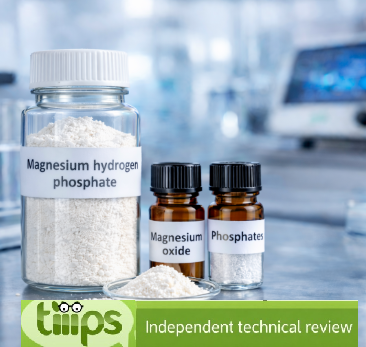
Definition
From a chemical standpoint, it is the salt MgHPO₄; in food applications it is commonly encountered as the trihydrate (MgHPO₄·3H₂O). Its formulation value comes from typical phosphate behavior: in aqueous systems it can help control pH and buffer capacity, influencing stability and performance in selected recipes.
Production process
Industrially, it is produced by a controlled reaction between a magnesium source (e.g., magnesium oxide/hydroxide or magnesium salts) and phosphoric acid or phosphates, followed by precipitation/crystallization, washing, and drying to specification (food grade). For food use, key controls include purity, heavy metals, fluorides, and consistency of form (anhydrous vs hydrated) and particle size.
Key constituents
In a product meeting specifications, the constituents essentially correspond to the substance itself: magnesium hydrogen phosphate (often as the trihydrate) and, when applicable, water of crystallization. The most relevant practical differences depend on hydration state, fineness, and specification-limited impurities.
Identification data and specifications
| Characteristic | Value | Note |
|---|---|---|
| Name | magnesium hydrogen phosphate | also “dimagnesium phosphate” |
| E number | E343(ii) | magnesium phosphates |
| Molecular formula | MgHPO₄ (anhydrous) / MgHPO₄·3H₂O (trihydrate) | hydrated form is very common |
| Molecular weight | 120.28 g/mol (anhydrous) / 174.33 g/mol (trihydrate) | depends on hydration |
| CAS number | 7757-86-0 (substance) / 7782-75-4 (trihydrate) | frequently used in technical sheets |
| EC number (EINECS) | 231-823-5 | EU identifier |
| Calories | 0 kcal | mineral salt, no energy contribution |
| Typical food function | acidity regulator, buffer, technological support | and sometimes magnesium/phosphate contribution |
Physicochemical properties (indicative)
| Characteristic | Indicative value | Note |
|---|---|---|
| Physical state | crystalline powder | generally white and odorless |
| Water solubility | low (slight) | increases in dilute acids |
| Alcohol solubility | negligible | typical for inorganic phosphates |
| Heat stability | good under normal processing | not a leavening agent |
| Effect on pH | buffering in suitable systems | depends on matrix and other phosphates/acids |
| Interactions | complexation/precipitation with ions | to consider in mineral-rich formulations |
Functional role and mechanism of action
In formulation, the core function is its contribution to phosphate buffering: in the presence of water and process conditions, it can help stabilize pH and manage buffer capacity. In certain applications it can improve technological stability (reducing pH drift during shelf life or processing) and may help limit caking in powders when used as a support in dry blends (performance is strongly matrix- and dose-dependent).
Medicine
Magnesium hydrogen phosphate has shown some potential in the orthopedic field, in applications as an effective biomaterial for bone repair (1) and, in combination with fatty acids (omega-6 and omega-7), it promotes the regression and/or resolution of acne symptoms and provides better results than medications (such as isotretinoin), without significant side effects (2).
Main uses in food
Magnesium hydrogen phosphate is used mainly as:
An acidity regulator and buffer in products where pH stability is important.
A technological support in some dry mixes, with potential effects on flowability and powder handling (case-by-case).
A mineral ingredient that may contribute magnesium and phosphate when the nutritional objective is coherent with the formulation.
Cosmetics- INCI Functions
Anticaking agent. This chemical compound facilitates free flow and prevents aggregation or clumping of substances in a formulation by reducing the tendency of certain particles to stick together.
Pros and cons
Pros
Useful as a buffer and acidity regulator in selected systems.
Generally stable and sensorially neutral at appropriate technological doses.
May provide a mineral contribution (magnesium/phosphate) when relevant.
Cons
Limited solubility: in beverages or clear systems it can promote haze/sediment if not managed.
Possible interactions with other minerals/ions in the formula (risk of precipitation or texture shifts).
If overall dietary phosphate intake is already high, added phosphates should be considered in the total balance.
Safety, regulatory, and practical aspects
Safety profile in the finished product
As E343(ii), it is subject to EU purity specifications (including limits for certain contaminants). From a nutritional perspective, practical attention focuses on the overall phosphorus/phosphate balance in the diet, especially in sensitive populations.
Allergen
It is not a label-declarable food allergen.
Contraindications and practical cautions
In people with renal impairment or conditions requiring dietary control of phosphorus and magnesium, the use of phosphate/magnesium-containing fortified foods or supplements should be handled cautiously. In general, the assessment is more critical when the ingredient is used to increase mineral intake, and less critical when it is present only at low technological doses.
Conclusion
Magnesium hydrogen phosphate (E343(ii)) is primarily a functional ingredient as an acidity regulator/buffer and technological support in certain formulations. Its strengths are stability and usefulness for pH control; its main limitations are solubility and potential interactions in mineral-rich matrices, plus the need to consider total phosphate intake in diets already high in phosphorus.

