



Citrus tangelo fragrance oil 15607: properties, uses, pros, cons, safety
Citrus-type fragrance blend (“grapefruit–tangelo” profile), intended to scent cosmetic bases and home care products (soaps, candles, detergents), marketed as a “fragrance oil” under product code 15607
Synonyms: grapefruit tangelo fragrance oil 15607, citrus tangelo fragrance oil (commercial usage)
INCI / Functions: Fragrance (in the EU often declared as Parfum on label; “fragrance” indicates a perfume blend)
Definition
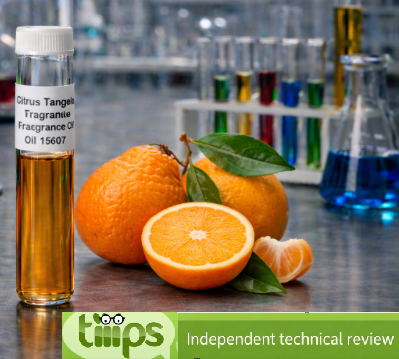
Citrus tangelo fragrance oil 15607 is a fragrance blend formulated to deliver a fresh, juicy citrus character with facets commonly described as bergamot, grapefruit, litsea cubeba, and tangelo (commercial olfactory description). It is not a single substance with a single CAS/EC, but a blend of odorants (natural and/or synthetic, depending on the perfume design) that, in a cosmetic context, is generally declared as Fragrance/Parfum.
From a technical standpoint, its formulation behavior is typical of perfume oils:
it requires management of solubility and stability (especially in aqueous or high-clarity bases);
it must comply with perfumery safety constraints per IFRA (product categories and maximum levels);
it may contain sensitizing components typical of citrus/terpene profiles (with implications for allergen labeling where applicable).
Main uses
Food.
Not intended for food use. For this perfume, IFRA compliance documentation typically indicates the presence of ingredients not qualified as food flavoring materials (not GRAS as flavor ingredients). In practice, it should not be handled as a food flavor and should not enter food supply chains unless explicitly supported by food-grade specifications (this is not the case here).
Cosmetics.
Used as a fragrance in rinse-off products (solid and liquid soaps, shower gels, shampoos, rinse-off facial cleansers) and, depending on positioning and compliance with IFRA limits and finished-product safety assessment, also in certain leave-on categories. In the EU, beyond correct Parfum/Fragrance declaration, the presence of specific fragrance allergens may require label listing above defined thresholds (leave-on and rinse-off), in line with the applicable regulatory framework.
Fragrance. It plays a very important role in the formulation of cosmetic products as it allows perfume to be enhanced, masked or added to the final product, improving its commercial viability. The consumer always expects to find a pleasant scent in a cosmetic product.
Skin conditioning agent - Occlusive. This ingredient has the task of modifying the condition of the skin when it is damaged or dry by reducing flaking and restoring elasticity. It has a strong lipophilic character and is identified as an occlusive ingredient; it is generally composed of oily and fatty materials that remain on the skin surface and reduce trans epidermal water loss.
Medicine.
Not a “therapeutic” ingredient; any uses are purely ancillary (scenting technical bases) and do not replace clinical evaluations.
Pharmaceutical.
Possible only as an odorant component in hygiene/parapharmaceutical products, subject to internal policies, specifications, and finished-product risk assessment (sensitive populations, application areas, etc.).
Industrial use.
Predominant use in home fragrance (candles, wax melts and—if compatible with brand requirements—diffusers/air care) and in home care/detergency. The “fresh citrus” profile is typically sought to signal cleanliness and brightness, but requires attention to stability (top notes), compatibility with waxes and packaging, and volatility management.
Identification data and specifications
| Identifier | Value |
|---|---|
| Trade name | Grapefruit tangelo fragrance oil 15607 (commercial name associated with code 15607) |
| Product code | 15607 (P15607 in some catalogs) |
| Declared INCI name | Fragrance |
| Nature | Mixture (not a single substance; a unique CAS/EC is not applicable) |
| Country of origin (declared) | United States |
| Phthalates | phthalate free (declared) |
| Vanillin content | 0.00% (declared) |
| Flash point | 130 °F (approximately 54 °C) |
Chemical-physical properties (indicative)
| Property | Value | Note |
|---|---|---|
| Physical state | liquid | typical of fragrance oils |
| Flammability (SDS classification) | combustible liquid | handle as a combustible substance per SDS |
| Flash point (commercial specification) | 130 °F (~54 °C) | key parameter for safety/transport and processing |
| Skin hazard (SDS) | irritant / sensitizer | typically associated with citrus perfume blends |
Functional role and practical mechanism
| Function | What it does in formula | Technical note |
|---|---|---|
| Perfuming | defines the odor of the finished product | citrus notes with bergamot/grapefruit/litsea/tangelo (commercial description) |
| Masking | covers/harmonizes base odors | useful in surfactant bases or waxes |
| Sensory signature | influences “clean/fresh” perception | particularly relevant in detergency and home fragrance |
Formulation compatibility
In formulation, a citrus fragrance oil such as 15607 is primarily managed along four axes:
Solubilization and clarity. In aqueous or clear surfactant systems, the fragrance may cause haze or separation if the base’s solubilizing capacity is insufficient. Robustness should be verified with thermal stress and hot/cold cycles, because citrus profiles may show cold instability or sensitivity to salts/electrolytes.
Soap process (cold process / melt & pour). For this fragrance, commercial product sheets report favorable soapmaking behavior (no typical acceleration or discoloration issues, and good scent retention without morphing/fading). It still must be validated in the actual recipe (unsaturated oils level, temperature, additives, colorants).
Wax compatibility and candle performance. The volatility typical of citrus may reduce persistence versus profiles with heavier base notes. Performance depends on wax type, load, wick size, and curing. Even when IFRA does not impose restrictive limits for “candles,” this does not replace performance and safety testing of the finished item.
Allergens and terpene oxidation. Fragrances containing terpene components may become more sensitizing when oxidized (pre-/pro-haptens). Good practice is to limit exposure to light/air/heat and to use correct storage; the EU obligation to list individual allergens on label applies above defined thresholds, with transitional periods established by current regulation.
Use guidelines (indicative)
| Application | Practical range | Technical note |
|---|---|---|
| Soap (IFRA category 9) | 2.0–5.0% | reported IFRA limit for this fragrance: 5.00% |
| Cleansers/shampoo/shower gel (IFRA category 9) | 0.5–3.0% | stay within category IFRA limits and validate irritation on the finished product |
| Body lotions (IFRA category 5A/5B) | 0.1–1.0% | even when IFRA is not restrictive, levels are set by tolerability/sensoriality |
| Room sprays (IFRA category 10B) | 0.5–2.5% | reported IFRA limit: 2.50% |
| Reed diffusers (IFRA category 10A) | 5–25% | certificate indicates a 2.50% limit for 10A; stay within the limit and optimize the solvent base |
| Candles / wax melts (IFRA category 12) | 6–10% | certificate indicates 100% (no specific IFRA restriction); real limits are technical/performance and process-driven |
Operational note: “practical ranges” reflect common industry use. Final compliance must follow the batch IFRA certificate and finished-product testing (stability, performance, safety).
Quality, grades, and specifications
| QC parameter | What to check |
|---|---|
| Batch identity | match code 15607 and ensure updated SDS/IFRA documents |
| Odor and deviations | lot-to-lot olfactory consistency (citrus top notes) |
| Flash point | alignment with specification (safety and transport impacts) |
| Color and clarity | indicators of oxidation/instability |
| Declared contaminants | phthalate free, vanillin 0% (if relevant to brand claims) |
Safety, regulatory, and environment
For cosmetic compliance, use must respect:
IFRA (use category and maximum concentration for the specific fragrance);
EU requirements on labeling of fragrance allergens above defined thresholds for leave-on and rinse-off, with transitional periods established by regulation;
safety assessment on the finished product (use scenario, target population, application area).
Formulation troubleshooting
| Problem | Possible cause | Recommended action |
|---|---|---|
| Haze/separation in aqueous bases | insufficient solubilization, salts, temperature | increase solubilizer or retune the surfactant system; verify thermal stability |
| “Weak” scent in candle | high citrus volatility, insufficient curing | retune load, wick, and curing time; consider blending with compatible base notes |
| Loss of freshness over time | oxidation of terpene components | store cool and dark; minimize headspace; use suitable packaging |
| Perceived irritation in leave-on | level too high or unsuitable matrix | reduce fragrance %, adjust solvents, validate on finished product and comply with IFRA/SDS |
| Soap acceleration (if it occurs) | interaction with the specific recipe | lower processing temperature, adjust recipe, add fragrance at lighter trace (comparative tests) |
Conclusion
Citrus tangelo fragrance oil 15607 is a “grapefruit–tangelo” citrus fragrance designed for soaps, detergency, and home fragrance, with commercially reported positive soapmaking behavior. Correct management requires discipline on IFRA, attention to solubilization/stability, and control of the typical irritant/sensitizing profile of perfume mixtures, alongside EU fragrance allergen labeling obligations where applicable.
Mini-glossary
INCI: standard nomenclature for cosmetic ingredient labeling.
Parfum/Fragrance: label declaration identifying a perfume mixture.
IFRA: International fragrance association; defines standards and use limits by product category.
SDS: safety data sheet; hazard classification and risk-management measures.
Skin sensitization: allergic response that can develop after repeated exposure; once established, it may be re-triggered even at lower levels.

