



Acrylates/vinyl isodecanoate crosspolymer: properties, uses, pros, cons, safety
Acrylates/vinyl isodecanoate crosspolymer is a synthetic crosslinked acrylic polymer used in cosmetics primarily as an emulsion stabilizer, film former, and rheology modifier (viscosity control). In practical terms, it is used to provide structure to the formula, improve long-term stability, and create a light surface film that can optimize skin feel and in-use performance, especially in leave-on systems and in some cleansing/hybrid bases.
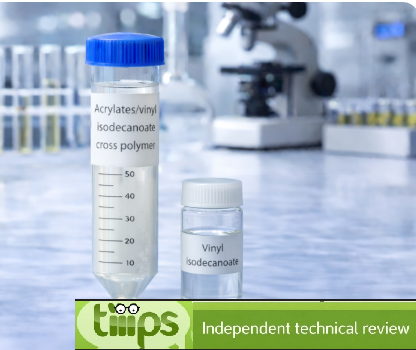
Acrylates/vinyl isodecanoate cross polymer is produced by an emulsion or solution polymerisation reaction. The polymer structure and properties of this ingredient can change depending on a number of variables such as the ratio of comonomers, the level of cross-linking and others.
From a formulation standpoint, crosslinking makes the material less “soluble” than a linear polymer and more oriented to:
form a micro-network that increases viscosity;
stabilize phase distribution in emulsions;
deposit a continuous film on skin/hair/nails when used in suitable systems.
Main uses
Cosmetics
Primary use in creams and lotions, gel-creams, structured serums, primers, and “soft focus” products (depending on the commercial grade), where the goal is to increase emulsion stability and obtain a more consistent yet spreadable texture. It may also be present in some rinse-off products when viscosity and dispensing behavior must be controlled.
INCI functions
Suspending agent. Non surfactant. Cosmetic or pharmaceutical suspensions are known to be thermodynamically unstable and it is therefore essential to include in the formulation a suspending agent capable of dispersing any sedimented particulates and reducing the rate of sedimentation. The presence of this agent increases the consistency of the suspension medium and exerts a protective colloidal action.
Viscosity control agent. It controls and adapts, Increasing or decreasing, viscosity to the required level for optimal chemical and physical stability of the product and dosage in gels, suspensions, emulsions, solutions.
Film-forming agent. It produces, upon application, a very thin continuous film with an optimal balance of cohesion, adhesion and stickiness on skin, hair or nails to counteract or limit damage from external phenomena such as chemicals, UV rays and pollution.
Emulsion stabiliser. Emulsions are thermodynamically unstable. Emulsion stabilisers improve the formation and stability of single and double emulsions. as well as their shelf-life. It should be noted that in the structure-function relationship, the molar mass of the ingredient used plays an important role.
Industrial use
Primarily cosmetic, as an additive to control rheology and stability in compatible matrices. Non-cosmetic uses depend on grade and supplier documentation.
Identification data and specifications
| Characteristic | Value | Note |
|---|---|---|
| INCI name | Acrylates/Vinyl Isodecanoate Crosspolymer | Cosmetic denomination |
| Origin | synthetic | Man-made polymer |
| Class | crosslinked acrylic copolymer | “Crosspolymer” = crosslinked network |
| Functions | emulsion stabilizing; film forming; viscosity controlling | Cosmetic functions |
| CAS number | to be verified in SDS/supplier docs | Often not handled as a single CAS uniformly |
| EC number (EINECS) | to be verified in SDS/supplier docs | Depends on material classification |
| Molecular formula | not applicable (polymer) | Polymeric structure |
| Molecular weight | not applicable (polymer) | Distribution, not a single value |
Chemical-physical properties (indicative)
| Characteristic | Indicative value | Note |
|---|---|---|
| Physical state | powder or granules /liquid as commercial blend | Depends on grade and carrier |
| Color | white–off-white/ | Batch-dependent |
| Odor | mild / neutral | Usually not dominant |
| Water solubility | low; tends to swell/disperse rather than “dissolve” | Depends on neutralization and system |
| Oil solubility | limited | Typical of acrylic polymers |
| Rheological effect | viscosity increase, structure, stabilization | Depends on pH, salts, phase, shear |
| Surface film | present in compatible systems | Affects sensoriality and “after-feel” |
Functional role and mechanism of action
The effect is mainly physical–rheological: the crosslinked polymer builds a network that increases resistance to flow in the continuous phase and improves stability against separation (creaming, sedimentation, syneresis) when the formula is properly balanced.
The film-forming function comes from the polymer’s ability to form a continuous film after application/drying, with possible effects on spread uniformity, a smoother skin feel, and in some cases improved perceived wear/hold (depending on the matrix and combination with other polymers).
Formulation compatibility
Performance is sensitive to:
pH and neutralization degree (if applicable to the system);
presence of electrolytes and salts (may reduce viscosity or disrupt the network);
interaction with surfactants, solvents, and other polymers (rheology synergies or competition);
processing (order of addition, wetting, dispersion, shear).
During development it is useful to verify hot/cold stability, centrifugation, thermal cycling, and accelerated aging.
Pros and cons
Pros
Improves emulsion stability and consistency, with a more controllable texture.
Provides a film-forming effect useful for sensoriality and application uniformity.
Enables good rheology control with often low use levels (grade-dependent).
Cons
Sensitive to pH and electrolytes: risk of viscosity loss or instability in “difficult” formulas.
If overdosed it can create a noticeable film, “plastic” feel, or drag during application.
Requires good dispersion technique: incomplete wetting can cause lumps or non-uniformity.
Safety, regulatory, and environmental aspects
In cosmetics, crosslinked acrylic polymers are generally considered to have low dermal bioavailability (macromolecules), but tolerability must always be assessed on the finished product (concentration, matrix, application area, usage pattern).
Allergen.
It is not typically a classic “fragrance allergen.” Any reactions are more often driven by the overall formula and individual sensitivity.
Contraindications (brief).
Use caution in leave-on formulas for highly reactive skin if film former level is high or if the formula contains other potential irritants; evaluate case by case on the finished product.
Formulation troubleshooting
Viscosity lower than expected.
Action: check pH and neutralization; reduce electrolytes or rebalance the system; evaluate synergy with compatible thickeners.
Lumps or non-uniform dispersion.
Action: improve wetting and pre-dispersion; optimize shear and order of addition; use a more suitable incorporation vehicle.
Film/drag sensation during application.
Action: reduce dosage; balance with emollients and sensory modifiers; re-tune the combination with other film formers.
Emulsion instability over time.
Action: review oil-phase/emulsifier ratio; optimize continuous-phase viscosity; check compatibility with actives and solvents.
Conclusion
Acrylates/vinyl isodecanoate crosspolymer is a versatile acrylic crosspolymer for emulsion stabilization, viscosity control, and film-forming contribution that can improve sensoriality and in-use performance. Outcomes depend mainly on pH, electrolyte management, dispersion technique, and overall formula balance.

