



Polysilicone-17: properties, uses, pros, cons, safety
Polysilicone-17 is a crosslinked silicone polymer (“siloxanes and silicones, diphenyl, phenyl oxy, methyl oxy, crosslinked”) of synthetic origin. In practical terms, it is a “structured” silicone (not a simple fluid) in which a siloxane network is modified with phenyl/diphenyl substituents and phenoxy and methoxy groups. This chemical profile tends to provide slip, a silky touch, and a skin conditioning effect, with high stability under typical cosmetic use conditions.
Silicones have high chemical stability but low biodegradability and high bioaccumulation potential.
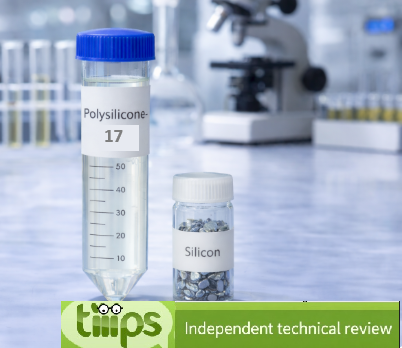
Definition
It is not a single molecule: it is a polymer based on Si–O–Si (siloxane matrix) with crosslinking, which creates a three-dimensional structure.
The presence of phenyl/diphenyl and phenoxy groups can influence:
the sensory profile (slip, dry/non-greasy feel),
affinity with certain oil phases or mixed systems,
spreading behavior and a “cushion” feel, in a formula-dependent way.
Main uses
Cosmetics
Primary use as a skin conditioning agent in emulsions and leave-on products (creams, lotions, serums) when improved sensoriality is desired: higher slip, reduced perception of greasiness, and better “after-feel.”
In certain commercial grades and formulation blends, Polysilicone-17 can also help improve wetting and spreading of actives or pigments on skin and hair, especially when carried in systems with compatible surfactants/co-solvents.
INCI functions
Skin conditioning agent. It is the mainstay of topical skin treatment as it has the function of restoring, increasing or improving skin tolerance to external factors, including melanocyte tolerance. The most important function of the conditioning agent is to prevent skin dehydration, but the subject is rather complex and involves emollients and humectants that can be added in the formulation.
Industrial use
As a crosslinked silicone additive, it can be used—within compatible matrices—to modulate surface tension, sensoriality, and wetting behavior. Non-cosmetic uses depend on the specific commercial grade and application requirements.
Identification data and specifications
| Characteristic | Value | Note |
|---|---|---|
| INCI name | Polysilicone-17 | Cosmetic denomination |
| Extended chemical name | Siloxanes and silicones, diphenyl, phenyl oxy, methyl oxy, crosslinked | Identifies a modified siloxane network |
| Origin | synthetic | Man-made polymer |
| CAS number | not unique / not always reported as a single identifier | A single CAS may be absent depending on classification |
| EC number (EINECS) | not unique / not always reported | Depends on registration/classification |
| Molecular formula | not applicable (polymer) | Crosslinked polymeric structure |
| Molecular weight | not applicable (polymer) | Distribution, not a single value |
| Main function | skin conditioning | INCI function |
Chemical-physical properties (indicative)
| Characteristic | Indicative value | Note |
|---|---|---|
| Physical state | polymeric material (often viscous/gel-like or dispersion) | Depends on crosslink density and commercial carrier |
| Color | colorless to pale yellow | Batch- and carrier-dependent |
| Odor | mild / characteristic | Usually not dominant in the finished product |
| Water solubility | very low / insoluble | Typical of silicones |
| Compatibility in oils/cosmetic solvents | variable | Depends on oil phase and commercial form |
| Surface tension | low | Contributes to slip and spreading |
| Chemical stability | high | Phase compatibility and dispersion are more critical |
Functional role and mechanism of action
Polysilicone-17 acts mainly as a sensory modifier and conditioning agent: it deposits a low-surface-energy phase that reduces friction, improving the feeling of softer and “silkier” skin.
Crosslinking contributes to a more “structuring” behavior than simple linear silicones: it can increase the cushion effect and improve perceived slip without a peak of greasiness, provided the system is compatible and stable.
Formulation compatibility
Performance is sensitive to:
polarity and composition of the oil phase,
type of emulsifiers and presence of polymers (acrylates, silicones, natural polymers),
dispersion process and order of addition.
If incompatibility occurs, uncontrolled haze, separation, or rheological drift may be observed. During development it is useful to verify hot/cold stability, centrifugation, accelerated aging, and batch-to-batch repeatability.
Pros and cons
Pros
Improves slip and “after-feel” with a drier perception compared with greasier emollients.
Contributes to sensory comfort in leave-on products and may support more uniform application.
Good chemical stability under typical cosmetic conditions.
Cons
Non-universal compatibility: may require optimization of carrier, emulsifier system, and process.
Possible perception of a “film” or excessive slip if overdosed or in unbalanced formulas.
Environmental profile: silicones are generally chemically stable; environmental management depends on the specific family, and some related categories (e.g., certain cyclic siloxanes) have known environmental concerns and regulatory scrutiny.
Safety, regulatory, and environmental aspects
From a cosmetic-use standpoint, siloxane polymers are often regarded as having low dermal absorption; practical assessment must still be based on the finished product (matrix, preservatives, fragrance, application area, usage pattern).
From an environmental and regulatory standpoint, it is important to distinguish between crosslinked polymers and possible impurities or volatile fractions present in the commercial grade. In the EU, for example, certain cyclic siloxanes (D4/D5/D6) are identified as very persistent and very bioaccumulative and are under strong regulatory scrutiny; if a silicone raw material contains these species as residues/impurities, it is advisable to verify specifications and supplier documentation.
Allergen.
It is not typically a classic “fragrance allergen”; reactions are more often linked to the overall formula and individual sensitivity.
Contraindications (brief).
Use caution in spray/aerosol systems if the commercial form or the formula entails incidental inhalation exposure; evaluate case by case on the finished product.
Formulation troubleshooting
Instability or separation.
Action: review oil phase and emulsifier system; optimize dispersion process (pre-mix in a compatible phase, controlled shear).
Feel too “slippery” or film-forming.
Action: reduce dosage, balance with less “slippy” emollients or with texturizers that increase sensory anchoring.
Undesired haze.
Action: verify compatibility with polymers and salts; consider a different commercial grade or a more suitable carrier.
Conclusion
Polysilicone-17 is a crosslinked silicone modified with aromatic groups, used mainly as a skin conditioning agent to improve slip and leave-on sensoriality. Its main advantage is the ability to “refine” touch while reducing perceived greasiness; its main limitations are formulation compatibility and the need to manage potential environmental profiles linked to siloxane families and to impurities/residues in the commercial grade.
Mini-glossary
Siloxane. A structure based on Si–O–Si bonds typical of silicones, associated with low surface tension and good chemical stability.
Crosslinked. A three-dimensional structure in which polymer chains are linked together, affecting consistency, deposition, and sensoriality.
Cyclic siloxanes (D4/D5/D6). Volatile silicone molecules related to silicone chemistry; in the EU they are identified as very persistent and very bioaccumulative and are under regulatory scrutiny.

