



Caprooyl Phytosphingosine: properties, uses, pros, cons, safety
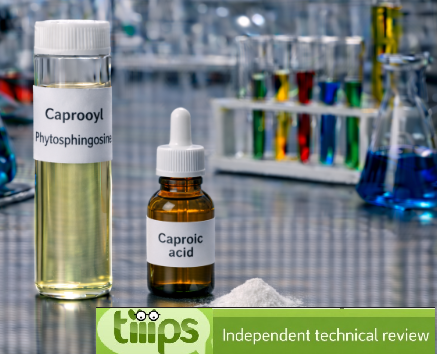
Caprooyl Phytosphingosine – a lipid amide (“ceramide-like” derivative) formed by combining caproic acid (C6, hexanoic acid) and phytosphingosine (a sphingoid base)
Synonyms: N-hexanoyl phytosphingosine, caproyl phytosphingosine (spelling variant), C6 phytoceramide (technical/commercial usage), ceramide NG (sometimes used as a family reference in certain contexts)
INCI / Functions: skin conditioning, hair conditioning
Definition
Caprooyl Phytosphingosine is a functional lipid belonging to the “family” of ceramide derivatives: structurally, it is an N-acylated form of phytosphingosine with a short-chain fatty acid (caproic). In cosmetic formulation, this “ceramide-like” architecture matters because it can mimic, from a physical-behavior standpoint, part of the skin-barrier lipids of the stratum corneum: it tends to support lamellar organization and contribute to the maintenance of superficial lipid cohesion, with practical effects on dryness, comfort feel, and perceived roughness reduction.
From an application standpoint, it should not be interpreted as a classic “humectant”: its contribution is primarily lipid/structural (matrix reinforcement), often included in systems that also contain cholesterol, other ceramides, and fatty acids or emollient esters, where the goal is a more “continuous” barrier-like structure and improved management of transepidermal water loss at the surface level.
Main uses
Cosmetics
The main use is in skincare as a component of “barrier” systems (creams, lotions, serums, balms), especially for dry, sensitized, or barrier-impaired skin (for example in routines including retinoids/acids, or during cold seasons). In formula it can support:
improved comfort feel and reduction of “tightness”;
a perception of a smoother, more compact surface;
support to lipid replenishment strategies when combined with cholesterol and other ceramides.
In haircare, its function is more often secondary: it may contribute to a conditioning effect (better combability and softness) in masks, conditioners, and leave-on treatments, but performance depends strongly on the cationic/polymeric system and the lipid vehicle.
INCI Functions
Hair conditioning agent. A large number of ingredients with specific purposes can co-exist in a hair shampoo: cleansers, conditioners, thickeners, mattifying agents, sequestering agents, fragrances, preservatives, special additives. However, the indispensable ingredients are the cleansers and conditioners as they are necessary and sufficient for hair cleansing and manageability. The others act as commercial and non-essential auxiliaries such as: appearance, fragrance, colouring, etc. Hair conditioning agents have the task of increasing shine, manageability and volume, and reducing static electricity, especially after treatments such as colouring, ironing, waving, drying and brushing. They are, in practice, dispersing agents that may contain cationic surfactants, thickeners, emollients, polymers. The typology of hair conditioners includes: intensive conditioners, instant conditioners, thickening conditioners, drying conditioners.
Skin conditioning agent - Miscellaneous. This ingredient has the task of modifying the condition of the skin when it is damaged or dry by reducing its flakiness and restoring its elasticity.
Identification data and specifications
| Identifier | Value |
|---|---|
| INCI name | Caprooyl Phytosphingosine |
| Chemical nature | “ceramide-like” derivative (amide of phytosphingosine with caproic acid) |
| Formula (indicative) | C24H49NO4 |
| Molar mass (indicative) | ~415.66 g/mol |
| CAS number | 249728-94-7 |
| EC/EINECS number | not always reported/uniquely mapped in public databases; verify on the supplier’s SDS/CoA |
| Typical commercial appearance | waxy solid/fine powder or supplied in a lipid premix (grade-dependent) |
Chemical-physical properties (indicative)
| Property | Value | Note |
|---|---|---|
| Polarity/affinity | markedly lipophilic | tends to be carried in oil phase or lamellar systems |
| Water solubility | very low | requires a solubilization/dispersion strategy |
| Solubility in oils/esters | moderate to good (matrix-dependent) | often better in esters, triglycerides, structured ceramide systems |
| Stability | good under compatible conditions | watch for crystallization/recrystallization in emulsions |
| pH sensitivity | generally low (as a lipid) | issues are more physical than chemical (texture/structure) |
Functional role and practical mechanism
| Function | What it does in formula | Technical note |
|---|---|---|
| Skin conditioning | supports comfort, softness, and a “barrier” feel | more evident in systems rich in barrier lipids |
| Hair conditioning | contributes to softness/combability | often synergistic with cationic conditioners and lipids |
| Lipid structuring | supports lamellar organization and surface cohesion | useful in barrier creams and reparative products |
Formulation compatibility
Caprooyl Phytosphingosine is a primarily lipid ingredient: the main challenge is not chemical reactivity but physical handling (solubilization, crystallization, long-term stability). In O/W emulsions, it typically performs better when:
it is pre-solubilized in a suitable oil phase (esters, triglycerides, oils with adequate solvent capacity) or incorporated as part of a ceramide premix;
the formula contains coherent co-lipids (for example cholesterol and other barrier lipids) and an emulsifier system able to support lamellar structures;
thermal cycles are managed (hot/cold stress), because recrystallization can affect texture, opacity, and sensoriality.
In high-surfactant cleansers, performance as a “barrier lipid” can decrease due to micellar solubilization or limited deposition: in these cases it is often more effective in leave-on products or in rinse-off systems designed for lipid deposition (with suitable polymers/structures).
Use guidelines (indicative)
| Application | Typical range | Technical note |
|---|---|---|
| Leave-on skincare (barrier creams/lotions/serums) | 0.01–0.30% | often in ceramide blends; the “effective dose” depends on premix assay |
| Balms/ointments and lipid-rich products | 0.05–0.50% | watch viscosity and potential crystals if overdosed or poorly solubilized |
| Haircare (conditioners/masks/leave-on) | 0.01–0.20% | evaluate compatibility with cationics and sensorial “weight/build-up” |
| Rinse-off cleansers | 0.005–0.10% | perceived benefit often lower vs leave-on; design for deposition |
Quality, grades, and specifications
| QC parameter | What to check |
|---|---|
| Identity | INCI and CAS alignment; SDS/CoA consistency |
| Assay/active level | if supplied in premix: actual % of Caprooyl Phytosphingosine |
| Impurity profile | process residues, solvents (if relevant), metals (if declared) |
| Moisture and physical behavior | agglomeration risk, powder flow, storage stability |
| Stability and crystallization | accelerated testing and thermal cycling in the finished formula |
| Microbiology | mainly for aqueous premixes or pre-dispersed ingredients |
Safety, regulatory, and environment
In cosmetics, Caprooyl Phytosphingosine is framed with skin conditioning and hair conditioning functions. Safety assessment must be performed on the finished product, considering use scenario, application area (face, lips, eye contour), frequency, and sensitive populations. Operationally, risk management is more often linked to formulation aspects (stability and grade purity) than to intrinsic issues typical of surfactants or preservatives; nevertheless, impurity control, lot-to-lot standardization, and tolerability verification aligned to product positioning remain essential.
From an EU regulatory standpoint, correct management relies on INCI compliance, supplier technical documentation (SDS/CoA), and the cosmetic PIF. At process and quality level, applying GMP (Good manufacturing practice; benefit: reduces variability and contamination) and, where relevant, a HACCP approach (Hazard analysis and critical control points; benefit: strengthens preventive control of critical points) supports manufacturing robustness and repeatability.
Formulation troubleshooting
| Problem | Possible cause | Recommended intervention |
|---|---|---|
| Graininess/crystals over time | incomplete solubilization or recrystallization | improve lipid solvent, use premix, optimize thermal curve and cooling |
| Opacity or physical instability | lamellar phase not stabilized, emulsifier incompatibility | retune emulsifier/co-emulsifier, introduce co-lipids (e.g., cholesterol), stress test |
| “Heavy” feel on skin/hair | excess lipid fraction or deposition | reduce dose, lighten oil phase, use lighter esters, rebalance film formers |
| Barrier benefit not perceived | use in rinse-off or level too low vs system | move to leave-on, increase effective assay, add within a coherent ceramide complex |
| Dispersion difficulty | direct addition into water or cold processing without pre-solubilization | pre-disperse in oil/esters, use controlled hot phase, standardize addition order |
Conclusion
Caprooyl Phytosphingosine is a ceramide-like ingredient with a mainly lipid/structural role, used to support skin conditioning and, secondarily, hair conditioning. The performance key is correct formulation integration: solubilization, prevention of crystallization, and building a coherent lipid system (often in blends with other ceramides and co-lipids). When used with appropriate stability and grade-quality controls, it is a useful building block for barrier- and comfort-oriented products.
Mini-glossary
INCI: standard nomenclature for cosmetic ingredient labeling.
Ceramide-like: ingredient with functional behavior similar to skin-barrier ceramides.
Lamellar structures: “layered” lipid organizations relevant to the stratum corneum barrier.
Recrystallization: crystal formation over time that can alter texture and stability.
GMP: Good manufacturing practice; benefit: improves quality control and reduces contamination.
HACCP: Hazard analysis and critical control points; benefit: strengthens prevention and control of critical process points.

