



Cetyl Myristate – waxy INCI emollient, identification data, cosmetic use levels, and formulation guidance
Cetyl myristate
Ester of cetyl alcohol and myristic acid – C₃₀H₆₀O₂
Synonyms: hexadecyl tetradecanoate, myristic acid cetyl ester, hexadecyl myristate
INCI / functions: skin conditioning, skin conditioning – emollient (emollient)
Definition
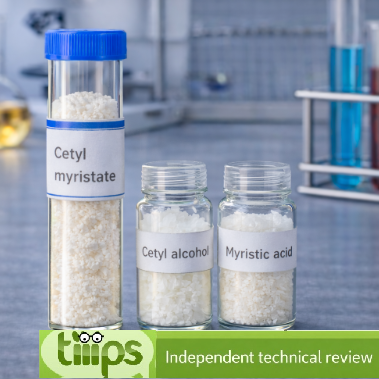
Cetyl Myristate is a waxy ester (wax ester) formed by esterification of cetyl alcohol (1-hexadecanol) with myristic acid (tetradecanoic acid). From a compositional standpoint, the ingredient consists primarily of the single molecule Cetyl Myristate, with possible controlled trace levels (grade-dependent) of related components (e.g., residual free acid/alcohol or closely related esters) within supplier specifications. In cosmetics it is used mainly as an emollient and texturizer: it contributes to a more silky feel, can reduce the perception of greasiness in certain bases, improves slip and payoff, and can support body in the oil phase of emulsions and anhydrous systems.
Food: not a typical food ingredient; mainly a technical material.
Cosmetics: emollient and texture support (creams, lotions, make-up, body and lip products).
Medicine: possible technical use in lipophilic topical bases (grade-dependent).
Pharmaceutical: potential lipophilic excipient, subject to grade and applicable dossier.
Industrial use: waxy ester for lubricity/feel and rheology modification (sector-dependent).
Calories (energy value)
| Metric | Value |
|---|---|
| Energy value (100 g) | ~900 kcal (typical order of magnitude for lipid esters) |
| Use note | used at functional levels: energy impact on the finished product is negligible |
Identification data and specifications
| Identifier | Value |
|---|---|
| INCI name | Cetyl Myristate |
| Chemical name (reference) | hexadecyl tetradecanoate |
| Molecular formula | C₃₀H₆₀O₂ |
| Molar mass | 452.81 g/mol |
| CAS number | 2599-01-1 |
| EC number (EINECS) | 220-001-1 |
Key constituents
| Fraction | Components | Technical note |
|---|---|---|
| Main ester | cetyl myristate | driver of emollient effect and sensorial performance |
| Controlled traces (grade-dependent) | residual free acid/alcohol, related esters | may affect odor, melting behavior, and batch repeatability; manage via QC |
Physicochemical properties (practically relevant)
| Property | Typical indication | Formulation impact |
|---|---|---|
| Physical state | waxy solid (flakes/pastilles) | useful as a texturizer in anhydrous systems and emulsions |
| Melting point | typically ~38–48 °C (supplier-dependent range) | impacts heat stability and “melt” sensoriality |
| Solubility | miscible in many oil phases; not water-miscible | incorporation into the oil phase |
| Skin feel | slip and a more silky feel | helps reduce “drag” in certain systems |
Functional role in formulation
| Function | What it does in the formula | Operational notes |
|---|---|---|
| Emollient | improves softness and glide | contributes to a more velvety finish (system-dependent) |
| Texturizer / rheology modifier | increases body and cushion in anhydrous systems | useful in balms, sticks, rich creams |
| Payoff support | improves application and sensorial profile | particularly useful in body care and cream make-up |
Formulation compatibility
Cetyl Myristate is generally highly compatible with anhydrous oil/ester/wax matrices and is commonly used to tune the sensory and structural profile of sticks, balms, and rich body products. In O/W emulsions it is added to the oil phase to contribute body and emolliency; the key control points are thermal stability (heat/cold cycling) and viscosity drift during maturation. In W/O systems, compatibility is typically good as well, but performance depends on the emulsifier system and the overall wax/oil balance. With pigments and powders, Cetyl Myristate can improve slip and payoff, but optimal results usually require balancing with other esters and dispersants based on pigment surface treatment.
Use guidelines (indicative)
| Application | Typical range | Technical note |
|---|---|---|
| Creams/lotions (oil phase) | 0.5–5.0% | improves emolliency and sensoriality |
| Body balms and butters | 1.0–10.0% | increases body and slip |
| Sticks/lip products | 1.0–10.0% | supports payoff and structure (in synergy with waxes) |
| Cream make-up | 0.5–8.0% | reduces drag and improves application |
Typical applications
Body and hand creams to improve comfort and sensorial profile.
Balms, butters, and anhydrous systems to increase body and cushion.
Lip products and cream make-up to support payoff and glide.
Quality, grades and specifications
| QC control | What to verify |
|---|---|
| Identity | CAS/EC alignment and supplier documentation |
| Chemical indices | acid value, saponification value (if part of the specification) |
| Melting point | acceptable range for performance and stability |
| Odor/color | long-term stability, especially in anhydrous and lip products |
| Documentation | lot CoA and SDS |
Safety, regulatory and environment
Cetyl Myristate is generally considered suitable for cosmetic use at typical use levels when formulated so the finished product is non-irritating. Handling is usually straightforward; however, bulk handling of flakes/pastilles should minimize dust generation and avoid inhalation of fine particulate. From a regulatory perspective within the EU, it is used under general cosmetic requirements and GMP, and the safety evaluation is performed on the finished product. Environmentally, it is a lipophilic waxy ester: avoid uncontrolled release and manage oily residues and cleaning effluents according to local rules and good practice.
Formulation troubleshooting
| Issue | Likely cause | Corrective actions |
|---|---|---|
| Graininess in butters/sticks | crystallization not optimized | rebalance wax/ester system, optimize cooling curve, consider compatible co-esters |
| Heat instability (excess softening) | melting point too low for target | increase structuring waxes or select a higher-melting texturizer |
| Too waxy feel | excessive waxy fraction | reduce dose; balance with “dry-feel” esters and/or light oils |
| Batch variability | melting/profile differences | set QC ranges (melting point, indices, odor) and qualify suppliers |
Conclusion
Cetyl Myristate is a waxy emollient that helps improve texture, slip, and sensorial performance in many cosmetic formulations. It is particularly effective as a texturizer in anhydrous systems and as an oil-phase structuring aid in emulsions, provided wax/ester balance and the melting window are managed to ensure stability and batch-to-batch repeatability.
Mini-glossary
| Term | Meaning | Note |
|---|---|---|
| Wax ester | ester formed from a fatty acid and a fatty alcohol | typically waxy/solid; useful as a texturizer |
| Acid value | acidity index (residual free acids) | quality and stability marker |
| Saponification value | index related to ester saponification | correlates with composition and purity |
| Drag | perceived friction during application | managed by balancing esters/oils/powders |

