



PPG-1-Trideceth-6: properties, uses, pros, cons, safety
PPG-1-Trideceth-6 is a synthetic cosmetic ingredient (INCI) described as Tridecanol, ethoxylated, propoxylated (6 mol EO, 1 mol PO average molar ratio). It belongs to the family of nonionic ethoxylated/propoxylated surfactants and is mainly used as a detergent/solubilizing aid and as an ingredient with skin conditioning function. The INCI functions commonly reported are SKIN CONDITIONING and SURFACTANT - CLEANSING.
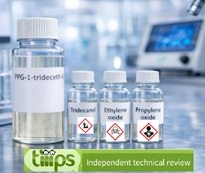
Definition
From a formulation standpoint, PPG-1-Trideceth-6 is a tridecanol ether modified with EO (ethylene oxide) and PO (propylene oxide) units. The wording “6 mol EO, 1 mol PO” expresses an average alkoxylation ratio, used to modulate the balance between the hydrophilic and lipophilic portions and therefore its behavior as a surfactant, solubilizer, and co-emulsifier in aqueous or mixed systems. (The actual value is a mixture average, not a single perfectly defined molecule.)
Production process
In general terms, it is obtained by controlled alkoxylation of tridecanol with ethylene oxide (EO) and propylene oxide (PO), followed by purification and quality control steps. As a synthetic ingredient, cosmetic-grade quality depends on control of residual process impurities, the average alkoxylation profile, and batch-to-batch consistency. Exact specifications may vary by manufacturer.
Key constituents
In practice, this is not a single perfectly monodisperse chemical species, but a technical mixture of molecules with a distribution of ethoxylated/propoxylated chains around the declared average (6 EO / 1 PO). The dominant functional component is still PPG-1-Trideceth-6 as a surfactant/conditioning system.
Identification data and specifications
| Characteristic | Value | Note |
|---|---|---|
| INCI name | PPG-1-Trideceth-6 | cosmetic denomination |
| INCI description | Tridecanol, ethoxylated, propoxylated (6 mol EO, 1 mol PO average molar ratio) | technical description |
| Origin | synthetic | reported in INCI repertories |
| Main functions | Skin conditioning; Surfactant - cleansing | cosmetic functions |
| Chemical nature | ethoxylated/propoxylated alkyl ether | nonionic surfactant |
| Molecular formula | not unique (mixture) | oligomer distribution |
| Molecular weight | not unique (apparent average) | depends on EO/PO distribution |
| CAS / EC number | variable depending on commercial designation/technical sheet | verify supplier SDS |
Physicochemical properties (indicative)
| Characteristic | Indicative value | Note |
|---|---|---|
| Physical state | viscous liquid / semi-liquid | depends on grade and temperature |
| Color | colorless–pale yellow | varies by batch/manufacturer |
| Odor | slight / characteristic | generally not strong |
| Water solubility | good–dispersible | depends on EO/PO balance |
| Compatibility | good with many surfactants | to be checked in full formula |
| Surfactant behavior | cleansing/solubilizing | supports removal of sebum/dirt |
| Sensory effect | may improve slip | linked to dosage and matrix |
| Stability | good under proper storage conditions | avoid non-recommended extremes |
Functional role and mechanism of action
As a surfactant, PPG-1-Trideceth-6 reduces surface tension and facilitates the removal of dirt, sebum, and residues, while also supporting the dispersion/solubilization of lipophilic components in aqueous systems.
As a skin conditioning ingredient, it can contribute to the sensory profile of the finished product, improving slip and “feel” during application and rinsing. In some cleansing and haircare formulations, it is also used as a functional component in more complex systems (e.g., with polymers or emollients), helping balance cleansing performance and cosmetic elegance.
Main uses
Cosmetics
It may be used in:
facial/body cleansers
shampoos
haircare products and some conditioners
gel formulations or polymer systems requiring dispersion/solubilization support
products seeking a balance between cleansing and skin/hair feel
INCI functions
Skin conditioning agent - Emollient. Emollients have the characteristic of enhancing the skin barrier through a source of exogenous lipids that adhere to the skin, improving barrier properties by filling gaps in intercorneocyte clusters to improve hydration while protecting against inflammation. In practice, they have the ability to create a barrier that prevents transepidermal water loss. Emollients are described as degreasing or refreshing additives that improve the lipid content of the upper layers of the skin by preventing degreasing and drying of the skin. The problem with emollients is that many have a strong lipophilic character and are identified as occlusive ingredients; they are oily and fatty materials that remain on the skin surface and reduce transepidermal water loss. In cosmetics, emollients and moisturisers are often considered synonymous with humectants and occlusives.
Surfactant - Emulsifying agent. Emulsions are thermodynamically unstable. Emulsifiers have the property to reduce the oil/water or water/oil interfacial tension, improve emulsion stability and also directly influence the stability, sensory properties and surface tension of sunscreens by modulating their filmometric performance.
Pros and cons
Pros
Versatile as a surfactant/solubilizing aid in many cosmetic bases.
May improve cleanser sensory feel versus harsher systems if well balanced.
Good formulation utility in systems requiring balance between cleansing and conditioning.
Synthetic ingredient with potential for standardization (useful for batch reproducibility).
Cons
Like other surfactants, at high levels or in poorly optimized formulas it may contribute to irritation/dryness in sensitive subjects.
Requires attention to compatibility and balance with other surfactants/polymers to avoid viscosity, performance, or sensory issues.
As an ethoxylated/propoxylated ingredient, quality also depends on control of process impurities and raw material purity.
It is not a targeted “active ingredient”: performance depends heavily on the overall formula.
Safety, regulatory and environmental aspects
Safety profile (practical)
PPG-1-Trideceth-6 belongs to the alkyl PEG/PPG ethers family. CIR assessments on this family generally indicate an adequate safety profile under normal cosmetic use conditions, when products are formulated to be non-irritating. As with similar ingredients, practical evaluation requires attention to dosage, product type (leave-on vs rinse-off), target users, and purity.
This ingredient is formed by an ethoxylation reaction using ethylene oxide. After the reaction, residues of ethylene oxide and 1,4-dioxane, chemical compounds considered carcinogenic, may remain. At present, no manufacturer is known to provide this information on the label.
Allergen
It is not a fragrance allergen. However, as with many surfactants/formulation aids, subjects with very sensitive skin may experience irritation or poor tolerance if the formula is too stripping or not well balanced.
Contraindications (practical)
Use caution in formulations for reactive skin or in high-frequency cleansing products if the overall surfactant system is aggressive. During formulation development, it is important to verify compatibility, internal patch testing (when required by the manufacturer/brand), and stability.
Conclusion
PPG-1-Trideceth-6 is a functional cosmetic ingredient whose main roles are cleansing surfactant and skin conditioning, useful for improving the performance of cleansing systems and some haircare/skin care formulations. Its main advantages are formulation versatility and contribution to cleansing/solubilization; its limitations mainly concern the need for good formula design (tolerability, compatibility, raw material purity).
Mini-glossary
EO (ethylene oxide): ethoxylating unit used to increase the hydrophilic portion of a molecule.
PO (propylene oxide): propoxylating unit used to modulate lipophilic and sensory properties.
Nonionic surfactant: a surfactant with no formal electric charge, often appreciated for formulation compatibility.

