



Laureth-3: properties, uses, pros, cons, safety
Laureth-3 is a non-ionic surfactant belonging to the ethoxylated fatty alcohols family, produced from lauryl alcohol with an average ethoxylation degree of about 3 EO units. In cosmetics it is mainly used as a solubilizer/light emulsifier and as a cleansing surfactant, with performance strongly dependent on the formulation matrix (water, surfactant systems, emulsions) and on the commercial “cut” (EO distribution, purity, impurity profile).
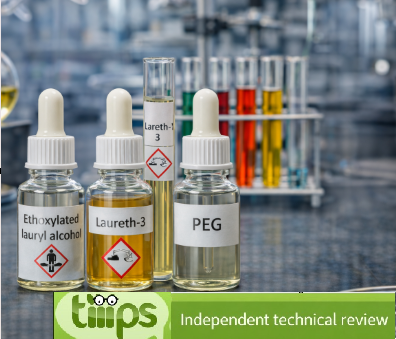
Definition
Laureth-3 is a UVCB substance with variable composition: it is not a single molecule, but a mixture of C12–C14 ethoxylated chains with a statistical distribution of ethylene oxide units. In practical terms, formulation performance is driven by: solubilization quality, compatibility with other surfactants, stability (haze/clarity), and specifications on impurities and process residues (especially relevant for leave-on products).
Main uses
Cosmetics.
Used in face/body cleansers, shampoos, shower gels, micellar waters, “milky” solutions, light emulsions, and systems where improved wetting and oil–water compatibility are needed. It is also used as a processing aid to solubilize small amounts of fragrance or lipophilic fractions in aqueous systems.
INCI Functions
Surfactant - Emulsifying agent. Emulsions are thermodynamically unstable. Emulsifiers have the property to reduce the oil/water or water/oil interfacial tension, improve emulsion stability and also directly influence the stability, sensory properties and surface tension of sunscreens by modulating their filmometric performance.
Deodorant agent. When substances that give off an unpleasant odour are included in cosmetic formulations (typical examples are methyl mercaptan and hydrogen sulphide derived from garlic), deodorants attenuate or eliminate the unpleasant exhalation.
Antistatic agent. Static electricity build-up has a direct influence on products and causes electrostatic adsorption. The antistatic ingredient reduces static build-up and surface resistivity on the surface of the skin and hair.
Identification data and specifications
| Characteristic | Value |
|---|---|
| INCI name | Laureth-3 |
| INCI functions | surfactant – cleansing; emulsifying (sometimes also described as a functional aid for flavours/fragrances) |
| CAS number | 3055-94-5 / 68439-50-9 (depending on repertory and grade) |
| EC/EINECS number | 221-280-2 / 500-213-3 (depending on repertory and grade) |
| Substance type | C12–C14 ethoxylated alcohols, variable-composition mixture |
| Molecular formula | Not applicable as a single formula; indicative: C12H25(OCH2CH2)nOH with average n ~3 (distribution) |
| Molecular weight | Not applicable as a single value; indicative average on the order of several hundred g/mol (grade-dependent) |
Indicative physico-chemical properties
| Characteristic | Indicative value | Note |
|---|---|---|
| Chemical nature | non-ionic surfactant (ethoxylated fatty alcohol) | EO distribution and C12–C14 chains |
| Solubility | good compatibility with aqueous systems via self-association; miscible/compatible with many organic phases | clarity depends on concentration and matrix |
| Behaviour in formula | solubilizer/light emulsifier, improves wetting | synergistic with other surfactants |
| pH stability | generally good within cosmetic range | extreme pH may affect overall system stability |
| Temperature stability | good under normal use; possible viscosity/haze changes under stress | validate via accelerated tests and final packaging |
| Critical parameters | haze, odour, process impurities, batch-to-batch consistency | drive performance and compliance |
Functional role and practical mechanism of action
It reduces surface tension and facilitates micelle/aggregate formation, improving solubilization of small lipophilic amounts and the stability of oil–water systems. In cleansing it supports removal of sebum and soils; in emulsions and opalescent solutions it can support texture and sensorial performance.
Formulation compatibility
Compatibility is generally good with many anionic, amphoteric, and non-ionic surfactants, but in practice clarity must be managed (especially in transparent formulas) as well as response to electrolytes/polymers that can induce haze or viscosity changes. In leave-on systems, impurity management and sensorial impact (tack, slip, potential “film” effect) are also relevant.
Use guidelines
Use levels depend on the target (solubilization, emulsification, cleansing), matrix, and sensorial requirements. During development, good practice is to set targets for clarity/haze, thermal stability, and fragrance/active compatibility, validating through accelerated stability and final-packaging tests.
Quality, grades, and specifications
Quality is driven by EO distribution, impurity profile, limits on process residues, and batch-to-batch stability. For leave-on applications or stricter regulatory markets, it is important to request supplier specifications and controls aligned with use (including limits on known ethoxylate contaminants, where applicable). Application of GMP (good manufacturing practice; benefit: reduces variability and contamination) supports traceability and repeatability.
Safety, regulatory, and environment
The term 'eth' refers to the ethoxylation reaction with ethylene oxide after which residues of ethylene oxide and 1,4-dioxane, chemical compounds considered carcinogenic, may remain. The degree of safety therefore depends on the degree of purity of the compound obtained. At present, no manufacturer is known to provide this information on the label.
Safety must be assessed on the finished product considering concentration, use area, and target population. As a class, non-ionic surfactants can be irritating at high concentrations, particularly in eye-contact scenarios; formulation design (use dilution, surfactant synergy, pH) is decisive. For ethoxylates, impurity management and compliance with supplier specifications are central operational aspects, especially for leave-on products.
Allergen.
It is not typically classified as an allergen (in the sense of fragrance allergens); however, it may contribute to irritation or non-specific sensitization in predisposed individuals, especially in aggressive or high-concentration formulas.
Contraindications (brief).
Use caution on very sensitive or reactive skin and on delicate areas; particular attention to eye irritation risk for products with potential eye contact. Avoid use on compromised skin if risk assessment and tolerability tests indicate concerns.
Formulation troubleshooting
Haze in transparent formulas.
Action: optimize surfactant ratios, reduce critical electrolytes, revise order of addition, evaluate compatible co-solubilizers, and validate across temperatures.
Viscosity instability in cleansers.
Action: check salt/electrolytes, thickening polymers, and the viscosity curve; consider surfactant blending and pH adjustments.
Perceived irritation or dryness.
Action: rebalance the surfactant system, reduce effective cleansing load, introduce re-fatting/conditioning agents, and recalibrate via tolerability testing on the finished product.
Conclusion
Laureth-3 is a non-ionic surfactant in the ethoxylated fatty alcohol class, used primarily as a cleansing surfactant and solubilizer/light emulsifier. Reliable use requires control of clarity and matrix compatibility, management of typical ethoxylate impurities via supplier specifications, stability in packaging, and finished-product safety assessment with attention to irritation and sensitive populations.
Mini-glossary
UVCB. Mixture of unknown or variable composition, typical of several industrial classes (including some ethoxylates).
Non-ionic surfactant. Surfactant without charge, often used as a solubilizer and emulsifier to stabilize oil–water systems.
Solubilizer. Ingredient that helps disperse small amounts of lipophilic substances in aqueous systems while maintaining stability and the desired appearance.
GMP. Good manufacturing practice; benefit: improves traceability and reduces contamination/variability.

