



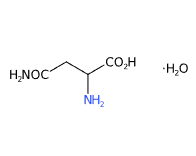
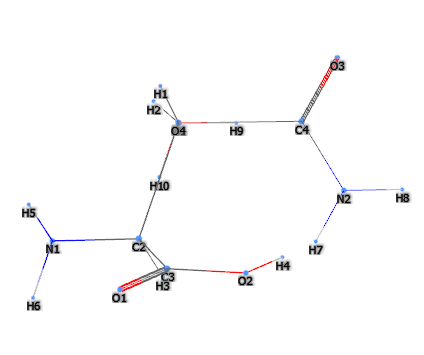
Asparagine monohydrate is the α-amino acid used by cells to synthesise α-acetamidyl-substituted proteins.
Amino acids play a key metabolic function in the human body and are constituents of proteins.
As food additives they perform different functions: preservatives, flavour enhancers, food supplements and more.
Amino acids together with their salts are used in cosmetics as conditioning agents for both hair and skin (e.g. as moisturisers and other similar functions). Moisturisers are different in nature: the best are the natural ones that exploit the mechanism of integration between the ingredient and the skin by moisturising the horny hydrolipid film, i.e. the thin protective layer that covers the epidermis protecting it from harmful external microbes, keeping the skin moisturised and supple and its pH or acidity value between 4 and 6. Then there are the occlusive moisturisers, usually derived from petroleum (Paraffinum, Paraffinum liquidum and others), but also triglycerides, lanolin oil, natural or synthetic waxes, fatty acid esters and others that create an artificial occlusive layer on the stratum corneum of the skin with the advantage of accelerating the protective process but with the disadvantage of preventing the skin's natural transpiration.
α-amino acids that have similar physical structures undergo similar changes with regard to solubility in water/ethanol mixtures, and technologies to separate α-amino acids from industrial residues, which may not even be innocuous, are constantly being improved. However, many data on the solubility in water-ethanol and ethanol of some α-amino acids are contradictory or even lacking, and the effects of ethanol on the solubility of amino acids may be different. Overall, the scientific literature considers that α-amino acids do not pose significant problems for human health when taken orally, except in people with certain genetic diseases.
Food safety: amino acid α generally considered safe.
Cosmetic safety: amino acid α generally considered safe when formulated to be non-irritant.
The most relevant studies on this ingredient have been selected with a summary of their contents:
Asparagine monohydrate studies
 |  |
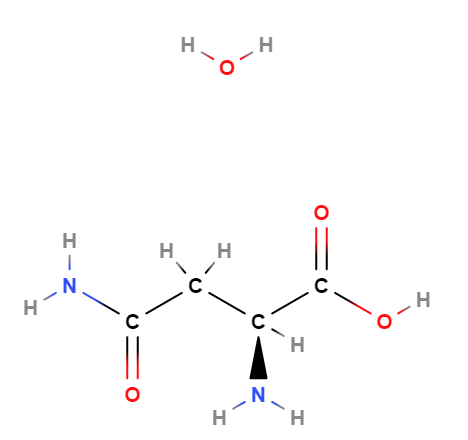 | 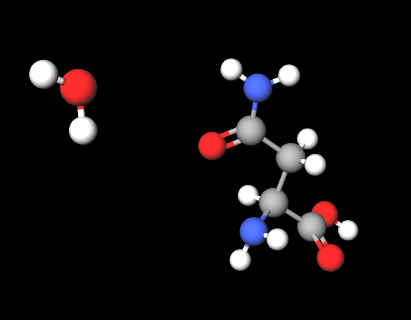 |
- Molecular Formula C4H10N2O4 NH2COCH2CH(NH2)COOH · H2O
- Molecular Weight 150.13
- Exact Mass 150.064056
- CAS 5794-13-8
- UNII 2PD79VF521
- EC Number 611-593-6 200-735-9
- DSSTox Substance ID DTXSID90973512
- IUPAC (2S)-2,4-diamino-4-oxobutanoic acid;hydrate
- InChl=1S/C4H8N2O3.H2O/c5-2(4(8)9)1-3(6)7;/h2H,1,5H2,(H2,6,7)(H,8,9);1H2/t2-;/m0./s1
- InChl Key RBMGJIZCEWRQES-DKWTVANSSA-N
- SMILES C(C(C(=O)O)N)C(=O)N.O
- MDL number MFCD00151038
- PubChem Substance ID 24891338
- Beilstein 1723527
- NCI C87433
Synonyms:
- l-asparagine hydrate
- L-Aspartic acid 4-amide
- (S)-(+)-2-Aminosuccinamic acid
- (S)-2-Aminosuccinic acid 4-amide

