Althaea officinalis Leaf/Root Extract: properties, uses, pros, cons, safety
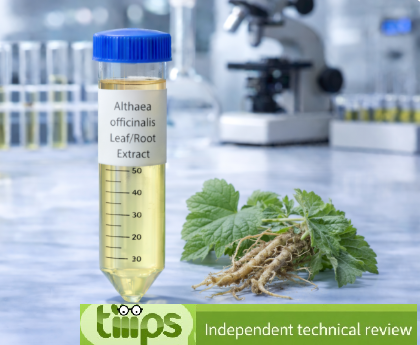
Althaea officinalis Leaf/Root Extract is the extract obtained by drying the leaves and root of Marshmallow (Althaea officinalis L.) is one of the most important medicinal plants of the Malvaceae family, whose roots, leaves and flowers are usually used in traditional medicine in many countries around the world.
Cosmetics - INCI Functions
Skin conditioning agent - Emollient. Emollients have the characteristic of enhancing the skin barrier through a source of exogenous lipids that adhere to the skin, improving barrier properties by filling gaps in intercorneocyte clusters to improve hydration while protecting against inflammation. In practice, they have the ability to create a barrier that prevents transepidermal water loss. Emollients are described as degreasing or refreshing additives that improve the lipid content of the upper layers of the skin by preventing degreasing and drying of the skin. The problem with emollients is that many have a strong lipophilic character and are identified as occlusive ingredients; they are oily and fatty materials that remain on the skin surface and reduce transepidermal water loss. In cosmetics, emollients and moisturisers are often considered synonymous with humectants and occlusives.
CAS 73049-65-7
EC 277-254-6
Studies
This plant has been used in traditional medicine to treat inflammatory reactions of the respiratory system and irritant cough and to resolve inflammation, including inflammation of the oral tissue and gingival abscesses (1).
Contains peptins, starch, monosaccharides, disaccharides, mucilages, flavonoids, antioxidants, coumarin, scopoletin, tannin, asparagus and many amino acids. The extracts obtained from the roots and flowers are antibacterial (Gram-positive and Gram-negative bacteria), antifungal, anti-inflammatory, anti-mycobacterial and anti-cough (2).
Other uses
In eastern countries it is used as an infusion to make tea.
For more:
Althaea officinalis studies
Typical commercial product characteristics Althaea Officinalis Root extract
| Appearance | Brown Yellow Powder |
Particle Size
| ≥95% pass 80 mesh |
Loss on Drying
| ≤5.0% |
| Ash | ≤5.0% |
Heavy Metals
| ≤10.0ppm |
| Lead | ≤2.0ppm |
| Arsenic | ≤2.0ppm |
| Mercury | ≤0.1ppm |
| Cadmium | ≤1.0ppm |
Yeast & Mold
| ≤100cfu/g |
Microbiological Test
| ≤1,000cfu/g |
References_______________________________________________
(1) Gautam, Shiv & , Navneet & Kumar, Sanjay & Chauhan, Antimicrobial efficacy of Althaea officinalis Linn. seed extracts and essential oil against respiratory tract pathogens. Reshu. (2015). Journal of Applied Pharmaceutical Science. 5. 115-119. 10.7324/JAPS.2015.50921.
Abstract. In present study, Althaea officinalis seed extracts and essential oil were screened for antimicrobial activity against five bacteria and one fungi responsible for dominant, lethal or opportunistic infection of respiratory regions. The maximum inhibition was noted by essential oil against Streptococcus pyogenes (21.3±0.28 mm) and Haemophilus influenzae (19.0±0.50 mm) at 200 mg/ml. The minimum inhibitory concentration values for methanol extract was 3.12-12.5 mg/ml. The antifungal activity noted highest with 41.28% by essential oil and 36.27% inhibition by aqueous extract represented by dosage-response curve.
(2) Banaee M, Soleimany V, Nematdoost Haghi B. Therapeutic effects of marshmallow (Althaea officinalis L.) extract on plasma biochemical parameters of common carp infected with Aeromonas hydrophila. Vet Res Forum. 2017 Spring;8(2):145-153.
Abstract. This study evaluated preclinical and clinical safety of marshmallow (Althaea officinalis L.) extract as a naturopathic medicine in common carp deliberately infected with Aeromonas hydrophila. The fish were fed 0 (control), 2.50, 5.00 and 10.00 g of marshmallow extract for 60 days in a preclinical experiment and then, challenged with A. hydrophila for a 10-day experiment. Significant increases were observed in aspartate aminotransferase (AST), lactate dehydrogenase (LDH), alkaline phosphatase (ALP), creatine phosphokinase (CPK) activities and plasma creatinine levels in fish fed 10 g marshmallow extract per kg feed. However, alanine aminotransferase (ALT) significantly decreased on day 60. The fish fed 2.50 g marshmallow extract per kg feed indicated increased levels of total protein and globulin. There were no significant changes in albumin levels (p > 0.05). 2.50 and 5.00 g marshmallow significantly decreased triglyceride and cholesterol levels and increased glucose levels (p < 0.05). A. hydrophila significantly increased AST, ALT, LDH, ALP and CPK activities and plasma glucose, cholesterol, triglycerides and creatinine levels after 10 days (p < 0.05). Total plasma protein, albumin and globulin levels in fish challenged with A. hydrophila were significantly lower than the control group (p < 0.05). Marshmallow extract at 5.00 and 10.00 g can adjust plasma biochemical parameters in fish challenged with A. hydrophila. The results of preclinical studies and pharmaceutical toxicity of marshmallow extract revealed that dietary levels lower than 5.00 g were safe and effective. The results of this clinical study demonstrated that marshmallow extract (5.00 g kg-1 feed) can protect fish against A. hydrophila.
Mehreen A, Waheed M, Liaqat I, Arshad N. Phytochemical, Antimicrobial, and Toxicological Evaluation of Traditional Herbs Used to Treat Sore Throat. Biomed Res Int. 2016;2016:8503426. doi: 10.1155/2016/8503426.
Abstract. The in vitro antibacterial activities of 29 traditional medicinal plants used in respiratory ailments were assessed on multidrug resistant Gram-positive and Gram-negative bacteria isolated from the sore throat patients and two reference strains. The methanolic, n-hexane, and aqueous extracts were screened by the agar well diffusion assay. Bioactive fractions of effective extracts were identified on TLC coupled with bioautography, while their toxicity was determined using haemolytic assay against human erythrocytes. Qualitative and quantitative phytochemical analysis of effective extracts was also performed. Methanolic extract of 18 plants showed antimicrobial activity against test strains. Adhatoda vasica (ZI = 17-21 mm, MIC: 7.12-62.5 μg/mL), Althaea officinalis (ZI = 16-20 mm, MIC: 15.62-31.25 μg/mL), Cordia latifolia (ZI = 16-20 mm, MIC: 12.62-62.5 μg/mL), Origanum vulgare (ZI = 20-22 mm, MIC: 3-15.62 μg/mL), Thymus vulgaris (ZI = 21-25 mm, MIC: 7.81-31.25 μg/mL), and Ziziphus jujuba (ZI = 14-20 mm, MIC: 7.81-31.25 μg/mL) showed significant antibacterial activity. Alkaloid fractions of Adhatoda vasica, Cordia latifolia, and Origanum vulgare and flavonoid fraction of the Althaea officinalis, Origanum vulgare, Thymus Vulgaris, and Ziziphus jujuba exhibited antimicrobial activity. Effective plant extracts show 0.93-0.7% erythrocyte haemolysis. The results obtained from this study provide a scientific rationale for the traditional use of these herbs and laid the basis for future studies to explore novel antimicrobial compounds.




