



Citrus limon peel oil: properties, uses, pros, cons, safety
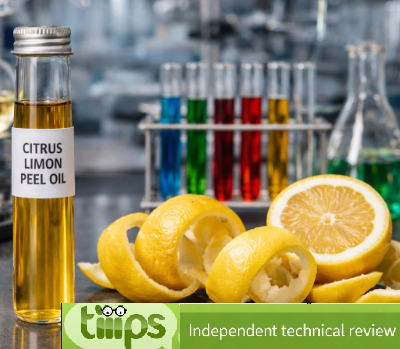
Citrus limon peel oil is the volatile oil obtained from lemon peel (Citrus limon, family Rutaceae). It is an aroma-functional raw material used mainly in cosmetics as a fragrance ingredient and for sensory support, with a composition dominated by monoterpenes and a smaller fraction of oxygenated constituents and “heavier” fractions that can influence stability and safety profile.
Definition
Citrus limon peel oil is a plant-derived ingredient consisting of a complex mixture of lipophilic compounds. Its behavior in formulation is driven by three practical factors: natural variability (origin, cultivar, batch), oxidative chemistry (formation of peroxides and oxidation products), and the possible presence of traces of photosensitizing compounds in certain qualities, with implications for leave-on use and sun exposure.
Use areas, in brief: Food use is possible as a flavor in specific contexts, but management is typically under “flavour” specifications rather than cosmetic; Cosmetics is the primary use; Medicine and pharmaceutical are not as general active ingredients, but may appear as odor components or, in selected contexts, as part of non-pharmacological topical products; Industrial use is mainly in perfumery, detergency, and fragranced products.
Main uses
Food.
It may be used as a flavor, but correct handling is governed by food-flavor regulations and specifications. In this report, use is addressed primarily from a cosmetic standpoint. Serving note: Not applicable in this cosmetic context. Safety: Possible reactions in individuals sensitive to terpene components and fragrance allergens. Storage and shelf-life: Critical to prevent oxidation. Labelling: Depends on the relevant “flavour” framework and purity specifications. Troubleshooting: Oxidation and drift of the aromatic profile are the most common issues.
Cosmetics.
Used as a fragrance and sensory component in cleansers, serums, creams, and body products, often at low percentages, with particular attention to leave-on products exposed to sunlight. Actual use is guided by quality, grade (for example, “deterpenated” or “folded” in commercial terminology), and fragrance objective.
INCI functions
Perfuming. Unlike fragrance, which can also contain slightly less pleasant or characteristic odours, the term perfume indicates only very pleasant fragrances. Used for perfumes and aromatic raw materials.
Skin conditioning agent. It is the mainstay of topical skin treatment as it has the function of restoring, increasing or improving skin tolerance to external factors, including melanocyte tolerance. The most important function of the conditioning agent is to prevent skin dehydration, but the subject is rather complex and involves emollients and humectants that can be added in the formulation.
Perfuming. Unlike fragrance, which can also contain slightly less pleasant or characteristic odours, the term perfume indicates only very pleasant fragrances. Used for perfumes and aromatic raw materials.
Industrial use.
Widely used in perfumery, detergency, and technical fragrances, with oxidative stability requirements and peroxide control often stricter than in “artisan” use.
Nutritional use note and bioactive compounds
In cosmetics, relevance is not nutritional. From a compositional standpoint, Citrus limon peel oil typically contains limonene as the dominant constituent, with variable contributions of β-pinene, γ-terpinene, citral (a mixture of neral and geranial), linalool, and traces of other terpenes and oxygenated compounds. The minor constituents can influence odor, stability, and skin tolerability, especially as the oil ages and oxidizes.
Identification data and specifications
INCI name: Citrus limon peel oil
Common name: lemon peel essential oil
Botanical family: Rutaceae
CAS number: Commonly reported as 84929-31-7 and 8008-56-8, with possible variants depending on grade and reference registry
EC/EINECS number: Commonly reported as 284-515-8 (for certain ECHA/CosIng registrations)
Technical note: For complex natural ingredients, multiple identifiers may coexist depending on standards, identification methods, and registries.
Physico-chemical properties (indicative)
| Characteristic | Value | Note |
|---|---|---|
| Physical state | Liquid | Typical appearance from pale yellow to yellow-green |
| Odor | Citrusy, fresh | Profile depends on batch and oxidation |
| Density (20 °C) | ~0.844–0.854 g/ml | Typical range from commercial technical data |
| Refractive index (20 °C) | ~1.458–1.479 | Identity and batch-control parameter |
| Optical rotation | ~+59 to +70° | Useful for authenticity and consistency |
| Water solubility | Practically insoluble | Soluble in oils and suitable organic solvents |
| Oxidative stability | Sensitive to oxygen and light | Peroxide increase and odor drift over time |
Functional role and practical mechanism of action
In formulations, Citrus limon peel oil acts primarily as a fragrance and sensorial modulator. The perceived effect depends on the volatility of monoterpenes (initial impact) and the less volatile fraction (persistence and “body” of the fragrance). From a safety standpoint, the most relevant phenomena involve oxidation (increasing sensitizing species) and potential photoreactivity for certain peel-derived qualities, managed through use limits and grade selection.
Formulation compatibility
Citrus limon peel oil is generally compatible with anhydrous systems and many O/W emulsions, but issues can arise if volatility and oxidation are not correctly managed. In emulsions, compatibility depends on the solubilizing system and surfactant structure: haze, loss of clarity, or olfactory instability can occur if the oil migrates or interacts with oxidation-prone actives. In detergency, incorporation can be easier due to solubilizers and surfactants, but “fragrance note drift” over time still requires control.
In practice, the most informative tests are: accelerated heat stability, heat/cold cycles, light exposure in real packaging, and peroxide/odor monitoring to confirm sensory shelf-life.
Use guidelines (indicative)
Use should be set based on product type (rinse-off vs leave-on), application area, sun-exposure profile, and oil quality. For leave-on products intended for photo-exposed areas, it is prudent to select grades with controlled photoreactive fractions and to follow industry standards for phototoxic substances. Managing fragrance allergens is a labelling and safety assessment constraint for the finished product, especially for limonene, linalool, and citral, depending on applicable requirements in the target market.
Quality, grades, and specifications
Key quality aspects are: authenticity (consistency of density, refractive index, optical rotation), composition (indicative GC profile), and oxidative stability (peroxides). Grade selection can materially change behavior in formula: some grades are oriented to perfumery, others to detergency, and others to more sensitive leave-on uses where phototoxicity management is critical. Natural variability supports batch-to-batch controls when the oil is a signature part of the finished product’s fragrance profile.
Safety, regulatory, and environment
From a safety perspective, the two most practical cosmetic risks are sensitization and potential phototoxicity for certain grades, especially when applied to skin exposed to UV light. Sensitization is often associated with oxidation products (peroxides), which is why storage and quality control directly affect tolerability.
From a regulatory standpoint, management typically includes: finished-product safety assessment, control and declaration of fragrance allergens per applicable requirements, and adherence to industry standards for phototoxic ingredients. Operationally, alignment between supplier specifications, intended use, and claims is decisive to minimize technical issues and non-compliance risk.
Formulation troubleshooting
Odor drift over time.
Common cause: oxidation and peroxide increase, often accelerated by light and oxygen headspace. Recommended action: higher-barrier packaging, reduced light exposure, peroxide control at intake, and defined sensory shelf-life management.
Loss of clarity in clear systems.
Common cause: insufficient solubilization or changes in surfactant/solubilizer balance. Recommended action: retune solubilizers, verify processing temperature, and evaluate a more suitable grade.
Conclusion
Citrus limon peel oil is a plant-derived fragrance ingredient with strong sensorial impact and technical sensitivities linked to natural variability and oxidation. In cosmetics, formulation success depends on: grade selection, robust quality control (including identity parameters and oxidative stability), fragrance-allergen management, and careful leave-on use design in relation to sun exposure. A targeted stability strategy and solid supplier qualification materially reduce the risk of olfactory drift and tolerability complaints.
Mini-glossary
Fragrance allergens: odor components that can contribute to sensitization and, in some markets, require label declaration above specific thresholds.
Deterpenated/folded: commercial terms indicating oils with terpene fractions partially removed or concentrated, affecting fragrance profile and stability.
Phototoxicity: a skin reaction induced by certain substances after UV exposure.
Peroxides: oxidation products indicating degradation that can increase sensitization risk.
Solubilization: the process by which a surfactant phase or solubilizer incorporates an oil into an aqueous system without haze.
Studies
The chemical composition of the lemon includes mainly citric acid and limonene. Citric acid in lemon juice is useful in the medical management of calcium urolithiasis.
Lemon juice contains flavonoids, which are extremely useful components for the immune defense of the human body and therefore to combat degenerative diseases such as cancer. In particular, Rutin, Quercetin, Neoeriocitrin (1).
It also contains a large amount of vitamin C, one of the most important antioxidants found in nature and an element of contrast to free radicals that are the cause of aging and many diseases related to the oxidation process of cells. However, the fruit that contains the highest amount of vitamin C is the kiwi.
A lemon juice, you know is a remedy against colds and flu and cooling diseases.
It also acts as a protector against rheumatoid arthritis.
Thin-skinned lemons are preferable as they have more juice.
The lemon have been recognized by scientific studies antimicrobial activity both in the form of nanoemulsions in essential oil and in the form of pure essential oil juice (2).
Among the various phenolic components present in lemon peel, Eriocitrin, for its anti-aging properties, has been the subject of specific studies in rats (3).
Lemon extract has also demonstrated antimicrobial activity against bacteria such as Pseudomonas aeruginosa and Klebsiella pneumoniae (4).
Lemon essential oil is used in food, cosmetics and pharmaceuticals for its antimicrobial and antioxidant activities. The aqueous phase of this oil is extracted by various chemical processes, e.g. with dichloromethane, dried with anhydrous sodium sulphate and the solvent is subsequently removed by low-pressure distillation. Cold pressing is generally used. In European Pharmacopoeia 10.0 (PhEur, 2020) it is defined as the essential oil obtained by a suitable mechanical procedure without heating from the fresh peel of Citrus limon (L.).
The most relevant studies on this ingredient have been selected with a summary of their contents:

