



CI 77499: properties, uses, INCI functions, safety, alternatives
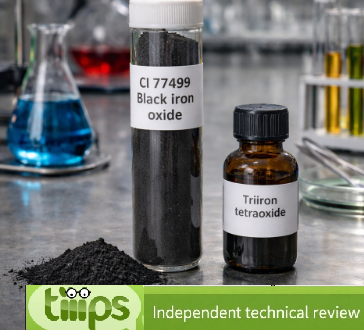
Black iron oxide – triiron tetraoxide (predominantly Fe₃O₄, magnetite)
Synonyms: black iron oxide, Pigment Black 11, E172 (food colorant; purity requirements are often used as a reference for cosmetic grades as well)
INCI / functions: colorant
Definition
CI 77499 is an inorganic pigment based on iron oxides, used mainly as a colorant in cosmetic formulations (make-up, colored products for face/eyes/lips, and sometimes hair cosmetics). From a compositional standpoint, it is primarily associated with ferrous–ferric oxide (triiron tetraoxide, Fe₃O₄). In regulatory and database contexts, the “CI 77499” entry may be linked to multiple CAS/EC identifiers associated with iron oxides/related forms, depending on the registered substance definition and the commercial grade. In formulation, its technical value comes from stability (light/heat), inertness, and the ability to modulate depth and “blackness” in pigment blends.
Main uses
Food: as E172 (iron oxides and hydroxides), where applicable by category.
Cosmetics: colorant (ref. Annex IV, dedicated entry), especially in make-up and decorative products.
Restricted cosmetic ingredient as IV/137 a Relevant Item in the Annexes of the European Cosmetics Regulation 1223/2009. Substance or ingredient reported:
Iron Oxide Black. Wording of conditions of use and warnings: Purity criteria as set out in Commission Directive 95/45/EC (E172)
INCI Functions
Colorant. This ingredient has the function of colouring the solution in which it is inserted in a temporary, semi-permanent or permanent manner, either alone or in the presence of the complementary components added for colouring.
CI 77499 is used in cosmetic products such as eyeliners, mascaras, eyeshadows, and foundations due to its intense black color and high opacity. It provides long-lasting color.
Medicine: not a standard “ingredient” use; any use is dossier-specific.
Pharmaceutical: potential technical use as a colorant pigment/excipient in specific cases (specification- and authorization-dependent).
Industrial use: pigment for coloration and technical applications (coatings, plastics, etc.).
Identification data and specifications
| Identifier | Value |
|---|---|
| Cosmetic name (CI) | CI 77499 |
| Class | inorganic pigment (iron oxides) |
| Reference formula (main component) | Fe₃O₄ |
| Color Index | Pigment Black 11 |
| EU cosmetics regulatory reference | Annex IV / 137 (permitted colorants) |
| Register | Data frequently associated with CI 77499 | Technical note |
|---|---|---|
| CAS/EC (recurring references) | CAS 1317-61-9; EC 215-277-5 / EC 235-442-5 | databases may show more than one number linked to iron oxides/related forms within the “iron oxides” family |
Key constituents
| Fraction | Typical components | Technical note |
|---|---|---|
| Main pigment | ferrous–ferric oxide (Fe₃O₄) | responsible for the black tone and stability |
| Secondary fractions (grade-dependent) | related oxides within the “iron oxides” family | depends on process, purity, and supplier specification |
| Controlled traces/impurities | trace metals and insolubles | relevant for cosmetic compliance and quality (CoA) |
Functional role and expected performance
| Function | What it does in the formula | Operational note |
|---|---|---|
| Colorant | provides black color / increases chromatic depth | often used in blends with CI 77491/CI 77492 for skin tones |
| Stability | good resistance to light and heat | performance depends on dispersion and grade |
| Coverage/optical effect | tunable via particle size and vehicle | monitor rheology and wetting behavior |
Use guidelines (indicative)
| Application | Typical range | Technical note |
|---|---|---|
| Foundations, concealers, BB/CC | 0.1–3.0% | frequently used in blends with other iron oxides |
| Mascara, eyeliner, eyeshadows | 1.0–15.0% | depends on coverage and system (anhydrous/emulsion) |
| Lipsticks and lip products | 0.05–2.0% | verify sensoriality and color homogeneity |
| Tinted skincare | 0.05–1.0% | control stability and color uniformity |
Formulation compatibility
CI 77499 is generally compatible with most cosmetic systems, but success is dominated by dispersion: pigment wetting, dispersant selection (if used), and shear management. In O/W emulsions and cream systems, incorporation is typically via pre-dispersion in the oil phase or dedicated carriers; in anhydrous systems (sticks, lipsticks), proper deagglomeration is critical to prevent speckling and non-uniformity.
In systems with electrolytes or specific polymers, the pigment can affect rheology (increased apparent viscosity, yield stress) and suspension stability. In very fluid “clean look” products, sedimentation tendency may increase and is addressed with structurants, rheology modifiers, and particle-size distribution optimization. If the grade is supplied in nano form, EU compliance and nanomaterial labeling obligations apply (case-by-case, based on regulatory definition and supplier documentation).
Quality, grades and specifications
| QC parameter | What to control |
|---|---|
| Identity and compliance | CI 77499; alignment with Annex IV and documentation (SDS/CoA) |
| Purity and trace metals | stringent limits for metallic contaminants (technically unavoidable traces, but controlled) |
| Particle size / physical form | impacts dispersion, coverage, gloss, and stability |
| Insolubles and microbial load | especially for treated/surface-coated or predispersed grades |
| “E172 compliance” (if declared by supplier) | useful as a purity/specification reference where applicable |
Safety, regulatory and environment
CI 77499 is a permitted cosmetic colorant in the European Union via inclusion in Annex IV (dedicated entry). Operationally, safety is assessed on the finished product (use scenario, application area, population, impurity profile). For inorganic pigments, key technical points are: control of impurities (trace metals), management of dust in production (respiratory protection for operators), and confirmation of documentary compliance for the selected grade. Environmentally, as a mineral pigment, impacts relate mainly to dust and industrial effluent handling; use in finished products typically results in low direct emissions, while responsible management is primarily a supply-chain and process-wastewater topic under local regulations.
Formulation troubleshooting
| Issue | Likely cause | Recommended action |
|---|---|---|
| Speckling | unbroken agglomerates, insufficient dispersion | increase shear, use predispersions or suitable dispersants, optimize addition sequence |
| Tone shift / “greying” | suboptimal pigment ratio, low coverage | rebalance blend (CI 77491/77492/77499), improve wetting and uniformity |
| Sedimentation in low-viscosity systems | insufficient rheological structure | add structurants, increase yield stress, evaluate surface-treated grades |
| Viscosity instability | interactions with polymers/electrolytes, high solids load | optimize rheology system and pigment load, run thermal and centrifuge tests |
| Low black intensity | unsuitable particle size/distribution, non-uniform film | select a more performant grade, improve dispersion and wetting |
Conclusion
CI 77499 is an inorganic pigment (black iron oxide, mainly Fe₃O₄) used as a cosmetic colorant due to stability and reliable performance. Final quality depends primarily on the grade (purity, particle size) and dispersion (wetting, deagglomeration, rheology), as well as control of impurities and regulatory compliance (Annex IV, entry 137).
Studies
Ultraviolet rays from the sun cause skin aging and smartphones emit high-energy visible light from which you should protect yourself. Iron oxides (yellow, red and black) in sunscreens have the property of effectively blocking high-energy visible light especially when combined with zinc oxide (1).
CI 77492 is generally considered safe for use in consumer products when handled according to proper safety procedures. It is important to avoid inhalation of the powder and minimize direct contact with skin and eyes (1).
Ultraviolet rays from the sun cause skin aging and smartphones emit high-energy visible light from which you should protect yourself. Iron oxides (yellow, red and black) in sunscreens have the property of effectively blocking high-energy visible light especially when combined with zinc oxide (1).
As regards food safety, being an additive also added in fruits and vegetables, for these foods a maximum permissible level of 6 milligrams per kilo body and the formula "enough" in 48 categories of food (Regulation (EC) No 1333/2008). Within these categories of foods, iron oxides and hydroxides are allowed in liquid food supplements, food supplements in syrup, in solid form, including capsules and tablets and similar forms, excluding chewable. However, EFSA recommends further scientific analysis (3).
Makeup cosmetics such as eye cosmetics that contain a high percentage of black iron oxide should be removed before MRI examination.(4)
- Molecular Formula : Fe2O3 Fe2H6O3
- Molecular Weight : 159,69 g/mol
- CAS : 1309-37-1 1332-37-2
- UNII
- EC Number: 215-168-2
- DSSTox Substance ID:
- MDL number
- MFCD00011008
- PubChem Substance ID 329753614
- InChI=1S/2Fe.3H2O/h;;3*1H2
- InChl Key YOBAEOGBNPPUQV-UHFFFAOYSA-N
- SMILES O.O.O.[Fe].[Fe]
- IUPAC iron;trihydrate
- ChEBI
Synonyms:
- Iron Oxide Black
- Pigment Black 11
- Black Iron Oxide
- CI77499
- E172 (i)
- Ferric oxide

