



Allergens
(Management, labeling, control, and prevention in the food sector)
Description
• Food allergens are components (usually proteins or protein fragments) that can trigger an immune response—often IgE-mediated (immunoglobulin E; immediate-type allergy)—in sensitized individuals, with effects ranging from mild symptoms to potentially fatal anaphylaxis.
• They differ from intolerance (e.g., lactose due to lactase deficiency) and from autoimmune conditions such as celiac disease (gluten), which are not IgE-mediated but demand the same rigor in management.
Regulatory framework (EU, operational summary)
• Regulation (EU) 1169/2011: mandatory labeling and clear emphasis of allergens within the ingredient list; mandatory information also for non-prepacked foods (foodservice, loose sale).
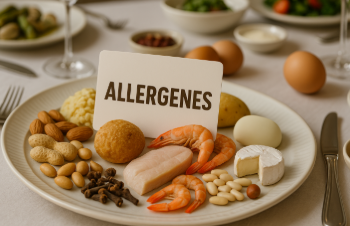
• Annex II (EU list of 14 major allergens):
Cereals containing gluten (wheat, rye, barley, oats, spelt, kamut) and their products;
Crustaceans; 3) Eggs; 4) Fish; 5) Peanuts; 6) Soybeans; 7) Milk (including lactose); 8) Tree nuts (almonds, hazelnuts, walnuts, cashews, pecans, Brazil nuts, pistachios, macadamia/Queensland nuts);
Celery; 10) Mustard; 11) Sesame seeds; 12) Sulphur dioxide and sulphites >10 mg/kg or L as SO₂; 13) Lupin; 14) Molluscs.
• Specific exemptions exist for some highly refined derivatives (e.g., certain wheat glucose syrups, highly refined soybean oil, fish gelatin as a vitamin carrier), where provided.
• “Gluten-free”: < 20 mg/kg; “very low gluten”: 20–100 mg/kg.
• PAL (Precautionary Allergen Labeling) such as “may contain …” should be used only after a documented risk assessment (e.g., VITAL approach with ED01/ED05 reference doses).
Allergy vs intolerance: key distinctions
• IgE-mediated allergy: rapid onset (minutes to hours), urticaria, angioedema, bronchospasm, anaphylaxis; emergency treatment with epinephrine.
• Non-IgE allergies (cell-mediated): delayed onset; gastrointestinal/dermatologic symptoms.
• Intolerances: non-immune mechanisms (e.g., enzyme deficits); often dose-dependent and with higher thresholds.
• Celiac disease: autoimmune reaction to gluten (gliadin peptides); managed via dietary exclusion and strict cross-contact control.
In-plant management (Allergen Management Plan)
• Mapping of allergens at site, line, recipe level and of personnel/material flows; risk assessment ingredient → process → product integrated into HACCP/GMP (first mention: HACCP = hazard analysis and critical control points; GMP = good manufacturing practices).
• Sourcing: supplier qualification, specifications with explicit allergen declaration, and control of derivatives (e.g., caseinates, whey proteins, soy lecithin, soy/wheat HVP, tahini).
• Design & segregation: dedicated storage, closed bins, color coding, dedicated tools, physical barriers where feasible.
• Production sequencing: schedule allergen-free first, with-allergen later; confine rework to the same allergen family.
• Sanitation & validation: validated cleaning procedures; verification via rapid protein or ELISA swabs; periodic re-validation and whenever changes occur.
• Training: staff awareness on identification, handling, hand/garment hygiene, and cross-contact prevention; control of PPE and flows.
• Documentation: integrated HACCP, CAPA, lot traceability, non-conformance handling and recall readiness.
Analytical methods (pros and cons)
• ELISA: allergen-specific proteins; excellent for cleaning verification; watch for matrix effects and denatured proteins.
• PCR: detects allergen DNA (useful for species ID); does not directly measure allergenic proteins.
• LC–MS/MS: targeted peptide markers; high specificity and multi-allergen capability; requires robust validation.
• Lateral flow (rapid tests): in-line screening; confirm with quantitative methods.
• Critical aspects: LOD/LOQ (limits), sample homogeneity, matrix effects, recovery, and reference materials.
Labeling
• Emphasize allergens within the ingredient list (bold, small caps, or color) consistently.
• Use ingredient names that clearly identify the allergen (e.g., “milk” rather than only “caseinate”).
• Apply PAL (“may contain …”) only if residual risk remains after all reasonable controls; define action levels (e.g., VITAL) and retain evidence.
• For foodservice and loose sale, ensure accessible information (allergen register, labels, digital menus).
Foodservice and retail
• Dedicated/prepared areas, separate utensils/tongs, glove changes between tasks, and fryer oil management (do not share oils to avoid transfer of gluten/fish/milk, etc.).
• “Free-from” preparations on freshly cleaned and sanitized surfaces; use covers and closed containers.
• Ongoing front-of-house training to capture customer information and communicate accurately with the kitchen.
Practical examples of “indicator” ingredients
• Milk: milk powder, whey, caseinates, lactose, clarified butter (ghee), dairy flavors.
• Egg: albumen/yolk, lecithovitellin, albumin, lysozyme (also as preservative).
• Soy: flour/tofu/tempeh, lecithin (E322), hydrolyzed vegetable protein (HVP), flavors.
• Gluten: semolina/flour, malt extract, breadcrumbs, thickened sauces.
• Tree nuts: pastes/creams/pralines, nut flours, gianduja, minimally refined nut oils.
• Sesame: tahini, bread/snack toppings.
• Sulphites: dried fruit, wine, vinegars, vegetable preserves.
• Fish: isinglass/fish gelatin (exempt in some uses), fermented fish sauces.
Consumer communication and health
• Allergic consumers must always read labels and ask in restaurants; carry their emergency plan and, if prescribed, an epinephrine auto-injector.
• “Free-from” products require rigorous cross-contact control and periodic analytical verification.
• Processing (cooking, fermentation) does not guarantee allergen inactivation; in some cases heat may increase allergenicity (e.g., roasted peanut).
Quality and specifications (typical contract topics)
• Absolute allergen disclosure for all ingredients and processing aids; analytical limits/targets for critical allergens.
• Validated cleaning plans and verification testing (rapid ELISA/total protein).
• Release criteria: approved label, claim coherence checks (e.g., “gluten-free”), production records and test results attached.
• Traceability for ingredients/packaging; tested withdrawal/recall plan.
Sustainability and supply chain
• Reduce waste by avoiding scrappage from mislabeling or accidental contamination (design for allergen control).
• Training lowers errors and recalls; optimized cleaning procedures and media cut BOD/COD (biochemical/chemical oxygen demand) in effluents.
• Efficient water/energy use and recyclable mono-material packaging support ESG goals.
Conclusion
Allergen management is a cross-functional process spanning formulation, procurement, production, sanitation, analysis, and labeling. A structured plan (HACCP extended to allergens), correct PAL usage, continuous training, and transparent consumer communication significantly reduce clinical risk and industrial risk (recalls and reputational damage).
Mini-glossary
• IgE — Immunoglobulin E; antibodies involved in immediate-type allergic reactions.
• PAL — Precautionary Allergen Labeling; statements like “may contain …,” used only after a documented risk assessment.
• VITAL — Voluntary Incidental Trace Allergen Labelling; scheme using ED01/ED05 (exposure doses eliciting reactions in 1%/5% of allergic population) to set action levels.
• ED01/ED05 — Reference doses for risk management (1%/5% of sensitive consumers); support PAL decision-making.
• HACCP/GMP — Hazard Analysis and Critical Control Points / Good Manufacturing Practices; food-safety systems that must explicitly cover allergen risks.
• LOD/LOQ — Limit of detection/limit of quantification; key analytical performance parameters.
• LC–MS/MS — Liquid chromatography–tandem mass spectrometry; targeted peptide method for multi-allergen detection.
• BOD/COD — Biochemical/Chemical Oxygen Demand; indicators of organic load in wastewater—important when optimizing cleaning systems.
• QUID — Quantitative Ingredient Declaration; percentage declaration of certain ingredients on labels.

