



CI 77491: properties, uses, INCI functions, safety, alternatives
Red iron oxide – diiron trioxide (predominantly Fe₂O₃, iron(III) oxide)
Synonyms: red iron oxide, Pigment Red 101, E172 (food colorant: iron oxides and hydroxides; often used as a purity reference for cosmetic grades as well)
INCI / functions: colorant
Definition
CI 77491 is an inorganic pigment from the iron oxide family, used as a colorant in cosmetic formulations (make-up and tinted products). From a compositional standpoint, it is primarily associated with iron(III) oxide (Fe₂O₃), responsible for the characteristic brick-red hue and good stability to light and heat. In regulatory databases and technical documentation, the “CI 77491” entry may appear linked to more than one CAS/EC combination because some registries associate the CI denomination with multiple oxides/related forms within the same family, depending on grade and substance registration scope.
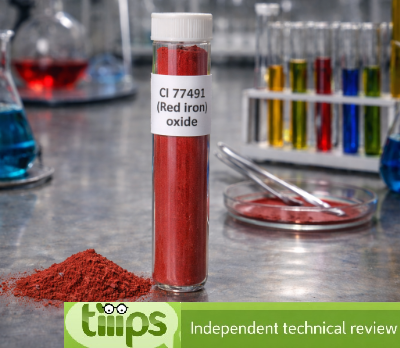
Main uses
Food: as E172 (where applicable by category and purity specification).
Cosmetics: colorant in make-up and decorative products; often blended with CI 77492 and CI 77499 for skin-tone tuning.
INCI Functions
- Colorant. This ingredient has the function of colouring the solution in which it is inserted in a temporary, semi-permanent or permanent manner, either alone or in the presence of the complementary components added for colouring.
Restricted cosmetic ingredient as IV/135 a Relevant Item in the Annexes of the European Cosmetics Regulation 1223/2009. Substance or ingredient reported: Iron Oxide red. Wording of conditions of use and warnings: Purity criteria as set out in Commission Directive 95/45/EC (E172)
CI 77491 is used in cosmetic products such as blushes, eyeshadows, lipsticks, and foundations due to its rich red color and high opacity.
Pharmaceutical: potential technical use as a colorant pigment/excipient in selected cases (specification/authorization-dependent).
Industrial Applications
Paints and Coatings: In the paint industry, iron oxide red is used to achieve deep red shades and enhance UV resistance. Its stability and strong tinting properties make it ideal for both decorative and protective coatings.
Plastics and Polymers: This pigment is employed in the production of plastics and polymers to improve color uniformity and opacity. It is commonly used in products like automotive parts, packaging materials, and consumer goods.
Ceramics and Glass: CI 77491 is used in the production of ceramics and glass to achieve stable red colors. It is particularly valued for its resistance to high-temperature processes.
Inks: The pigment is also used in printing inks to produce intense red colors, ensuring high-quality and durable prints.
Identification data and specifications
| Identifier | Value |
|---|---|
| Cosmetic name (CI) | CI 77491 |
| Class | inorganic pigment (iron oxides) |
| Reference formula (main component) | Fe₂O₃ |
| Color Index | Pigment Red 101 |
| EU cosmetics regulatory reference (CosIng) | Annex IV / 135 |
| Registry | Data frequently associated with CI 77491 | Technical note |
|---|---|---|
| CAS/EC (main substance) | CAS 1309-37-1; EC 215-168-2 | associated with diiron trioxide (Fe₂O₃) |
| CAS/EC (other database references) | multiple CAS/EC listings depending on database/grade | some databases link CI 77491 to several oxides/related forms within the “iron oxides” family |
Key constituents
| Fraction | Typical components | Technical note |
|---|---|---|
| Main pigment | iron(III) oxide (Fe₂O₃) | responsible for the red tone and stability |
| Secondary fractions (grade-dependent) | related oxides within the “iron oxides” family | depends on process, purity, and supplier specification |
| Controlled traces/impurities | trace metals and insolubles | critical for quality, compliance, and repeatability (CoA) |
Functional role and expected performance
| Function | What it does in the formula | Operational note |
|---|---|---|
| Colorant | provides red color / modulates warm tones | often blended with CI 77492/CI 77499 |
| Stability | high resistance to light and heat | depends on particle size and dispersion |
| Coverage/optical effect | adjustable via particle size and wetting | influences opacity, pay-off, and uniformity |
Use guidelines (indicative)
| Application | Typical range | Technical note |
|---|---|---|
| Foundations, concealers, BB/CC | 0.2–10.0% | frequently used in blends with other iron oxides |
| Blush, bronzer, contour | 0.1–8.0% | balance with yellow/black oxides for skin tones |
| Eyeshadows | 0.5–20.0% | depends on coverage and system (anhydrous/emulsion) |
| Lipsticks and lip products | 0.05–5.0% | verify sensoriality and homogeneity |
Formulation compatibility
CI 77491 is generally compatible with most cosmetic systems, but performance is strongly dependent on dispersion: pigment wetting, deagglomeration, and shear management. In anhydrous systems (sticks, lipsticks), breaking agglomerates is essential to prevent speckling and chromatic non-uniformity; in O/W emulsions and creams, a robust approach is pre-dispersion into the oil phase or the use of predispersions/pigment pastes, with rheology control to prevent sedimentation.
In systems containing polymers and/or electrolytes, pigment loading can alter rheology (apparent viscosity and yield stress). If the grade falls under the EU definition of a nanomaterial, specific compliance and labeling obligations apply; therefore, complete supplier documentation is critical (particle characterization and regulatory status).
Quality, grades and specifications
| QC topic | What to verify |
|---|---|
| Identity and compliance | CI 77491; alignment with Annex IV and documentation (SDS/CoA) |
| Purity and trace metals | limits for metallic contaminants (lot control) |
| Particle size / physical form | impacts coverage, gloss, drag, and stability |
| Surface treatment (if present) | wetting, compatibility with oils/polymers, long-term stability |
| “E172 compliance” (if declared) | useful as a purity/specification reference where applicable |
Safety, regulation and environment
CI 77491 is a permitted cosmetic colorant in the EU via inclusion in Annex IV (CosIng reference). Safety must be assessed on the finished product (use scenario, application area, population, impurity profile). Operationally, the most relevant factors are: control of impurities (trace metals), management of dust during manufacturing (operator protection), and confirmation of nano/non-nano status and full documentary compliance. Environmentally, as a mineral pigment, key impacts relate to dust and industrial effluent management along the supply chain under local regulations.
Formulation troubleshooting
| Issue | Likely cause | Recommended action |
|---|---|---|
| Speckling | agglomerates, insufficient shear | increase shear, use predispersions/suitable dispersants, optimize addition sequence |
| Non-uniform color / streaking | incomplete wetting, unbalanced rheology | improve wetting, retune viscosity/yield stress, consider surface-treated grades |
| Sedimentation (fluid systems) | insufficient rheological structure | add structurants, increase yield stress, reduce agglomerate size |
| Overly “brick” tone | blend not optimized | rebalance with CI 77492 and CI 77499, recalibrate pigment ratios |
| Viscosity instability | polymer/electrolyte interactions, high solids load | optimize rheology system and pigment load, run thermal and centrifuge tests |
Alternatives
| Option (INCI) | Product type | Key advantages |
|---|---|---|
| CI 75120 (Annatto) | Plant-derived colorant (annatto) | Warm orange-red, useful for coral/warm red shades; strong natural-origin positioning. Stability should be validated (light/pH). |
| CI 75125 (Lycopene) | Plant-derived carotenoid | Warm tomato-like red, useful in blends to tune shade; manage oxygen/light sensitivity. |
| Beta Vulgaris (Beet) Root Extract | Botanical tinting extract | Botanical red-purple tint for natural-positioned products. Typically more pH/light/heat sensitive. |
| Oxide-rich clays (e.g., red clay/kaolin) | Naturally occurring mineral pigment (clays) | Softer, matte terracotta/pink effect; strong naturalness perception and easy use in masks and powders (lower coverage than CI 77491). |
Conclusion
CI 77491 is a red iron oxide (predominantly Fe₂O₃) used as a cosmetic colorant due to stability and reliable performance. Perceived quality in formula depends mainly on grade (purity, particle size, potential surface treatment) and technically correct dispersion (wetting, deagglomeration, rheology), as well as control of impurities and full regulatory/documentary compliance.
Studies
CI 77491 is generally considered safe for use in consumer products when handled according to proper safety procedures. It is important to avoid inhalation of the powder and minimize direct contact with skin and eyes (1).
Ultraviolet rays from the sun cause skin aging and smartphones emit high-energy visible light from which you should protect yourself. Iron oxides (yellow, red and black) in sunscreens have the property of effectively blocking high-energy visible light especially when combined with zinc oxide (2).
"The Panel on Food Additives and Nutrient Sources added to Food provides a scientific opinion re‐evaluating the safety of iron oxides and hydroxides used as food additives (E 172): yellow iron oxide (FeO(OH)·H2O), red iron oxide (Fe2O3) and black iron oxide (FeO·Fe2O3). Brown Iron Oxide has been included in this assessment for completeness, due to its importance as a commercial blend. The Panel considered that the particle size and particle size distribution should be included in the specifications. In 1980, an ADI of 0‐0.5 mg/kg bw/day was established by JECFA. Absorption of iron from iron oxides is low. The acute oral toxicity of iron oxides is greater than 10 g iron oxide/kg bw. From a subacute and a subchronic toxicity study, the Panel identified a NOAEL for red iron oxide of 1 000 mg/kg bw/day, the highest dose tested. Red (Fe2O3) and black (FeO·Fe2O3) iron oxide, both in nano‐ and micro‐form, were positive in in vitro genotoxicity assays in mammalian cells. Due to the limitations of the database, and considering the impossibility to read‐across between iron oxides with different redox state, the Panel considered that the genotoxicity of iron oxides cannot be evaluated based on the available data. Concerning carcinogenicity and reproductive and developmental toxicity, no signs of toxicity were observed in unpublished studies which were not available and could not be evaluated by the Panel. The Panel concluded that an adequate assessment of the safety of E 172 could not be carried out because a sufficient biological and toxicological database was not available. Refined exposure estimates show that exposure to E 172 ranged from 0.03 mg/kg bw/day for infants to 3.7 mg/kg bw/day for toddlers at the mean and from 0.1 mg/kg bw/day for infants to 9.5 mg/kg bw/day for toddlers at the 95th percentile for the non‐brand‐loyal scenario" (3).
Molecular Formula : Fe2O3
Molecular Weight : 159,69
CAS : 1332-37-2
EC number 215-722-3 215-168-2 257-870-1
UNII 1K09F3G675
Synonyms:
Ferric Oxide Red
Pigment Brown 6
Pigment Brown 7

