Il Solfato di zinco è un composto chimico, un sale inorganico.
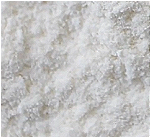
Si presenta in forma di polvere bianca solubile in acqua
Medicina
Il Solfato di zinco viene usato spesso in medicina per contrastare la mancanza dello zinco nell'organismo umano, come coadiuvante nella cura delle ustioni, ferite e dell'acne, verruche virali multiple recalcitranti, come alternativa a bassa tossicità e ben tollerata per la D-penicillamina.
Nell'artrite reumatoide grave e nella psoriasi la sua efficacia è messa in dubbio da studi scientifici (1) e può quindi essere considerato un efficace farmaco antireumatico di terza linea, come l'oro e la d-penicillamina (2).
Negli integratori alimentari, il solfato di zinco è utilizzato principalmente come fonte di zinco, un oligoelemento essenziale. Contribuisce alla normale funzione del sistema immunitario. Supporta la sintesi proteica e il metabolismo dei macronutrienti. È coinvolto nella protezione delle cellule dallo stress ossidativo. Favorisce il mantenimento di pelle, capelli e unghie normali. Partecipa ai processi di divisione cellulare. Contribuisce alla normale funzione cognitiva. Supporta la vista e il metabolismo della vitamina A. È importante per la fertilità e la riproduzione. Può contribuire al metabolismo dei carboidrati. Svolge un ruolo nella regolazione enzimatica. È una forma solubile e biodisponibile di zinco.
Sicurezza medica
il solfato di zinco è ben tollerato e gli effetti avversi hanno carattere di lievità (3).
Cosmetica
E' un ingrediente soggetto a restrizioni III/24 come Voce pertinente negli allegati del regolamento europeo sui cosmetici n. 1223/2009
Agente antimicrobico. Questo ingrediente è in grado di sopprimere o inibire la crescita e la replicazione di un ampio spettro di microrganismi come batteri, funghi e virus rendendo lo strato corneo temporaneamente battericida e fungicida.
Agente antiplacca. E' un ingrediente che ha la proprietà di prevenire l'insorgenza della carie contrastando i batteri responsabili della corrosione acida dei denti.
Astringente. Questo ingrediente esercita un effetto diretto sulla pelle restringendo i pori dilatati contraendo le cellule dello strato corneo e rimuovendo l'olio superfluo.
Agente per l'igiene orale. Questo ingrediente può essere inserito nella cavità orale di per migliorare e/o mantenerne l'igiene orale e la salute, per prevenire o migliorare un disturbo dei denti, gengive, mucosa.
Altri usi
Fertilizzante ad alta solvibilità per terreni trattati, ma se i terreni non sono trattati, può causare fino al 40% di perdita di rendimento (4).
Alimentazione animale.
E' utilizzato per aumentare la concentrazione di zinco in ortaggi.
Su questo composto chimico sono stati selezionati gli studi più rilevanti con una sintesi dei contenuti:
Solfato di zinco studi
- Formula molecolare O4SZn ZnSO4
- Peso molecolare 161.436 g/mol
- CAS 7446-19-7 (monohydrate) 7733-02-0 (heptahydrate) 7733-02-0 (anhydrous)
- UNII PTX099XSF1
- EC number 231-793-3
Synonyms:
- Zinc sulphate
- Bonazen
- Medizinc
- Optised
- Sulfuric acid, zinc salt (1:1)
Bibliografia_____________________________________________________________________
(1) Cimmino, M.A., Mazzucotelli, A., Rovetta, G., Bianchi, G. and Cutolo, M., 1984. The controversy over zinc sulphate efficacy in rheumatoid and psoriatic arthritis. Scandinavian journal of rheumatology, 13(2), pp.191-192.
(2) Rasker, J.J. and Kardaun, S.H., 1982. Lack of beneficial effect of zinc sulphate in rheumatoid arthritis. Scandinavian journal of rheumatology, 11(3), pp.168-170.
Abstract. Twenty-two patients with severe long-standing rheumatoid arthritis were treated with oral zinc sulphate in a prospective long-term open trial. Six patients had (only subjective) improvement during the first 6 months of treatment, but all deteriorated subsequently. The remaining 16 deteriorated or did not improve and these patients expressed a wish to stop taking the drug after a mean period of 5 months. In the whole group of 22 patients, neither the number of affected joints, the ARA grading, nor functional classification changed significantly, nor did ESR, haemoglobin, haematocrit, or platelet count. The unpleasant taste and nausea caused by zinc sulphate was the main side effect. Our study confirms that ZnSO4 has no long-lasting beneficial effect for patients severely affected with rheumatoid arthritis.
(3) Kurugöl, Z., Akilli, M., Bayram, N. and Koturoglu, G., 2006. The prophylactic and therapeutic effectiveness of zinc sulphate on common cold in children. Acta Paediatrica, 95(10), pp.1175-1181.
Abstract. Aim: To determine the efficacy of prophylactic administration of zinc sulphate in reducing the occurrence of the common cold in children, and to evaluate the efficacy of zinc sulphate in reducing the duration and severity of cold symptoms. Methods: A total of 200 healthy children were randomly assigned to receive oral zinc sulphate (zinc group, n=100) or placebo (placebo group, n=100). Zinc sulphate (15 mg of zinc) or placebo syrup were administered for prophylaxis once daily during a 7-mo study period. The dose was increased to two times per day (30 mg of zinc) at the onset of cold, until symptoms resolved. Results: The mean number of colds in the zinc group was significantly less than in the placebo group (1.2 vs 1.7 colds per child; p=0.003). The mean cold-related school absence was 0.9 d per child in the zinc group versus 1.3 d in the placebo group (p=0.04). Compared to the placebo group, the zinc group had shorter mean duration of cold symptoms and decreased total severity scores for cold symptoms (p<0.0001). Adverse effects were mild and similar in both groups. Conclusion: Zinc sulphate appears to be an easily administered, safe and well-tolerated alternative for the prevention and treatment of the common cold in children.
(4) Vadlamudi, K., Upadhyay, H., Singh, A. and Reddy, M., 2020. Influence of zinc application in plant growth: an overview. Eur. J. Mol. Clin. Med, 7, pp.2321-2327.
Abstract. Although zinc is considered as micronutrient it has a vital role in plant growth. Among all metals, the largest number of proteins required zinc for their catalytic function. Zinc-binding proteins make up nearly 10% of all protein in biological systems. Zinc plays a vital role in biological systems like structural integrity of membrane and contribution to protein synthesis also gene expression. According to FAO that zinc is considered as most commonly deficient in agriculture soils about 50%. Sometimes add more phosphorus may lead to the deficient of zinc in the soil for some reason. In plants zinc deficient can be noticed by the leaf chlorosis, necrotic spots on leaves, bronzing of leaves, resetting of leaves, stunting of plants, dwarf leaves, malformed leaves. Zinc deficient soil can as treat well in many ways and the most used method is the application of zinc-containing fertilizers. Zinc sulphate is a widely used fertilizer. If soils are untreated it may cause up to 40% yield loss without the appearance of distinct leaf symptoms. One percent zinc-containing NPK and urea fertilizer are available in many countries. Zinc also is used as seed treatment instead of the application of fertilizer and root dipping or transplant seedlings. Thus, zinc is considered an important micronutrient for plant growth.




