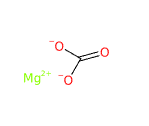
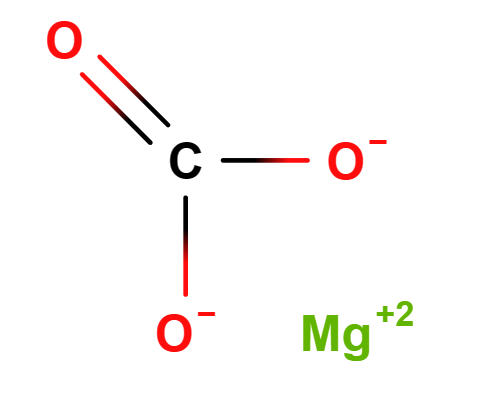
Magnesium Carbonate is a chemical compound, magnesium salt of carbonic acid and is formed from hydrotalcite material.
Industrially, it appears in the form of a white powder.

What it is used for and where
Food
It is an anti-caking agent on the European food additives list with the number E504 and used in cheeses, wines etc. and in the Colour Index International as 77713, dye.
Cosmetics
It is a restricted ingredient as IV/139, a Relevant Item in the Annexes of the European Cosmetics Regulation 1223/2009
Absorbent. Absorbs substances dispersed or dissolved in aqueous solutions, water/oil, oil/water..
Binder agent. Ingredient that is used in cosmetic, food and pharmaceutical products as an anti-caking agent with the function of making the product in which it is incorporated silky, compact and homogenous. The binder, either natural such as mucilage, gums and starches or chemical, may be in the form of a powder or liquid.
Opacifying agent. This additive is inserted into formulations that may be translucent or transparent to make them opaque and less permeable to light.
Colorant. Ingredient whose primary function is to colour the solution in which it is inserted in a temporary, semi-permanent or permanent manner, either alone or in the presence of complementary components added for colouration.
Dietary supplements
In dietary supplements, magnesium carbonate is mainly used as a source of magnesium, an essential mineral for muscle and nerve function. It contributes to the reduction of fatigue and tiredness and to normal energy metabolism. It may also act as a gastric buffering agent. In some formulations, it is used as a technological excipient. Absorption is improved when taken with meals.
Medical
Magnesium carbonate is used against heartburn or indigestion. Unlike other magnesium salts (aspartate, citrate, gluconate, lactate, orotate, pyruvate) that are easily absorbed in the body, magnesium carbonate is slower. It is used as an effective treatment in hemodialysis patients with calcium-phosphoric problems (1) with some warning (3). In the human body it helps the development of muscles and bones.
Although positive long-term effects on coronary artery calcification have been found (2), it is believed that these studies still need to be further investigated to ensure that the product is effective.
In inappropriate doses it can cause diarrhea and stomach ache.
Magnesium salts are used in treatments for preserving the integrity of the blood system, urine pH, etc.
- aspartate
- citrate
- gluconate
- lactate
- orotate
- pyruvate
The most relevant studies on this ingredient have been selected with a summary of their contents:
Magnesium carbonate studies
- Molecular Formula: CMgO3 MgCO3
- Linear Formula: MgCO3 · x H2O
- Molecular Weight: 84.313 g/mol
- CAS: 546-93-0 7757-69-9 13717-00-5 13717-00-5 23389-33-5
- EC Number: 208-915-9 231-817-2 604-004-9
- UNIII: 0IHC698356
Synonyms:
- Magnesium carbonate hydrate
- magnesium carbonate (1:1) hydrate
- carbonic acid, magnesium salt (1:1), hydrate
- magnesium carbonate anhydrous
- CI 77713
- E504
- UNII-0IHC698356
- Caswell No. 530
- Magnesite dust
- Hydromagnesite
- Stan-mag magnesium carbonate
- nesquehonite
References_______________________________________________________________________
(1) Zwiech R, Dryja P, Łacina D, Króliczak V, Chrul S, Kacprzyk F. The influence of short-term magnesium carbonate treatment on calcium-phosphorus balance in dialysis patients. Wiad Lek. 2011;64(1):9-14.
Abstract. Introduction: The phosphate-binders presently used in the treatment of calcium-phosphorus disorders in dialysis patients remain a crucial element of cardio-vascular protection. The aim of the study was to assess short-time magnesium carbonate treatment efficacy in hemodialysis patients with hyperphosphatemia. Material and methods: The study involved 64 participants (32 male and 32 female) aged 29-84 years, with end-stage renal disease, hyperphosphatemia (> 1.78 mmol/l), dialysis 3 times a week, mean session time 4 hours 15 minutes. All the patients were divided into three groups: I--30 patients treated with magnesium carbonate 3 x 1 g; group II--10 patients treated with sevelamer hydrochloride 0.8 g--3 x 2 tabl (3 x 1.6 g); group III--24 patients treated with calcium carbonate 3 x 2 g. Participants were categorized randomly to groups I and II and to group III only patients with decreased serum calcium concentration (< 2.1 mmol/1) were assigned. The doses stayed constant within 12 weeks of therapy. Conclusions: Magnesium carbonate seems to be the effective treatment of calcium-phosphorus disorders in hemodialysis patients. However its administration, similarly to other non-calcium phosphate-binders, is limited and dedicated to patients with normal serum calcium concentration.
Spiegel DM, Farmer B, Smits G, Chonchol M. Magnesium carbonate is an effective phosphate binder for chronic hemodialysis patients: a pilot study. J Ren Nutr. 2007 Nov;17(6):416-22. doi: 10.1053/j.jrn.2007.08.005.
Abstract. Objective: This study was designed to evaluate the efficacy of magnesium carbonate as a phosphate binder in hemodialysis patients. Design: This study was a prospective, randomized, open-label trial comparing magnesium carbonate/calcium carbonate versus calcium acetate as a sole phosphate binder. Setting: This study involved outpatient hemodialysis. Participants: We recruited 30 stable hemodialysis patients without a history of frequent diarrhea. Intervention: After receiving informed consent, we randomized patients 2:1 to magnesium carbonate versus calcium acetate. The dose of each binder was titrated to achieve the Kidney Disease Outcomes Quality Initiative (K/DOQI) phosphate target of <5.5 mg/dL. Main outcome measure: The efficacy-phase serum phosphorus concentration and the percentage of patients meeting K-DOQI targets for phosphorus, along with the daily elemental calcium intake, were the primary outcome measures. Results: Magnesium carbonate provided equal control of serum phosphorus (70.6% of the magnebind group and 62.5% of the calcium acetate group had their average serum phosphorus within the K-DOQI target during the efficacy phase), while significantly reducing daily elemental calcium ingestion from phosphate binders (908 +/- 24 vs. 1743 +/- 37 mg/day, P < .0001). Conclusion: Magnesium carbonate was generally well-tolerated in this selected patient population, and was effective in controlling serum phosphorus while reducing elemental calcium ingestion.
(2) Spiegel DM, Farmer B. Long-term effects of magnesium carbonate on coronary artery calcification and bone mineral density in hemodialysis patients: a pilot study. Hemodial Int. 2009 Oct;13(4):453-9. doi: 10.1111/j.1542-4758.2009.00364.x.
Abstract. Observational data suggest that elevated magnesium levels in dialysis patients may prevent vascular calcification and in vitro magnesium can prevent hydroxyapatite crystal growth. However, the effects of magnesium on vascular calcification and bone mineral density have not been studied prospectively. Seven chronic hemodialysis patients participated in this open label, prospective pilot study to evaluate the effects of a magnesium-based phosphate binder on coronary artery calcification (CAC) scores and vertebral bone mineral density (V-BMD) in patients with baseline CAC scores >30. Magnesium carbonate/calcium carbonate (elemental Mg: 86 mg/elemental Ca 100 mg) was administered as the principal phosphate binder for a period of 18 months and changes in CAC and V-BMD were measured at baseline, 6, 12, and 18 months. Serum magnesium levels averaged 2.2+/-0.4 mEq/L (range: 1.3-3.9 mEq/L). Phosphorus levels (4.5+/-0.6 mg/dL) were well controlled throughout the 18 months study. Electron beam computed tomography results demonstrated a small not statically significant increase in absolute CAC scores, no significant change in median percent change, and a small none significant change in V-BMD. Magnesium may have a favorable effect on CAC. The long-term effect on bone mineral density remains unclear. Larger studies are needed to confirm these findings.
(3) Delmez JA, Kelber J, Norword KY, Giles KS, Slatopolsky E. Magnesium carbonate as a phosphorus binder: a prospective, controlled, crossover study. Kidney Int. 1996 Jan;49(1):163-7. doi: 10.1038/ki.1996.22.
Abstract. The use of calcium carbonate (CaCO3) to bind phosphorus (P) in chronic hemodialysis patients has been a popular tactic in the past decade. Nonetheless, problems with hypercalcemia decrease its usefulness, particularly in patients treated with calcitriol. A P binder not containing calcium (Ca) would be of value in these circumstances. In short-term studies, we showed that magnesium carbonate (MgCO3) was well-tolerated and controlled P and Mg levels when given in conjunction with a dialysate Mg of 0.6 mg/dl. We, therefore, performed a prospective, randomized, crossover study to evaluate if the chronic use of MgCO3 would allow a reduction in the dose of CaCO3 and yet achieve acceptable levels of Ca, P, and Mg. We also assessed whether the lower dose of CaCO3 would facilitate the use of larger doses of calcitriol. The two phases were MgCO3 plus half the usual dose of CaCO3 and CaCO3 alone given in the usual dose. It was found that MgCO3 (dose, 465 +/- 52 mg/day elemental Mg) allowed a decrease in the amount of elemental Ca ingested from 2.9 +/- 0.4 to 1.2 +/- 0.2 g/day (P < 0.0001). The Ca, P, Mg levels were the same in the two phases. The maximum dose of i.v. calcitriol without causing hypercalcemia was 1.5 +/- 0.3 micrograms/treatment during the MgCO3 phase and 0.8 +/- micrograms/treatment during the Ca phase (P < 0.02). If these studies are confirmed, the use of MgCO3 and a dialysate Mg of 0.6 mg/dl may be considered in selected patients who develop hypercalcemia during treatment with i.v. calcitriol and CaCO3.