



Sorbic acid: properties, uses, pros, cons, safety
Sorbic acid (E200) – (2E,4E)-hexa-2,4-dienoic acid, an unsaturated carboxylic acid used primarily as a preservative
Synonyms: sorbic acid; (E,E)-2,4-hexadienoic acid; hexa-2,4-dienoic acid; E200
INCI / functions: preservative (some databases also list it as fragrance)
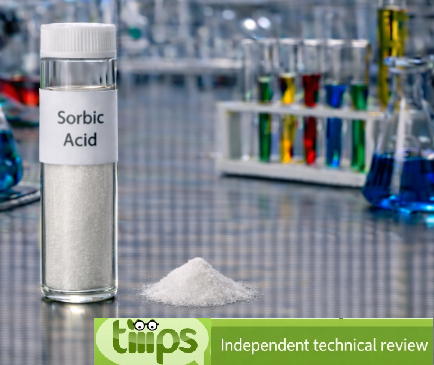
Definition
Sorbic acid is a short-chain (C6) organic acid with two conjugated double bonds ((2E,4E) configuration), used mainly as an antimicrobial agent against molds and yeasts. From a compositional standpoint, the “core” of the ingredient is the molecule C6H8O2; in technical/commercial grades, the most relevant practical variables are purity, potential traces of synthesis-related by-products, and physical form (powder/crystals).
In formulation, the performance of sorbate-based preservation systems is strongly influenced by pH: antimicrobial activity is generally more favorable in an acidic environment because the non-dissociated form is more active against microorganisms. A common practical limitation is water solubility, which is relatively low for the free acid; therefore, in many formulas the salt form (e.g., potassium sorbate) is preferred when higher solubility is required, while still controlling finished-product pH.
Process note: industrial sorbic acid is commonly produced via chemical synthesis; supplier selection and specifications (impurities, metals, residual solvents) are key for regulated uses.
Main uses
Food.
As additive E200, sorbic acid is used to inhibit mold and yeast growth and extend shelf life in a range of foods and beverages. At typical use levels (mg/kg), it does not provide meaningful nutritional contribution; the focus is on compliance (permitted categories, applicable limits) and quality control (purity, contaminants). From a technological standpoint, real-world efficacy depends on the matrix, pH, and interactions with other ingredients (e.g., sugars, proteins, buffering systems).
As a food additive it has a neutral taste and is a substance generally recognized as safe and allowed in many countries at a concentration of 1,000 to 2,000 ppm (1), however it is necessary to remember the toxicity of sorbic acid and some of its derivatives (2) even at low concentrations (3)
Cosmetics.
In cosmetics it is used as a preservative (often in combination with other preservatives or boosters) to reduce microbial growth in water-containing formulas. Use requires attention to pH and solubility: in many cases, partial neutralization or salts are employed to improve incorporation and robustness. It is often selected for “mild” systems where a simpler preservative profile is desired, while still meeting challenge-test and stability requirements.
It is a restricted (V/4) ingredient as a Relevant Item in the Annexes of the European Cosmetics Regulation 1223/2009. Identified INGREDIENTS or substances e.g. Hexa-2,4-dienoic acid and its salts
INCI Functions
Fragrance. It plays a decisive and important role in the formulation of cosmetic products as it provides the possibility of enhancing, masking or adding fragrance to the final product, increasing its marketability. The consumer always expects to find a pleasant or distinctive scent in a cosmetic product.
Preservative. Any product containing organic, inorganic compounds, water, needs to be preserved from microbial contamination. Preservatives act against the development of harmful microorganisms and against oxidation of the product.
Pharmaceutical.
May be used as a preservative in certain dosage forms (or as part of preservative systems) when compliant with grade specifications and applicable monographs. In these cases, material qualification (impurities, metals, residual solvents) and preservative-efficacy validation on the finished product are decisive.
Industrial use.
Used as a microbial-growth inhibitor in various technical applications (subject to regulations and material/system compatibility), with attention to stability and safe handling.
Other uses:
- tobacco
- pesticides
- resins
- spices
- rubber
Identification data and specifications
| Identifier | Value |
|---|---|
| INCI name | Sorbic Acid |
| Formula | C6H8O2 |
| Molar mass | 112.13 g/mol |
| CAS number | 110-44-1 |
| EC/EINECS number | 203-768-7 |
| Physical form (typical) | white powder or crystals |
| Food designation | E200 (sorbic acid) |
Chemical-physical properties (indicative)
| Property | Value | Note |
|---|---|---|
| Melting point | ~134–135 °C | typical value from substance data |
| Boiling point | ~228 °C | indicative (decomp./conditions may vary) |
| pKa | ~4.76 (25 °C) | critical for pH-dependent efficacy |
| Water solubility | low (order of g/L) | often limiting in formulas |
| Density | ~1.20 g/cm³ | indicative value |
Functional role and practical mechanism
| Function | What it does in formula | Technical note |
|---|---|---|
| Preservative | inhibits microbial growth, especially molds and yeasts | more effective at acidic pH |
| Microbiological stabilizer | supports shelf life and reduces contamination risk | typically used in preservative blends |
| System “acidulant” (indirect effect) | can influence pH if not buffered | pH control remains a design requirement |
Formulation compatibility
The main formulation constraint for sorbic acid is balancing solubility and efficacy. In general, good preservative activity is supported by a moderately acidic pH window; however, within that window the free acid’s limited solubility can become critical, with a risk of crystallization/haze if the system is not well designed (temperature, addition order, presence of co-solvents, partial neutralization).
In aqueous cosmetic and pharmaceutical systems, it is common to use sorbates (salt forms) or controlled neutralization to optimize incorporation, while maintaining sufficient “active” (non-dissociated) fraction to ensure efficacy in the finished product. In food, efficacy depends on the matrix: higher-water, higher-pH systems may require combined strategies (pH control, other preservatives, packaging, thermal processing).
From a stability standpoint, sorbic acid can be sensitive to oxidative processes and stressors (light/air) depending on the formula and packaging; therefore, raw-material qualification and finished-product stress testing (temperature, light, cycling) are essential technical steps.
Use guidelines (indicative)
| Application | Typical range | Technical note |
|---|---|---|
| Water-containing cosmetics (in preservative blends) | 0.05–0.30% | depends on pH and overall preservative system |
| Typical EU cosmetic preservative limit (expressed as acid) | up to 0.6% | always verify the applicable regulatory condition |
| Food (E200) | mg/kg (category-dependent) | set by regulation per food category |
Quality, grades, and specifications
| QC parameter | What to check |
|---|---|
| Identity | INCI/chemical name match, CAS/EC, spectrum/IR if applicable |
| Assay/purity | % on an anhydrous basis and impurity profile |
| Heavy metals | limits according to intended use (food/pharma/cosmetic) |
| Solvents/residuals | compliance with specs and regulations |
| Physical parameters | melting point, appearance, particle size (if relevant) |
| Stability | sensitivity to light/oxygen and packaging compatibility |
| Microbiology | typically not critical for anhydrous raw material, but crucial for the finished product |
Safety, regulatory, and environment
The safety profile of sorbic acid is supported by long-standing use as a food additive (E200) and as a preservative in other applications. In food, risk assessment is based on dietary exposure and category limits; in cosmetics and pharmaceuticals, safety is assessed on the finished product (use scenario, population, application area, frequency) together with appropriate demonstration of preservative efficacy.
In cosmetics regulation, use as a preservative typically falls under positive lists and conditions of use (with a maximum level commonly expressed “as acid”). In manufacturing, applying GMP (Good manufacturing practice; benefit: reduces variability and operational risk) improves control and repeatability. Where adopted as an approach, HACCP (Hazard analysis and critical control points; benefit: strengthens prevention and quality control at critical process points) supports preventive management of sensitive points.
Formulation troubleshooting
| Problem | Possible cause | Recommended intervention |
|---|---|---|
| Crystals/precipitation | insufficient solubility of free acid, temperature, pH not optimized | retune pH, consider salt form (sorbate), use compatible co-solvents, optimize addition order |
| Insufficient preservative efficacy | pH too high, unbalanced preservative system, high initial bioburden | optimize pH, move to preservative blends, verify challenge testing and process hygiene |
| Odor/color drift over time | oxidation or interactions with matrix/packaging | reduce light/air exposure, qualify packaging, evaluate compatible antioxidants (if appropriate) |
| Emulsion instability | interactions with surfactants/polymers, complex aqueous phase | retune emulsifier system, simplify or buffer aqueous phase, thermal stress testing |
Conclusion
Sorbic acid is a widely used preservative, particularly effective against molds and yeasts, with performance strongly dependent on pH and solubility. In practice, success is achieved by defining raw-material specifications (purity/impurities), the finished-product pH window, and the preservation strategy (often in blends), supported by challenge testing and stress testing. When used appropriately, it remains a robust technical solution in both food (E200) and cosmetic/pharmaceutical applications.
Mini-glossary
pKa: measure of acid/base equilibrium; technical note: determines the non-dissociated fraction, often more relevant to antimicrobial activity.
Solubility: the maximum amount that can dissolve in a medium; technical note: limits the use of the free acid in aqueous systems.
Challenge test: preservative efficacy test performed on the finished product.
GMP: Good manufacturing practice; benefit: reduces variability and contamination.
HACCP: Hazard analysis and critical control points; benefit: strengthens prevention and control at critical process points.
Molecular Formula: C6H8O2
Linear Formula: CH3CH=CHCH=CHCOOH
Molecular Weight: 112.128 g/mol
CAS: 110-44-1 22500-92-1 91751-55-2
EC Number: 203-768-7 618-788-5
UNII: X045WJ989B
FEMA Number: 3921
PubChem Substance ID: 24899486
MDL number: MFCD00002703
Beilstein Registry Number: 1098547
- α-trans-γ-trans-Sorbic acid
- (E,E)-1,3-Pentadiene-1-carboxylic acid
- 2,4-Hexadienoic acid
- 2E,4E-Hexadienoic acid
- trans,trans-2,4-Hexadienoic acid
- Panosorb
- 2-Propenylacrylic acid
- Acetic acid, (2-butenylidene)-
- Crotylidene acetic acid
- alpha-trans-gamma-trans-Sorbic acid
- Hexa-2,4-dienoic acid
(1) Lund, B. M., and T. Eklund. 2000. Control of pH and use of organic acids, p. 175-200. In M. Lund, T. C. Baird-Parker, and G. W. Gould (ed.), The microbiological safety and quality of food. Aspen Publisher, Inc., Gaithersburg, MD.
(2) Walker R. Toxicology of sorbic acid and sorbates. Food Addit Contam. 1990 Sep-Oct;7(5):671-6. doi: 10.1080/02652039009373932.
Abstract. Sorbic acid and its salts have been subjected to an extensive battery of tests, including acute, short-term and chronic toxicity/carcinogenicity tests, two-generation reproduction and teratogenicity studies. These studies show that sorbic acid and sorbates have a very low level of mammalian toxicity, even in chronic studies at up to 10% of the diet, and are devoid of carcinogenic activity. They are non-mutagenic and non-clastogenic in vitro and in vivo. The low toxicity is explicable by the fact that sorbic acid is metabolized rapidly by similar pathways to other fatty acids. In humans, a few cases of idiosyncratic intolerances have been reported (non-immunological contact urticaria and pseudo-allergy). The frequency appears low but there are too few reported data for an accurate assessment of the true incidence. In extreme conditions (high concentrations and temperature) sorbic acid may react with nitrite to form mutagenic products but these mutagens are not detectable under normal conditions of use, even in curing brines.
(3) Soschin D, Leyden JJ. Sorbic acid-induced erythema and edema. J Am Acad Dermatol. 1986 Feb;14(2 Pt 1):234-41. doi: 10.1016/s0190-9622(86)70027-3.
Abstract. Sorbic acid concentrations as low as 0.1% produced transient erythema with edema and flare after open or closed application to human skin. Multiple areas of the body were tested. Reactions were most intense on the face but also could be produced on the back, forearm, and deltoid areas. Sorbic acid-induced erythema, edema, and flare were not associated with mast cell degranulation. Pretreatment of skin with topical steroids to induce vasoconstriction resulted in a diminished response to sorbic acid. Aspirin blocked the erythematous component, suggesting that prostaglandins are important mediators. Systemic steroids, antihistamines, and hydroxyzine failed to influence sorbic acid-induced erythema and edema. The anti-inflammatory effect of topical steroids was not affected by sorbic acid-induced erythema.
Harvey HJ, Hendry AC, Chirico M, Archer DB, Avery SV. Adaptation to sorbic acid in low sugar promotes resistance of yeast to the preservative. Heliyon. 2023 Nov 4;9(11):e22057. doi: 10.1016/j.heliyon.2023.e22057. PMID: 38034742; PMCID: PMC10682675.

