

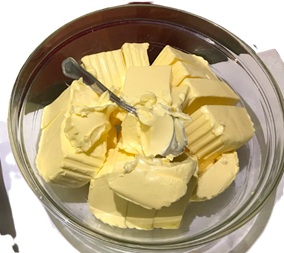
Butter
Rating : 3.8
| Evaluation | N. Experts | Evaluation | N. Experts |
|---|---|---|---|
| 1 | 6 | ||
| 2 | 7 | ||
| 3 | 8 | ||
| 4 | 9 | ||
| 5 | 10 |
Cons:
Possible risk. Click on ingredient (1)18 pts from A_Partyns
| Sign up to vote this object, vote his reviews and to contribute to Tiiips.Evaluate | Where is this found? |
| "Butter studies" about Butter Review Consensus 8 by A_Partyns (13106 pt) | 2020-Oct-07 09:36 |
| Read the full Tiiip | (Send your comment) |
The best studies about butter:
Substitutions between dairy products and risk of stroke: Results from the EPIC-NL cohort.
Laursen ASD, Sluijs I, Boer JMA, Verschuren WMM, van der Schouw YT, Jakobsen MU.
Br J Nutr. 2019 Mar 14:1-21. doi: 10.1017/S0007114519000564.
Dairy foods and health: an umbrella review of observational studies.
Godos J, Tieri M, Ghelfi F, Titta L, Marventano S, Lafranconi A, Gambera A, Alonzo E, Sciacca S, Buscemi S, Ray S, Del Rio D, Galvano F, Grosso G.
Int J Food Sci Nutr. 2019 Jun 14:1-14. doi: 10.1080/09637486.2019.1625035.
Dairy Product Intake and Cardiometabolic Diseases in Northern Sweden: A 33-Year Prospective Cohort Study.
Johansson I, Esberg A, Nilsson LM, Jansson JH, Wennberg P, Winkvist A.
Nutrients. 2019 Jan 28;11(2). pii: E284. doi: 10.3390/nu11020284.
Effects of Protein, Fat and Both Protein and Fat on Glycemic Response of a Meal (P18-094-19).
Taai M, Lilly L, Heiss C, Senne-Duff B.
Curr Dev Nutr. 2019 Jun 13;3(Suppl 1). pii: nzz039.P18-094-19. doi: 10.1093/cdn/nzz039.P18-094-19. eCollection 2019 Jun
Meals with Similar Fat Content from Different Dairy Products Induce Different Postprandial Triglyceride Responses in Healthy Adults: A Randomized Controlled Cross-Over Trial.
Hansson P, Holven KB, Øyri LKL, Brekke HK, Biong AS, Gjevestad GO, Raza GS, Herzig KH, Thoresen M, Ulven SM.
J Nutr. 2019 Mar 1;149(3):422-431. doi: 10.1093/jn/nxy291.
Influence of the frequency of consumption of foodstuffs on the risk of overweight and obesity in a group of post-menopausal women.
Górna I, Kowalówka M, Morawska A, Kosewski G, Bolesławska I, Przysławskia J.
Prz Menopauzalny. 2019 Apr;18(1):39-45. doi: 10.5114/pm.2019.84156. Epub 2019 Apr 9.
Randomised trial of coconut oil, olive oil or butter on blood lipids and other cardiovascular risk factors in healthy men and women.
Khaw KT, Sharp SJ, Finikarides L, Afzal I, Lentjes M, Luben R, Forouhi NG.
BMJ Open. 2018 Mar 6;8(3):e020167. doi: 10.1136/bmjopen-2017-020167.
Effect of different commercial fat sources on brain, liver and blood lipid profiles of rats in growth phase.
Angelis-Pereira MC, Barcelos MFP, Pereira JAR, Pereira RC, Souza RV.
Acta Cir Bras. 2017 Dec;32(12):1013-1025. doi: 10.1590/s0102-865020170120000003
Nutritional metabolomics and breast cancer risk in a prospective study.
Playdon MC, Ziegler RG, Sampson JN, Stolzenberg-Solomon R, Thompson HJ, Irwin ML, Mayne ST, Hoover RN, Moore SC.
Am J Clin Nutr. 2017 Aug;106(2):637-649. doi: 10.3945/ajcn.116.150912. Epub 2017 Jun 28.
And a video about the risks related to butter:
| Sign up to vote this object, vote his reviews and to contribute to Tiiips.EvaluateClose | (0 comments) |
| "Descrizione" about Butter Review Consensus 18 by A_Partyns (13106 pt) | 2026-Feb-21 18:00 |
| Read the full Tiiip | (Send your comment) |
Butter: properties, uses, pros, cons, safety
Definition
Butter is a dairy product obtained from the fat phase of cow’s milk (Bos taurus, family Bovidae) via cream separation followed by churning. It is a predominantly lipid matrix (milk fat) with a smaller proportion of water and non-fat solids. Commercially, the main distinction is between sweet cream butter (from non-fermented or minimally ripened cream) and butter from ripened/fermented cream, with differences in flavour profile. It is a key ingredient for plasticity, flavour and performance in cooking and bakery.

Production process
The typical process includes: separation of cream from milk, optional pasteurisation, then ripening (optional controlled fermentation to develop flavour, if required). The cream is then churned to separate butter granules from buttermilk. This is followed by washing, working (to distribute water uniformly), forming and packaging in light- and oxygen-barrier materials. Key controls include fat content, moisture, microbiological quality, acidity and oxidative stability.
Key constituents
The matrix is mainly milk triglycerides with a complex fatty acid profile. It contains a relevant share of SFA (saturated fatty acids), together with MUFA (monounsaturated fatty acids) and smaller amounts of PUFA (polyunsaturated fatty acids). Small amounts of phospholipids and unsaponifiable components are present (including fat-soluble vitamins: vitamin A and, to a variable extent, vitamins D and E). The aqueous phase contains trace amounts of proteins and lactose, generally low in butter but not zero.
Identification data and specifications
| Parameter | Value | Note |
|---|---|---|
| Ingredient name | Butter | Sweet cream or ripened-cream butter |
| Origin | Cow’s milk (Bos taurus) | Dairy product |
| Source/derivation | Cream → butter | Churning and working |
| Nature | Water-in-oil emulsion (W/O) | Continuous fat phase |
| Key parameters | % fat, moisture, acidity, peroxide value, sensory profile, microbiological load | Quality and shelf-life drivers |
| Allergen | Yes: milk | Contains milk-derived components |
| Caloric value | Typically ~700–760 kcal/100 g | Depends on water and composition |
Physico-chemical properties (indicative)
| Property | Indicative value | Note |
|---|---|---|
| Physical state | Solid/semi-solid | Plasticity depends on temperature |
| Colour | White → yellow | Depends on diet/seasonality |
| Odour | Dairy, buttery | Rancid notes indicate oxidation |
| Water solubility | Insoluble | W/O emulsion |
| Melting range | Indicatively ~28–35 °C | Gradual melt, depends on fat profile |
| Stability | Good if refrigerated and protected | Key risks: rancidity, odour uptake |
| Typical criticalities | Oxidation, water separation, sensory defects | Driven by light, oxygen and cold chain |
Main uses
Food
Used as a spread, for sautéing and cooking, in sauces and emulsions (clarified butter / finishing with butter), for finishing risotto and pasta, and in pastry and bakery (shortcrust, cakes, brioche, laminated doughs). In lamination, butter plasticity and melting behaviour influence layering and friability.
Industrial use
Used in bakery, creams, fillings, ready meals and sauces. Industrial drivers include consistent plasticity, sensory quality and oxidation control.
Nutrition and health
Butter is energy-dense and composed mainly of fat. The share of SFA is significant; MUFA and small amounts of PUFA are also present. In a balanced diet, portion size and consumption frequency are key, together with the overall saturated-fat balance in the diet.
Pros
It has high palatability and provides a characteristic flavour profile. It offers baking performance that can be difficult to replicate with other fats and provides fat-soluble vitamins at variable levels.
Cons
It is calorie-rich and high in SFA; uncontrolled use can rapidly increase energy and saturated-fat intake. It is an allergen (milk).
Serving note
Practical portions are often small (spread amounts or recipe inclusion), but energy density is high. For impact assessment, consider actual grams used and total daily saturated fat intake.
Safety (allergens, contraindications)
Allergen: milk. For those with cow’s milk protein allergy, or severe lactose intolerance (even though lactose is generally low in butter), individual tolerance and product specification should be considered. Food safety depends on maintaining the cold chain, appropriate packaging and process hygiene. Typical defects include oxidative rancidity and odour uptake.
Storage and shelf-life
Store refrigerated, tightly closed and protected from light and odours. Butter readily absorbs external aromas. Freezing is possible to extend shelf-life, with attention to oxidation protection and freezer burn.
Labelling
On-pack, declare “butter” and highlight the allergen milk. In composite products, butter affects saturated fat content and energy value in the nutrition declaration.
Functional role and rationale for use
Butter acts as a fat phase with the characteristic plasticity, crystalline structure and flavour of milk fat. In bakery, fat crystal structure influences lamination and friability; in sauces and emulsions it contributes gloss and sensory roundness.
Formulation compatibility
In fine pastry, temperature and handling must be controlled to maintain plasticity (especially for laminated doughs). In emulsions and sauces, aqueous-phase and emulsion management influence stability; in sweet products, choosing sweet cream vs ripened-cream butter changes the flavour profile.
Safety, regulatory and quality
Application of GMP/HACCP across the milk-to-butter chain supports hygiene, traceability and microbiological control. Quality control focuses on acidity, peroxide value (oxidation) and sensory profile, as well as compliance with composition specifications.
Conclusion
Butter is a core dairy fat valued for flavour and technological performance in cooking and bakery. Key drivers are raw material quality, oxidation control, cold-chain management and plasticity consistency. From a nutrition perspective, the critical point is high energy density and the share of SFA, best managed through appropriate portions.
Mini-glossary
SFA: saturated fatty acids; excessive intake may be less favourable than unsaturated fats in the context of an overall diet.
MUFA: monounsaturated fatty acids; often considered more favourable when replacing part of SFA.
PUFA: polyunsaturated fatty acids; include omega-6 and omega-3 families with potential benefits when balanced.
W/O emulsion: water-in-oil emulsion with a continuous fat phase (typical of butter).
Peroxide value: indicator of primary lipid oxidation, used to monitor freshness and stability.
GMP/HACCP: good manufacturing practices (GMP) and the hazard analysis and critical control points (HACCP) system for safety and contamination prevention.
A correlation between butter consumption and Alzheimer's disease has also been established (5).
References_________________________________________________________
(1) von Ruesten A, Feller S, Bergmann MM, Boeing H. Diet and risk of chronic diseases: results from the first 8 years of follow-up in the EPIC-Potsdam study. Eur J Clin Nutr. 2013 Apr;67(4):412-9. doi: 10.1038/ejcn.2013.7.
(2) Patterson E, Larsson SC, Wolk A, Åkesson A. Association between dairy food consumption and risk of myocardial infarction in women differs by type of dairy food. J Nutr. 2013 Jan;143(1):74-9. doi: 10.3945/jn.112.166330. Epub 2012 Nov 21.
(3) Livingstone KM, Lovegrove JA, Cockcroft JR, Elwood PC, Pickering JE, Givens DI. Does dairy food intake predict arterial stiffness and blood pressure in men?: Evidence from the Caerphilly Prospective Study. Hypertension. 2013 Jan;61(1):42-7. doi:10.1161/HYPERTENSIONAHA.111.00026. Epub 2012 Nov 12.
(4) Vlajinac H, Ilic M, Marinkovic J, Sipetic S. Nutrition and prostate cancer. J BUON. 2010 Oct-Dec;15(4):698-703.
(5) Janssen, C. I., Jansen, D., Mutsaers, M. P., Dederen, P. J., Geenen, B., Mulder, M. T., & Kiliaan, A. J. (2016). The Effect of a High-Fat Diet on Brain Plasticity, Inflammation and Cognition in Female ApoE4-Knockin and ApoE-Knockout Mice. PloS one, 11(5), e0155307. https://doi.org/10.1371/journal.pone.0155307
| Sign up to vote this object, vote his reviews and to contribute to Tiiips.EvaluateClose | (0 comments) |
Read other Tiiips about this object in __Italiano (3)
Content:   Family:   Last update:   2012-10-23 17:53:41 | Kcal/100g:   758 Threat factors:   |

