

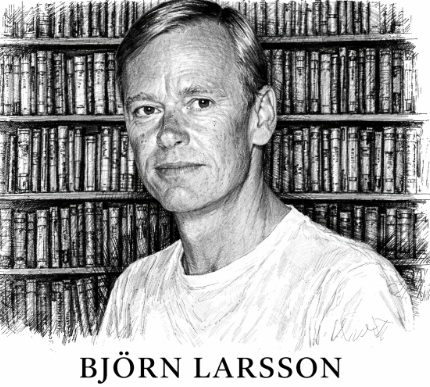
Bjorn Larsson
Rating : 6
| Evaluation | N. Experts | Evaluation | N. Experts |
|---|---|---|---|
| 1 | 6 | ||
| 2 | 7 | ||
| 3 | 8 | ||
| 4 | 9 | ||
| 5 | 10 |
0 pts from Al222
| Sign up to vote this object, vote his reviews and to contribute to Tiiips.Evaluate | Where is this found? |
| "Descrizione" about Bjorn Larsson by Al222 (24136 pt) | 2026-Jan-23 22:24 |
| Read the full Tiiip | (Send your comment) |
Björn Larsson, complete biography, sea narratives, freedom and identity, adventure novels and bibliography
Profile
Björn Larsson (1953) is a Swedish writer and professor of French literature, known for a body of fiction in which the sea, travel, and freedom function as literary and anthropological categories, as well as concrete settings for action. Alongside his novels, he has pursued an academic career in French literature and published essayistic and autobiographical-reflective works that examine the relationship between experience, language, and the construction of the self.

His international reputation is tied above all to novels with a strong narrative and “maritime” architecture, capable of combining suspense, moral reflection, and a taste for adventure, with sustained attention to individual responsibility and the fragility of modern identities.
From 1953 to 1979: context, education, and intellectual horizon
Born in Jönköping in 1953, Larsson is shaped in late twentieth-century Sweden, within a cultural landscape in which Nordic literature increasingly intersects with a broader European dimension. From the outset his trajectory stands out for a dual orientation: on the one hand an interest in narrative writing, on the other a profile as a scholar and lecturer in French literature.
This dual commitment produces a recognizable trait in his work: the construction of his texts tends to be both “adventurous” and self-aware in its procedures, attentive to narrative rhythm while also to the devices through which meaning, memory, and self-representation are produced.
From 1980 to 1991: early works and the emergence of a “sea” author
Larsson’s literary debut takes the form of a short-story collection, marking an early entry into the field of narrative prose. In this phase he gradually develops an imaginary connected to sailing and mobility, not as a picturesque backdrop, but as an existential condition: the sea becomes a measure of risk, uncertainty, and the necessity of decision.
The author’s identity thus takes shape along a tension between the technical credibility of maritime experience and an interest in cultural and linguistic processes, allowing adventure to remain convincing without being reduced to mere entertainment.
From 1992 to 1999: international recognition and the major-novel period
Full recognition arrives with The Celtic Ring (original title Den keltiska ringen, 1992), a novel that combines thriller elements with the centrality of the sea and Northern European routes. The book’s strength lies in its ability to transform navigation into a narrative mechanism of pressure, where natural unpredictability intertwines with political and moral conflicts.
This phase also includes Long John Silver (original title Long John Silver, 1995), a narrative rewriting that engages the adventure tradition and nineteenth-century imaginaries, while reinterpreting them in a modern key: the pirate figure becomes an occasion to reflect on freedom, violence, power, and the construction of first-person storytelling.
In 1997 he publishes The Port of Dreaming (original title Drömmar vid havet), a novel that further consolidates Larsson’s reputation and receives significant recognition in France. In these years his fiction displays a mature balance between plot and reflection: adventure is not escapism, but a tool for interrogating desires and the consequences of choices.
From 2000 to 2009: essayistic reorientation and intellectual autobiography
In the 2000s Larsson increasingly accompanies his fiction with reflective writing. A representative example is Need for Freedom (original title Besoin de liberté, 2006), written in French, which can be read as a conceptual autobiography: freedom is not presented as a slogan, but as a demanding practice made of discipline, renunciations, and responsibility.
This phase clarifies a structural aspect of his poetics: the sea and navigation are not only themes, but models of thought. Writing is conceived as an action exposed to uncertainty, analogous to steering a course, and therefore as an exercise in partial control and in accepting risk.
From 2010 to 2019: genre experimentation and the development of the contemporary novel
In the following decade Larsson also experiments with crime fiction through Dead Poets Don’t Write Crime Novels (original title Döda poeter skriver inte kriminalromaner), a work that signals an interest in genre conventions and, at the same time, in their deconstruction. The operation is consistent with his profile: using recognizable narrative forms to bring to the surface questions about truth, identity, and representation.
In 2019 he publishes Gertrud’s Letter, a novel that confirms his attention to personal genealogies and the blind spots of identity, shifting the center of gravity from maritime adventure toward a more intimate and familial dimension, without abandoning controlled narrative construction.
From 2020 to today: recent maturity and thematic expansion
In more recent years Larsson continues his fiction with In the Name of the Son (original title I sonens namn, 2021), where relational and generational dimensions become the main axis. In parallel, he expands his essay production with To Be or Not to Be Human. Rethinking Humanity Between Science and Other Forms of Knowledge (2024), indicating an explicit interest in interdisciplinary dialogue and in contemporary definitions of the human.
This phase confirms the author’s overall profile: a storyteller able to unite plot and thought, concrete experience and general reflection, keeping freedom as a central problem rather than a merely declared value.
Narrative style and poetic framework (discursive analysis)
Larsson’s prose tends to privilege clarity and progression, with suspense often arising from material conditions (weather, course, danger, technical choice) and then being converted into moral conflict. The sea acts as a narrative device because it forces decisions and reveals the limits of human control.
Another recurring feature is the tension between storytelling and self-reflection. Especially in works with a strong autobiographical or essayistic imprint, Larsson uses his own experience to discuss the concept of freedom as a process, avoiding presenting it as an immediate, natural property. The result is a poetics in which adventure is inseparable from responsibility, and freedom is inseparable from the constraints that make it effective.
Themes and system of ideas
The dominant thematic nucleus is freedom understood as a demanding practice: choice, discipline, risk, and the inevitable exposure to loss. To this are added the centrality of narration as a form of identity and the presence of the sea as a place of truth, in the sense that it compels the measuring of desires against real capacities.
Culturally, Larsson fits within a line of European fiction that uses travel and adventure to discuss contemporary problems: belonging, conflict, memory, responsibility. His originality lies in doing so with evident competence in maritime experience and with consistent control over formal construction.
Bibliography (main)
Fiction and novels
Splitter (1980)
The Celtic Ring (original title Den keltiska ringen, 1992)
Long John Silver (original title Long John Silver, 1995)
The Port of Dreaming (original title Drömmar vid havet, 1997)
Dead Poets Don’t Write Crime Novels (original title Döda poeter skriver inte kriminalromaner, 2010; Italian edition 2011)
Gertrud’s Letter (2019)
In the Name of the Son (original title I sonens namn, 2021)
Essays and reflective works
Need for Freedom (original title Besoin de liberté, 2006; Italian edition 2007)
To Be or Not to Be Human. Rethinking Humanity Between Science and Other Forms of Knowledge (2024)
Legacy and recognition
Larsson is a significant figure in contemporary Nordic literature because he has made the sea a modern narrative language: not a generic symbol, but a concrete space of decision, responsibility, and trial. His contribution lies in holding together the energy of adventure and the ambition of reflection, producing texts that can reach a wide readership without relinquishing conceptual density.
International reception, the recognition he has obtained, and editorial continuity testify to the solidity of an author who has built a recognizable territory: fiction in which freedom is continuously measured against the limits of the world and against the consequences of choices.
Conclusion
Björn Larsson represents a significant case of a contemporary European author in whom the practice of travel, maritime imagination, and reflection on the self converge into a coherent project. From sea and adventure novels to essays on freedom and the human, his work proposes a form of narrative in which experience and thought proceed together, and in which freedom remains an open problem rather than a reassuring formula.
| Sign up to vote this object, vote his reviews and to contribute to Tiiips.EvaluateClose | (0 comments) |
Read other Tiiips about this object in __Italiano (1)
Last update:   2012-10-10 22:12:41 |

