

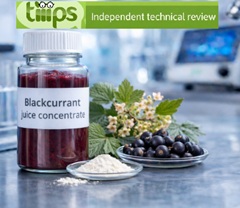
Blackcurrant juice concentrate
Rating : 7
| Evaluation | N. Experts | Evaluation | N. Experts |
|---|---|---|---|
| 1 | 6 | ||
| 2 | 7 | ||
| 3 | 8 | ||
| 4 | 9 | ||
| 5 | 10 |
0 pts from Al222
| Sign up to vote this object, vote his reviews and to contribute to Tiiips.Evaluate | Where is this found? |
| "Descrizione" about Blackcurrant juice concentrate by Al222 (24812 pt) | 2026-Feb-23 21:29 |
| Read the full Tiiip | (Send your comment) |
Blackcurrant juice concentrate: properties, uses, pros, cons, safety
Definition
Blackcurrant juice concentrate is a food ingredient obtained from processing blackcurrant (Ribes nigrum, botanical family Grossulariaceae), through juice extraction followed by concentration (partial removal of water) to increase the content of soluble solids.
It is used as:
an ingredient for beverages, nectars, syrups, and smoothies,
a component for desserts, yogurt, ice cream, and sorbets,
an ingredient for sauces, glazes, and fruit preparations,
a base for fruit blends to modulate color, acidity, and aromatic profile,
a semi-finished product to be reconstituted with water.
From a technological point of view, blackcurrant concentrate is appreciated for its intense color (mainly linked to anthocyanins), acidic-fruity taste, and logistic practicality (lower volume than single-strength juice). However, it is a matrix sensitive to oxygen, light, and heat, which may reduce color stability and sensory profile.

Production process
The production process of blackcurrant juice concentrate generally includes:
Selection and sorting of the fruits.
Washing and removal of impurities/foreign bodies.
Possible destemming (if required according to the line/process).
Crushing and/or pressing.
Juice extraction/pressing.
Possible clarification/filtration or turbidity standardization.
Possible enzymatic treatment (e.g., pectinases) to improve yield/filterability.
Concentration (often under vacuum) to limit thermal damage.
Possible deaeration.
Pasteurization and packaging (aseptic, frozen, or other industrial format).
Key controls include °Brix, pH, color, anthocyanin stability, microbiology, absence of foreign bodies, formulation compliance (100% blackcurrant vs blends), and behavior during reconstitution.
Key constituents
Composition varies depending on cultivar, ripeness, process, and degree of concentration. In general, the most relevant components are:
Water (residual, lower than in unconcentrated juice):
Favorable aspect: keeps the concentrate workable and reconstitutable.
Less favorable aspect: residual water content affects microbiological stability and storage.
Natural sugars (e.g., glucose, fructose, in variable amounts; sometimes other sugars):
Favorable aspect: contribute to sweetness, body, and palatability.
Less favorable aspect: concentration increases the sugar density of the semi-finished product.
Organic acids (especially fruit acids such as citric acid and malic acid, variable):
Favorable aspect: provide acidity, sensory freshness, and support microbiological stability.
Less favorable aspect: high acidity may require formulation balancing.
Anthocyanins (key color components):
Favorable aspect: contribute significantly to the dark red-purple color and phenolic profile.
Less favorable aspect: they are sensitive to pH, temperature, light, and oxidation.
Polyphenols (including flavonoids and other phenolics):
Favorable aspect: contribute to matrix complexity and antioxidant profile.
Less favorable aspect: quantity and stability are variable and may decrease during processing/storage.
Vitamin C (variable, often of interest in blackcurrant):
Favorable aspect: contributes to the micronutrient profile.
Less favorable aspect: it is sensitive to heat, oxygen, and storage; the residual amount in concentrate/processed product may vary greatly.
Pectins (variable, more relevant if the product retains turbidity/pulp):
Favorable aspect: affect viscosity, body, and matrix stability.
Less favorable aspect: they may complicate filtration and process behavior if not standardized.
Minerals (e.g., potassium, in variable amounts):
Favorable aspect: micronutrient contribution.
Less favorable aspect: practical impact depends on portion size and degree of reconstitution.
Important technical note
In a food-technical sheet, it is useful to distinguish between:
main matrix components (residual water, sugars, organic acids, anthocyanins/polyphenols, pectins),
minor/representative components (vitamins and variable micronutrients).
In the case of concentrate, a central parameter is the degree of concentration (e.g., °Brix) and how the semi-finished product is dosed/reconstituted in the finished product.
Identification data and specifications
| Parameter | Value | Note |
|---|---|---|
| Ingredient name | Blackcurrant juice concentrate | Semi-finished product obtained by juice concentration |
| Botanical name | Ribes nigrum | Botanical family: Grossulariaceae |
| Plant part | Fruit | Berry |
| Nature | Concentrated liquid (more or less viscous) | Aqueous matrix with concentrated soluble solids |
| Key components | Water (residual), sugars, organic acids, anthocyanins, polyphenols, pectins (variable) | Variable profile by cultivar/process |
| Allergen | No (intrinsic, typically) | Check blends/formulations and cross-contamination |
| Calories | Variable (depend on degree of concentration/°Brix) | Higher than single-strength juice at equal weight/volume of concentrate |
| Key parameters | °Brix, pH, color, microbiology, anthocyanin/polyphenol stability, viscosity | Quality and batch consistency drivers |
Indicative physicochemical properties
| Parameter | Indicative value | Note |
|---|---|---|
| Physical state | Concentrated liquid / viscous | Depends on degree of concentration and turbidity |
| Color | Dark red / violet / intense purple | Mainly linked to anthocyanins |
| Odor | Fruity, intense, characteristic | Alterations may indicate oxidation/deterioration |
| Taste | Acidic-fruity, intense | Depends on cultivar, °Brix, and process |
| pH | Acidic (variable) | Key parameter for stability and formulation |
| °Brix | Variable (high compared with unconcentrated juice) | Central specification parameter |
| Water solubility | Miscible/dilutable | Designed for reconstitution or dosing |
| Viscosity | Variable (medium-low → high) | Influenced by °Brix, temperature, pectins/turbidity |
| Stability | Good if properly treated and stored | Critical: oxidation, color loss, microbiology, phase separation |
Main uses
Food use
Blackcurrant juice concentrate is used in:
Beverages, juices, nectars, and smoothies (after reconstitution or in blends).
Syrups and bases for flavored beverages.
Yogurt, spoon desserts, ice cream, and sorbets.
Sauces, toppings, glazes, and fruit preparations.
Bakery and fillings, where color and an acidic-fruity note are desired.
Fruit blends to modulate color, acidity, and aroma.
Preparations requiring a high-intensity fruit ingredient with good logistic efficiency.
It may be used alone or in combination with other concentrated juices/purees to balance sweetness, acidity, color, and texture.
Industrial use
The main industrial drivers are:
constant °Brix,
stable and repeatable color,
anthocyanin/polyphenol stability,
viscosity/pumpability,
reconstitution yield,
microbiological safety.
Nutrition and health
Blackcurrant juice concentrate is a fruit matrix that may provide polyphenols (including anthocyanins) and a variable amount of micronutrients (e.g., vitamin C, depending on processing and storage). However, real nutritional evaluation depends on:
degree of concentration,
dosing/reconstitution in the finished product,
presence of other ingredients (added sugars, stabilizers, other juices),
consumed portion.
Practical aspects:
compared with single-strength juice, concentrate has a higher solids density;
anthocyanins are of technological and nutritional interest, but they are sensitive to processing/storage;
if used in small amounts as a color/profile adjuster, nutritional impact may be limited.
Pros
Provides intense natural color and a characteristic sensory profile.
Good versatility in beverages, desserts, and fruit blends.
May contribute anthocyanins and other polyphenols.
Logistic advantage over unconcentrated juice (lower volume).
Cons
Anthocyanins and aroma are sensitive to oxygen, light, and heat.
Marked acidity must be balanced in many formulations.
Composition and performance vary by cultivar/process.
Higher sugar density of the semi-finished product (to be considered in dosing).
Portion note
Portion should be evaluated on the finished product (beverage, yogurt, dessert, sauce, etc.), considering:
percentage of concentrate in the recipe,
possible reconstitution (water/concentrate ratio),
presence of added sugars or other ingredients,
consumption frequency.
Safety (allergens, contraindications)
Allergens: it is not typically a major allergen; always check the full label and possible cross-contamination in blends.
Microbiological safety: process hygiene, heat treatment, packaging, and correct storage conditions are essential.
Oxidative/color stability: oxygen and light may degrade anthocyanins and sensory profile.
Specific dietary needs: the contribution of natural sugars should be considered in the context of the final product and dietary plan.
Storage and shelf-life
Storage depends on the format:
aseptic: follow the conditions indicated by the manufacturer;
refrigerated: maintain the cold chain;
frozen: follow storage temperatures and thawing procedures;
after opening, limit exposure to air and light.
Key points:
protect from oxygen and light to preserve color and sensory quality;
avoid contamination during dispensing;
reseal the container properly;
respect post-opening use times.
Labelling
On the ingredient label, it may appear as:
blackcurrant juice concentrate
concentrated blackcurrant juice
equivalent wording according to regulations and product specification
Elements to evaluate:
possible “from concentrate” declaration in the finished product (when applicable),
presence of other added ingredients (e.g., other juices, acid regulators, antioxidants),
any nutrition claims to be verified on the finished product,
consistency between technical specification (e.g., °Brix, color profile) and declared use.
Functional role and rationale for use
Blackcurrant juice concentrate is chosen to combine:
intense natural color,
characteristic acidic-fruity note,
contribution of soluble solids,
logistic and formulation practicality,
possible contribution of polyphenols (including anthocyanins).
In formulation, it is often an ingredient of color and aromatic identity, also useful for balancing the sensory profile of blends and complex preparations.
Formulation compatibility
The main points are:
°Brix: influences sweetness, viscosity, and reconstitution yield.
pH: affects color stability, taste, and interactions with other ingredients.
Anthocyanins/polyphenols: sensitive to heat processing, oxygen, and light.
Viscosity/pectins: influence pumpability, dosing, and final texture.
Blending with other juices/purees: useful to modulate color, acidity, and aromatic profile.
Phase stability: in some applications may require control of separation/sedimentation.
Safety, regulation, and quality
GMP/HACCP management is recommended with clear specifications on:
°Brix,
pH,
microbiology,
color and color stability,
absence of foreign bodies,
formulation compliance and batch traceability.
For practical quality, batch consistency, color stability, predictable behavior during reconstitution/processing, and a coherent sensory profile are crucial.
Conclusion
Blackcurrant juice concentrate (Ribes nigrum, botanical family Grossulariaceae) is a versatile fruit semi-finished product, useful for providing intense color, an acidic-fruity note, and formulation practicality in many food applications.
Its technical value depends mainly on °Brix, pH, anthocyanin stability, process quality, and proper storage. From a nutritional standpoint, it may contribute polyphenols and characteristic matrix compounds, but real evaluation should always be referred to the finished product and the consumed portion.
Mini-glossary
Concentrate: product obtained by removing part of the water to increase solids concentration.
°Brix: measure of soluble solids (mainly sugars) in a liquid matrix.
Anthocyanins: plant pigments responsible for red-purple/blue shades in many fruits.
Polyphenols: class of plant compounds that contribute to color, taste, and antioxidant profile.
Reconstitution: dilution of the concentrate with water to obtain a ready-to-use or intermediate product.
Deaeration: removal of dissolved air to improve stability and reduce oxidation.
GMP/HACCP: good manufacturing practices and food safety self-control system.
| Sign up to vote this object, vote his reviews and to contribute to Tiiips.EvaluateClose | (0 comments) |
Read other Tiiips about this object in __Italiano (1)
Content:   Last update:   2026-02-23 21:24:06 | Kcal/100g:   Family:   Threat factors:   |

