

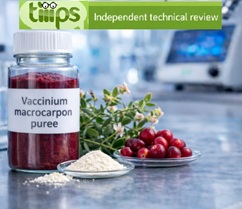
Cranberry puree
Rating : 7
| Evaluation | N. Experts | Evaluation | N. Experts |
|---|---|---|---|
| 1 | 6 | ||
| 2 | 7 | ||
| 3 | 8 | ||
| 4 | 9 | ||
| 5 | 10 |
0 pts from Al222
| Sign up to vote this object, vote his reviews and to contribute to Tiiips.Evaluate | Where is this found? |
| "Descrizione" about Cranberry puree by Al222 (24812 pt) | 2026-Feb-23 19:28 |
| Read the full Tiiip | (Send your comment) |
Cranberry puree: properties, uses, pros, cons, safety
Definition
Cranberry puree is a food ingredient obtained from processing the fruit of cranberry (botanical family Ericaceae), generally through selection, washing, crushing/pulping, and subsequent refining to obtain a homogeneous mass.
Commercially, the term “cranberry” may refer to different species (most often cranberry / Vaccinium macrocarpon or, in other contexts, Vaccinium vitis-idaea). For an accurate technical assessment, it is always useful to verify the botanical species indicated by the supplier, because it may affect acidity, sensory profile, and composition.

The puree may be:
100% fruit (no added sugars),
sweetened,
stabilized/pasteurized,
sometimes concentrated or used as a base for semi-finished products.
From a technological standpoint, it is an acidic matrix, rich in water, with fibers/pectins and phenolic compounds, useful for providing color, flavor, and a fruit component in many formulations.
Production process
The production process of cranberry puree generally includes:
Selection and sorting of the fruit (removal of damaged fruit and foreign bodies).
Washing.
Possible blanching or thermal pretreatment (depending on the process).
Crushing/pulping.
Sieving/refining to reduce skins/seeds or standardize texture.
Possible deaeration.
Pasteurization (common) to improve safety and shelf-life.
Packaging (refrigerated, aseptic, frozen, or in buckets/bag-in-box for industry).
Key controls concern pH, °Brix, viscosity/consistency, color, microbiological load, foreign bodies, product stability, and, where relevant, the presence of added sugars or other declared ingredients.
Key constituents
Composition depends on the species, ripeness, and formulation (100% puree vs sweetened puree). In general, the most relevant components are:
Water: the main component.
Favorable aspect: makes the puree easy to process and mix.
Less favorable aspect: requires microbiological control and proper storage.
Carbohydrates (naturally occurring sugars; possibly added sugars):
Favorable aspect: contribute to taste, body, and palatability.
Less favorable aspect: the nutritional profile changes significantly if the puree is sweetened.
Dietary fiber (especially if the puree retains part of the pulp/skin):
Favorable aspect: supports satiety and nutritional profile.
Less favorable aspect: may vary greatly depending on the degree of refining.
Pectins: natural fruit polysaccharides.
Favorable aspect: contribute to consistency, viscosity, and matrix stability.
Less favorable aspect: behavior depends on pH, sugars, and thermal treatment.
Organic acids (mainly citric acid, malic acid, partly natural benzoic acid in some berry matrices):
Favorable aspect: provide acidity, sensory freshness, and support microbiological stability.
Less favorable aspect: high acidity may require balancing in the recipe.
Polyphenols (including flavonoids and other phenolic compounds):
Favorable aspect: contribute to the antioxidant profile of the matrix and to color/taste sensation.
Less favorable aspect: they are sensitive to oxygen, light, and heat; losses during processing/storage are possible.
Anthocyanins (variable, more relevant for red-purple color):
Favorable aspect: responsible for part of the color and phenolic profile.
Less favorable aspect: they degrade with pH, temperature, and oxidation.
Vitamin C (variable):
Favorable aspect: contributes to the micronutrient profile.
Less favorable aspect: it is sensitive to heat and storage.
Minerals (e.g., potassium, in variable amounts):
Favorable aspect: micronutrient contribution.
Less favorable aspect: practical impact depends on portion size and the type of finished product.
Important technical note
Popular lists of “main substances” (such as polyphenols, quercetin, lutein, etc.) may include compounds present in traces or varying by species/batch. In an industrial technical sheet, it is always advisable to distinguish between:
main matrix components (water, sugars, fiber/pectins, organic acids),
representative phytocompounds (polyphenols/anthocyanins, etc.).
Identification data and specifications
| Parameter | Value | Note |
|---|---|---|
| Ingredient name | Cranberry puree | May be 100% fruit or formulated (e.g., sweetened) |
| Botanical name | Vaccinium macrocarpon and/or Vaccinium vitis-idaea (depending on product) | Botanical family: Ericaceae |
| Plant part | Fruit | Berries processed by pulping/refining |
| Nature | Semi-fluid fruit puree/pulp | Acidic matrix with water, sugars, fibers/pectins |
| Key components | Water, sugars, organic acids, pectins, polyphenols, fiber | Variable profile by species and formulation |
| Allergen | No (intrinsic, typically) | Always verify any added ingredients and cross-contamination |
| Calories | Variable (typically low–moderate if 100% fruit; higher if sweetened) | Depend on °Brix and added sugars |
| Key parameters | pH, °Brix, viscosity, color, microbiology, consistency | Quality and batch consistency drivers |
Indicative physicochemical properties
| Parameter | Indicative value | Note |
|---|---|---|
| Physical state | Semi-fluid / viscous | Depends on refining and solids content |
| Color | Red / dark red | Variable by species, concentration, and process |
| Odor | Fruity, acidic | Off-odors indicate possible alteration |
| Taste | Acidic/astringent, sometimes slightly bitter | Often balanced with sugar in applications |
| pH | Acidic (variable by species/formulation) | Key parameter for stability and taste |
| °Brix | Variable | Depends on ripeness, concentration, added sugars |
| Water solubility | Not properly “soluble” | It is a dispersion of pulp/solids in an aqueous phase |
| Viscosity | Variable (medium-low → medium-high) | Influenced by pectins, refining, solids, temperature |
| Stability | Good if properly treated and stored | Critical: microbiology, phase separation, color oxidation |
Main uses
Food use
Cranberry puree is used in many applications:
Jams, fruit spreads, fillings, and spreadable preparations.
Yogurt, spoon desserts, ice cream, and sorbets.
Beverages, smoothies, nectars, and fruit bases.
Bakery (fillings, toppings, inclusions, sauces).
Sauces and accompaniments for sweet/savory dishes.
Functional or fruit-based preparations where characteristic color and acidity are desired.
It may be used on its own or blended with other purees/fruits to modulate acidity, color, and aromatic profile.
Industrial use
The main industrial drivers are:
consistent pH and °Brix,
stable color,
repeatable viscosity/texture,
microbiological safety,
storage stability and process compatibility (pumps, dosers, heat exchangers).
Nutrition and health
Cranberry puree may contribute phytocompounds (especially polyphenols) and some fiber (if not highly refined), but the real nutritional profile depends greatly on the formulation.
Practical aspects to consider:
a 100% fruit puree has a different profile than a sweetened puree;
in finished products, portion size, consumption frequency, and associated ingredients also matter;
heat treatment may reduce some sensitive compounds (e.g., vitamin C, some polyphenols).
Pros
Provides characteristic color, acidity, and fruity profile.
May contribute polyphenols and matrix bioactive compounds.
Good versatility in desserts, beverages, bakery, and sauces.
Useful for standardizing formulations compared with fresh fruit.
Cons
Acidity and astringency may require formulation balancing.
Composition is highly variable among products (100% vs sweetened/concentrated).
Color and phytocompounds are sensitive to heat, oxygen, and light.
If sweetened, caloric and sugar profile increase significantly.
Portion note
Portion should be evaluated on the finished product (yogurt, beverage, dessert, sauce, etc.), considering:
percentage of puree in the recipe,
any added sugars,
presence of other ingredients (fats, thickeners, other fruits),
consumption frequency.
Safety (allergens, contraindications)
Allergens: it is not typically a major allergen; always verify the full label and possible cross-contamination.
Microbiological safety: process control is essential (hygiene, pasteurization when applicable, packaging, cold chain if refrigerated).
Acidity: may be less tolerated in individuals sensitive to highly acidic products.
Commercial formulations: pay attention to added ingredients (sugars, preservatives, stabilizers) if relevant for specific dietary needs.
Storage and shelf-life
Storage depends on the type of product:
refrigerated: maintain the cold chain;
pasteurized/aseptic: follow the manufacturer’s instructions (before and after opening);
frozen: follow storage temperature requirements and thawing procedures.
Key points:
limit exposure to oxygen and light to preserve color and sensory quality;
reseal properly after use;
avoid contamination during dispensing.
Labelling
On the ingredient label, it may appear as:
cranberry puree
American cranberry puree (if specified)
equivalent wording depending on species and applicable regulations
Elements to evaluate:
presence of the species (when declared),
indication of any added sugars,
any nutrition claims (e.g., “no added sugars,” “source of fiber”) to be verified on the finished product,
correct declaration of added ingredients (if present).
Functional role and rationale for use
Cranberry puree is chosen to combine:
natural fruit color,
acidity and sensory freshness,
structuring fruit component (thanks to pectins/fibers),
possible contribution of phytocompounds.
In formulation, it is often a sensory identity ingredient, useful for defining the aromatic and color profile of the product.
Formulation compatibility
The main points are:
pH: affects taste, stability, and behavior with other ingredients.
°Brix: important for balancing sweetness, consistency, and preservation.
Viscosity/pectins: affect pumpability, texture, and stability of the preparation.
Thermal process: may modify color, aroma, and some sensitive compounds.
Interaction with sugars/thickeners: central in desserts, fillings, and sauces.
Phase stability: in some applications, phase separation/syneresis may need to be controlled.
Safety, regulation, and quality
GMP/HACCP management is recommended with clear specifications on:
pH,
°Brix,
microbiology,
color/consistency,
absence of foreign bodies,
compliance of declared formulation (100% fruit vs sweetened).
For practical quality, batch consistency, repeatable sensory profile, color stability, and predictable process behavior are crucial.
Conclusion
Cranberry puree (botanical family Ericaceae) is a versatile fruit ingredient, useful for providing color, acidity, and aromatic identity in many food applications. Its technical value depends mainly on pH, °Brix, viscosity, processing quality, and proper storage.
From a nutritional standpoint, it may provide polyphenols and a variable amount of fiber, but real assessment must always consider whether the product is 100% fruit or sweetened, as well as the consumed portion.
Mini-glossary
Puree: preparation obtained from crushed and refined fruits/vegetables, with homogeneous consistency.
°Brix: measure of soluble solids (mainly sugars) in a liquid/semi-liquid matrix.
Pectins: plant cell wall polysaccharides that contribute to viscosity and gelation.
Polyphenols: class of plant compounds involved in color, taste, and antioxidant activity of the matrix.
Anthocyanins: plant pigments responsible for red-purple/blue colors in many fruits.
Syneresis: release of liquid phase from a gelled/structured matrix.
GMP/HACCP: good manufacturing practices and food safety self-control system.
| Sign up to vote this object, vote his reviews and to contribute to Tiiips.EvaluateClose | (0 comments) |
Read other Tiiips about this object in __Italiano (1)
Content:   Family:   Last update:   2026-02-23 19:21:13 | Kcal/100g:   Threat factors:   |

