

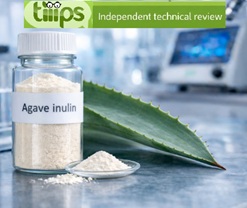
Agave inulin
Rating : 7
| Evaluation | N. Experts | Evaluation | N. Experts |
|---|---|---|---|
| 1 | 6 | ||
| 2 | 7 | ||
| 3 | 8 | ||
| 4 | 9 | ||
| 5 | 10 |
0 pts from Al222
| Sign up to vote this object, vote his reviews and to contribute to Tiiips.Evaluate | Where is this found? |
| "Descrizione" about Agave inulin by Al222 (24812 pt) | 2026-Feb-23 15:53 |
| Read the full Tiiip | (Send your comment) |
Agave inulin: properties, uses, pros, cons, safety
Definition
Agave inulin is a food ingredient consisting mainly of fructans (non-digestible carbohydrates) extracted from agave (particularly Agave tequilana Weber blue, in many commercial supply chains). In labeling and technical documentation, it may appear as “agave inulin”, “agave fructans”, or “agave inulin / agave fructans.”

From a practical standpoint, it is a soluble fiber used as a functional ingredient: it contributes to body, texture, and bulking effect, and can be used in reduced-sugar or reduced-fat formulations. It is important to note that the commercial term “agave inulin” may include a mixture of fructans with variable structure (often referred to as agavins/agave fructans), not always identical to classic linear chicory inulin.
Production process
In general, the production of agave inulin includes:
Selection and preparation of the raw material (agave heart/piña or extracted juice).
Aqueous extraction of fructans.
Purification/filtration to reduce impurities, pigments, and undesirable components.
Concentration of the fructan-rich fraction.
Drying (often spray-drying) to obtain a stable powder.
Sieving and standardization of the final product (particle size, moisture, purity, pH, etc.).
The most relevant quality controls are moisture, fructan content, residual simple sugars (fructose/glucose/sucrose), ash, microbiological load, heavy metals/contaminants, and storage stability. The ingredient is often described as hygroscopic, therefore sensitive to moisture uptake.
Key constituents
Composition depends on the degree of purification and production technology, but high-purity food powders mainly contain agave fructans.
Agave fructans (inulin/agavins): these are the main component and represent the key technological and nutritional function.
Favorable aspect: they act as soluble fiber and may support texture, satiety, and prebiotic functionality.
Less favorable aspect: at higher doses they may increase intestinal fermentation with bloating and flatulence in sensitive individuals.
Fructose, glucose, sucrose (residual, variable): present in residual amounts depending on purity and batch profile.
Favorable aspect: they may contribute slightly to taste and solubility.
Less favorable aspect: higher amounts reduce “fiber purity” and may affect the nutritional/technological profile.
Minerals/ash (low amounts): reflect process purity.
Favorable aspect: useful as a quality control parameter.
Less favorable aspect: high values may indicate lower refining or greater variability.
Water (residual moisture): unavoidable component of the powder.
Favorable aspect: controlled levels support stability.
Less favorable aspect: high moisture increases the risk of clumping, loss of flowability, and shelf-life issues.
Identification data and specifications
| Parameter | Value | Note |
|---|---|---|
| Ingredient name | Agave inulin | Commercially also listed as agave fructans |
| Botanical origin | Agave tequilana (common) | Commercial naming may cover different fructan specifications |
| Plant part | Heart/piña (or derived juice) | Depends on the industrial supply chain |
| Nature | Non-digestible soluble fiber (fructan mixture) | Functional food ingredient |
| Main component | Agave fructans (typically high) | In many technical sheets: >90% on dry/ash-free basis (variable by product) |
| Residual sugars | Fructose / glucose / sucrose (variable amounts) | Depend on purity and process |
| Allergen | Not considered a typical allergen | Always verify cross-contamination and supplier statements |
| Caloric value | In the EU, fiber uses an energy factor of 2 kcal/g; | value on finished product label depends on formulation |
Indicative physicochemical properties
| Parameter | Indicative value | Note |
|---|---|---|
| Physical state | Powder | Fine, free-flowing if well stored |
| Color | White → off-white / slightly yellowish | Variable by batch and purity |
| Odor / taste | Mild / neutral, slightly sweet | Useful in “clean taste” applications |
| Water solubility / dispersibility | Good (requires agitation) | Performance depends on DP, temperature, and concentration |
| pH (solution/concentrate) | Variable (often weakly acidic to neutral area in specs) | Depends on measurement method (°Brix/concentration) |
| Hygroscopicity | Present | Critical for shelf-life, clumping, and flowability |
| Moisture | Generally low (supplier specification) | Should be checked at receiving and during storage |
| Stability | Good if kept dry and sealed | Sensitive to moisture and severe processing conditions |
| Typical issues | Clumping, compaction, variability in viscosity/texture | Depend on dose, matrix, DP, and process |
Main uses
Food use
Agave inulin is used as a functional ingredient in:
Bakery and baked goods (biscuits, cakes, snacks) to support texture and fiber.
Dairy or dairy-alternative products (e.g., yogurt/fermented products), where it can contribute to body and creaminess.
Powdered beverages, purees, spray-dried preparations, and instant mixes as a stabilizing/bulking component.
Reformulated products with reduced sugar or reduced fat, where fructans can help compensate part of the loss in structure/mouthfeel.
In practice, performance depends greatly on dose, food matrix, processing temperature, and the fructan profile (shorter/longer chains, linear/branched).
Industrial use
The main industrial drivers are:
Solubility/dispersibility
Moisture control
Process stability (mixing, heating, drying)
Batch consistency
Sensory impact (residual sweetness, texture, mouthfeel)
Nutrition and health
Agave inulin falls within fermentable fibers and is also used for its prebiotic role (substrate for the intestinal microbiota). In practical terms, it may contribute to:
increased fiber content in the diet/product;
support for intestinal regularity in some individuals;
improvement of certain texture aspects with lower energy contribution than the sugars or fats it replaces (depending on formulation).
However, tolerance is dose-dependent: increasing intake too quickly may cause bloating, gas, and abdominal discomfort, especially in people sensitive to FODMAPs or with irritable bowel symptoms.
Pros
Functional soluble fiber, useful for improving the nutritional profile.
Can act as a texturizer/bulking agent in many matrices.
Can support reduced-sugar or reduced-fat formulations.
Generally offers good sensory compatibility (neutral or mildly perceptible taste).
Cons
Possible gastrointestinal intolerance (bloating, flatulence, borborygmi), especially at higher doses or if introduced abruptly.
Technological performance may be variable among products/suppliers (different fructan/DP profile).
Being hygroscopic, it requires careful packaging and storage management.
It does not automatically replace sugar or fat 1:1: formulation adjustment is required.
Portion note
A useful portion depends on the finished product and individual tolerance. It is advisable to consider:
dose of agave inulin per serving,
total amount of fermentable fibers in the daily diet,
presence of other potentially fermentable ingredients in the same meal.
Safety (allergens, contraindications)
Agave inulin is generally considered a food ingredient with a favorable safety profile under intended conditions of use, but with attention to gastrointestinal tolerability.
Allergens: it is not typically classified as a major allergen; supplier information on cross-contamination remains relevant.
Contraindications/cautions: caution in individuals with IBS or high FODMAP sensitivity, because it may increase fermentation, gas, and bloating.
Dose and adaptation: it is prudent to increase intake gradually to improve tolerance.
Supply-chain quality/safety: controls on heavy metals, mycotoxins/pesticides (if applicable), microbiology, and purity are important.
Storage and shelf-life
Store in a cool, dry place, in a well-sealed package with a good moisture barrier.
Key points:
avoid prolonged exposure to humidity;
reseal well after use to limit clumping and compaction;
manage stock rotation and stable warehouse conditions.
The ingredient is generally stable, but hygroscopicity is the most common practical issue.
Labelling
On the ingredient label, depending on applicable regulations and supplier documentation, it may appear as:
agave inulin
agave fiber
agave fructans
Any nutrition claims (e.g., source of fiber / high fiber) must be verified on the finished product, not only on the ingredient. Any health claims also require compliance with applicable rules and cannot be inferred automatically from the mere presence of the ingredient.
Functional role and rationale for use
Agave inulin is used primarily to combine:
nutritional function (fiber),
technological function (bulk, body, texture),
good sensory versatility.
It is therefore a useful ingredient when aiming to improve the product profile without introducing a dominant taste. Formulation success depends on proper balancing with water, sugars, fats, proteins, and the effects of the process.
Formulation compatibility
In food formulation, the most important points are:
Dose: small changes may affect texture and GI tolerance.
Matrix: behavior in bakery, dairy, beverages, and snacks is not identical.
Thermal process: under some conditions fructans may undergo changes, with effects on functionality and sensory profile.
Water and mixing: hydration and dispersion management is central to avoid clumps and inconsistent texture.
Safety, regulation, and quality
From an industrial perspective, GMP/HACCP management is recommended with clear specifications on:
fructan purity,
moisture,
ash,
residual sugars,
microbiology,
contaminants (heavy metals, pesticides, mycotoxins where relevant).
For labeling and nutrition declaration, classification as fiber and energy calculation must follow applicable regulations (EU/other jurisdictions) and the supplier’s technical documentation.
Conclusion
Agave inulin is a fructan-based food ingredient with a dual value: nutritional (fermentable fiber) and technological (bulk, texture, stabilization in different matrices). It is particularly interesting in reformulations and functional products, but it requires good management of dose, process, and individual tolerance.
In practice, the main drivers are batch quality, fructan profile (DP/structure), hygroscopicity, and proper integration into the finished product formula.
Mini-glossary
Fructans: carbohydrates made mainly of fructose units, not digested in the small intestine.
Agavins: agave fructans often having a more branched structure than classic linear inulin.
DP (degree of polymerization): average number of sugar units in the chain; influences solubility and technological behavior.
Prebiotic: a substance selectively used by intestinal microorganisms with potential beneficial effects.
FODMAPs: a group of fermentable carbohydrates that may cause bloating and discomfort in sensitive individuals.
GMP/HACCP: good manufacturing practices and food safety control system.
| Sign up to vote this object, vote his reviews and to contribute to Tiiips.EvaluateClose | (0 comments) |
Read other Tiiips about this object in __Italiano (1)
Content:   Family:   Last update:   2026-02-23 15:43:40 | Kcal/100g:   2 Threat factors:   |

