

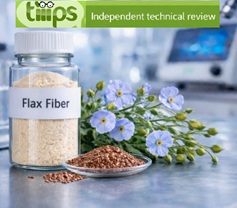
Flax fiber: properties, uses, pros, cons, safety
Definition
Flax fiber is a food ingredient obtained from the seeds of Linum usitatissimum (family Linaceae) through milling and separation of fibre-rich fractions, or as a partially defatted meal/fraction rich in fibres. In food applications it is used to increase fibre content and for the presence of mucilages (polysaccharides) that bind water and increase viscosity, affecting texture and stability of doughs and colloidal systems. It is naturally gluten-free, but “gluten-free” suitability depends on supply-chain control and cross-contamination management.

Production process
Processing varies by commercial product:
cleaning and sorting of seeds;
optional defatting (pressing/solvent extraction of oil) when a more stable, less lipid-rich fraction is required;
controlled milling and sieving to reach the target particle size and fibre specification;
optional thermal stabilisation to reduce microbiological load and inactivate enzymes.
Key controls include moisture, microbiology, particle size, fibre content, oxidative stability (if residual lipids are significant) and foreign-body absence.
Key constituents
The matrix combines structural fibre and flax-specific functional fractions, with variability depending on defatting level and fineness.
Insoluble fibre: supports bowel regularity and satiety by increasing stool bulk; potential downside: rapid increases or high doses may increase bloating/discomfort in sensitive individuals.
Mucilages (soluble fibre): polysaccharides that absorb water and form gels/viscosity; benefit: improve hydration and cohesion in doughs (a “binding” effect also useful in gluten-free) and may support a more “stable” glycaemic response within a meal context; potential downside: excessive viscosity can penalise texture (gel-like mouthfeel) and increase intestinal fermentation with gas in predisposed individuals.
Residual lipids (variable): higher in non-defatted fibres; benefit: ALA (alpha-linolenic acid, omega-3) may be present when residual oil is meaningful; potential downside: higher sensitivity to oxidation/rancidity and more critical shelf-life.
Seed proteins (variable): contribute to overall protein content; benefit: supports nutritional value; potential downside: they do not provide gluten-like elastic structure and may affect flavour if used at high levels.
Lignans (e.g., secoisolariciresinol diglucoside, SDG): characteristic phenolics of flax; benefit: potential antioxidant contribution and nutritional interest; potential downside: amount and bioavailability depend on processing and food matrix, so practical effect is variable.
Phytates (variable): naturally present in seeds; benefit: matrix chelating/antioxidant roles; potential downside: may reduce bioavailability of some minerals (iron, zinc) within the meal context, especially in marginal diets.
For more information: Flax
Identification data and specifications
| Parameter | Value | Note |
|---|
| Ingredient name | Flax fiber | From whole seeds, milled seeds or defatted fraction |
| Botanical name | Linum usitatissimum | Family: Linaceae |
| Plant part | Seed (fibre-rich fractions) | Mucilages drive functionality |
| Nature | Fibrous powder/particles | Natural hydrocolloid (mucilages) |
| Key parameters | Total/soluble fibre, particle size, moisture, microbiological load, residual lipids, oxidative stability | Performance and shelf-life drivers |
| Allergen | Not typical | Possible individual sensitivities; consider cross-contact |
| Caloric value | Variable | Lower when defatted; increases with residual lipids |
Physico-chemical properties (indicative)
| Property | Indicative value | Note |
|---|
| Physical state | Powder/particles | Fineness affects hydration |
| Colour | Beige → brown | Depends on seed and defatting |
| Odour | Mild vegetal/cereal | Rancid notes indicate oxidation |
| Water solubility | Partial (mucilages) | Forms gels/viscous dispersions |
| Water-binding capacity | High | Increases with mucilage fraction |
| Stability | Good if kept dry | Critical: moisture and oxidation (if lipidic) |
| Typical criticalities | Lumping, excessive viscosity, rancidity | Driven by particle size and storage |
Main uses
Food
Used to enrich fibre in bread, crackers, biscuits/cookies, bars, cereals and gluten-free products. In gluten-free doughs it can improve cohesion and water retention, supporting softness and reducing crumbling. It is also used in smoothies and gel-like preparations (via mucilages), with attention to dispersion to avoid lumps.
Industrial use
Fibre blends and gluten-free premixes, extruded products and bakery: key industrial drivers are soluble-fibre consistency, rheological behaviour, oxidative stability and microbiological control.
Nutrition and health
Flax fiber can significantly increase fibre intake (insoluble + soluble) and—if not fully defatted—can contribute some ALA (omega-3). Actual effect depends on dose, portion size and individual tolerance; overly rapid increases may cause discomfort.
Pros
Supports higher fibre intake with a functional mucilage effect that is also useful in gluten-free formulations. It may improve satiety and bowel regularity within a balanced diet; in non-defatted versions it can add some ALA.
Cons
At higher doses it may increase bloating and gas, especially in individuals sensitive to fermentable fibres. If residual lipids are meaningful, shelf-life is more critical due to rancidity risk. In sweet or highly processed foods, overall benefit may be limited by the recipe (added sugars/fats).
Serving note
Serving depends on the finished product and inclusion level. In practice, consider grams of fibre per serving and adequate hydration, along with individual tolerance.
Safety (allergens, contraindications)
Not a typical allergen, but individual reactions can occur. Main concerns are gastrointestinal tolerance at higher doses and quality (oxidation). Proper hygiene and microbiological control are important, especially for powdered ingredients. In specific conditions or with certain medications, very viscous fibre increases may influence absorption timing; use should be considered within the overall context.
Storage and shelf-life
Store in a cool, dry place, tightly closed and protected from light and heat. If residual lipids are present, it is more oxidation-prone: barrier packaging, stock rotation and lower temperatures improve stability.
Labelling
Declare “flax fiber” (or equivalent commercial wording). “Source of fibre” or “high fibre” claims must meet applicable thresholds for the finished product. “Gluten-free” wording is appropriate only with controlled supply chain and coherent checks.
Functional role and rationale for use
Acts as a fibre enrichment ingredient and a natural hydrocolloid (mucilages), increasing water binding, viscosity and cohesion. In gluten-free systems it can partially compensate for gluten’s structuring role, but hydration and process must be tuned to avoid excessive density or gel-like texture.
Formulation compatibility
Requires careful dispersion to avoid lumps; pre-hydration or mixing with dry powders before adding water is often helpful. In bakery, higher hydration is usually needed; in extruded products the soluble fraction influences expansion and crispness. Oxidation control is important for long shelf-life products, especially when not defatted.
Safety, regulatory and quality
GMP/HACCP management supports traceability, contaminant control, microbiology and performance consistency. Clear specifications for total/soluble fibre, residual lipids and oxidative stability reduce variability and complaints (lumping, rancidity, inconsistent performance).
Conclusion
Flax fiber (Linum usitatissimum) is a functional ingredient used to increase fibre and improve cohesion via mucilages, with relevant applications in gluten-free systems. Key drivers are soluble-fibre fraction, hydration management, and oxidation control (if residual lipids are present), together with individual tolerance at higher inclusion levels.
Mini-glossary
Mucilages: soluble polysaccharides that absorb water, forming gels and increasing viscosity.
ALA: alpha-linolenic acid (omega-3); may be present if residual lipids are significant.
Phytates: natural compounds that can bind minerals and influence bioavailability within the meal context.
Rancidity: oxidative lipid degradation causing rancid notes and quality loss.
GMP/HACCP: good manufacturing practices (GMP) and the hazard analysis and critical control points (HACCP) system for food safety.