

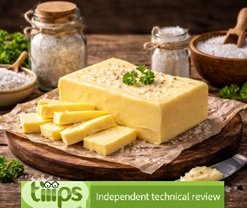
Salted butter
Rating : 4
| Evaluation | N. Experts | Evaluation | N. Experts |
|---|---|---|---|
| 1 | 6 | ||
| 2 | 7 | ||
| 3 | 8 | ||
| 4 | 9 | ||
| 5 | 10 |
Cons:
Possible risk. Click on ingredient (1)0 pts from Al222
| Sign up to vote this object, vote his reviews and to contribute to Tiiips.Evaluate | Where is this found? |
| "Descrizione" about Salted butter by Al222 (24830 pt) | 2026-Feb-21 18:00 |
| Read the full Tiiip | (Send your comment) |
Salted butter: properties, uses, pros, cons, safety
Definition
Salted butter is a dairy product obtained from the fat phase of cow’s milk (Bos taurus, family Bovidae) to which salt is added at a variable level (typically for flavour and improved keeping quality). It is a predominantly lipid matrix (milk fat) with a small proportion of water and non-fat solids. Compared with unsalted butter, it has higher saltiness and, in some formulations, improved microbiological and sensory stability due to salt’s effect on the aqueous phase.

Production process
Production typically starts with separation of cream from milk, followed by optional pasteurisation. The cream may then be ripened (optional controlled fermentation, depending on the desired flavour profile) and churned to separate butter granules from buttermilk. This is followed by washing, working (to distribute water uniformly), and salting (dry salt or brine). Finally, the butter is formed and packaged in light- and oxygen-barrier materials. Key controls include fat content, moisture, microbiological quality, salt level and oxidative stability.
Key constituents
The matrix is mainly milk triglycerides with a complex fatty acid profile. It contains a relevant share of SFA (saturated fatty acids), together with MUFA (monounsaturated fatty acids) and smaller amounts of PUFA (polyunsaturated fatty acids). Small amounts of phospholipids and unsaponifiable components are present (including fat-soluble vitamins such as vitamin A and, to a variable extent, vitamins D and E). The aqueous phase contains trace amounts of proteins and lactose, generally low in butter but not zero. Salt contributes to flavour and reduces water activity in the aqueous phase.
Identification data and specifications
| Parameter | Value | Note |
|---|---|---|
| Ingredient name | Salted butter | Added salt, variable level |
| Origin | Cow’s milk (Bos taurus) | Dairy product |
| Source/derivation | Cream → butter | Churning and working |
| Nature | Water-in-oil emulsion (W/O) | Continuous fat phase |
| Key parameters | % fat, moisture, % salt, acidity, peroxide value, sensory profile, microbiological load | Quality and shelf-life drivers |
| Allergen | Yes: milk | Contains milk-derived components |
| Caloric value | Typically ~700–760 kcal/100 g | Depends on water and composition |
| Molecular formula | Not applicable | Lipid mixture + minor fractions |
| Molecular weight | Not applicable | Complex mixture |
Physico-chemical properties (indicative)
| Property | Indicative value | Note |
|---|---|---|
| Physical state | Solid/semi-solid | Plasticity depends on temperature |
| Colour | White → yellow | Depends on diet/seasonality |
| Odour | Dairy, buttery | Rancid notes indicate oxidation |
| Water solubility | Insoluble | W/O emulsion |
| Melting range | Indicatively ~28–35 °C | Gradual melt, depends on fat profile |
| Stability | Good if refrigerated and protected | Key risks: rancidity, odour uptake |
| Typical criticalities | Oxidation, water separation, sensory defects | Driven by light, oxygen and cold chain |
Main uses
Food
Used as a spread, in cooking and pastry/baking (shortcrust, cakes, laminated doughs), for finishing risotto and sauces, and as an aromatic fat in savoury preparations. The salt makes it particularly suitable as a table butter and can enhance flavour perception in recipes where saltiness is part of the intended profile. In some fine pastry applications, unsalted butter is preferred to control total recipe salinity.
Industrial use
Used in bakery, ready meals, sauces and fillings. Industrial drivers include plasticity consistency, salt level and sensory profile.
Nutrition and health
Salted butter is energy-dense and composed mainly of fat. The SFA fraction is substantial, with MUFA and small amounts of PUFA. In a balanced diet, portion size and consumption frequency are decisive, along with the overall saturated-fat balance in the diet. Added salt increases sodium intake, which is relevant especially when the diet already includes salty foods.
Pros
It has high palatability and enhances the sensory profile of many preparations. Technologically, it offers plasticity and baking performance that can be difficult to replicate with some alternative fats, and it provides fat-soluble vitamins at variable levels.
Cons
It is calorie-rich and high in SFA; uncontrolled use can rapidly increase energy and saturated-fat intake. It also contains salt: for individuals who need to limit sodium, or in already high-salt diets, it can contribute to excess. It is an allergen (milk).
Serving note
Practical portions are often small (spread amounts or recipe inclusion), but energy density is high. For realistic evaluation, consider the actual grams used and the total daily intake of salt and saturated fats.
Safety (allergens, contraindications)
Allergen: milk. For those with cow’s milk protein allergy, or severe lactose intolerance (even though lactose is generally low in butter), individual tolerance and product specification should be considered. Food safety depends on maintaining the cold chain, appropriate packaging and process hygiene. Typical defects include oxidative rancidity and odour uptake.
Storage and shelf-life
Store refrigerated, tightly closed, protected from light and odours (butter readily absorbs aromas). Salted butter tends to be slightly more stable than unsalted, but it remains sensitive to oxygen and light. Freezing is possible to extend shelf-life, with attention to oxidation protection and freezer burn.
Labelling
On-pack, it is declared as “butter” with “salt” listed among ingredients (sometimes with a stated percentage), and the allergen milk must be highlighted according to applicable rules. In composite foods, salted butter affects total salt content and may be relevant for nutrition declaration of sodium/salt.
Functional role and rationale for use
Salted butter acts as a fat phase with the characteristic plasticity and flavour of milk fat. Salt amplifies flavour perception and can contribute to aqueous-phase stability. In baking, the crystalline structure of milk fat influences lamination, friability and mouthfeel.
Formulation compatibility
In pastry/bakery, total recipe salt must be considered: added salt often needs to be reduced or removed to avoid excess. In emulsions and sauces, salt can interact with stabilisers and flavour balance. In delicate preparations (sweet creams), salted butter may shift the profile; selection depends on the target outcome.
Safety, regulatory and quality
Application of GMP/HACCP across the milk-to-butter chain supports hygiene, traceability and microbiological control. Quality control focuses on acidity, peroxide value (oxidation) and sensory profile, as well as verification of declared salt content.
Conclusion
Salted butter is a dairy fat with added salt, valued for flavour and technological performance in cooking and baking. Key drivers are raw material quality, oxidation control, cold-chain management and salt level. From a nutritional perspective, the critical points are high energy density and the share of SFA, together with sodium contribution.
Mini-glossary
SFA: saturated fatty acids; excessive intake may be less favourable than unsaturated fats in the context of an overall diet.
MUFA: monounsaturated fatty acids; often considered more favourable when replacing part of SFA.
PUFA: polyunsaturated fatty acids; include omega-6 and omega-3 families with potential benefits when balanced.
W/O emulsion: water-in-oil emulsion with a continuous fat phase (typical of butter).
Peroxide value: indicator of primary lipid oxidation, used to monitor freshness and stability.
GMP/HACCP: good manufacturing practices (GMP) and the hazard analysis and critical control points (HACCP) system for safety and contamination prevention.
A correlation between butter consumption and Alzheimer's disease has also been established (5).
References_________________________________________________________
(1) von Ruesten A, Feller S, Bergmann MM, Boeing H. Diet and risk of chronic diseases: results from the first 8 years of follow-up in the EPIC-Potsdam study. Eur J Clin Nutr. 2013 Apr;67(4):412-9. doi: 10.1038/ejcn.2013.7.
(2) Patterson E, Larsson SC, Wolk A, Åkesson A. Association between dairy food consumption and risk of myocardial infarction in women differs by type of dairy food. J Nutr. 2013 Jan;143(1):74-9. doi: 10.3945/jn.112.166330. Epub 2012 Nov 21.
(3) Livingstone KM, Lovegrove JA, Cockcroft JR, Elwood PC, Pickering JE, Givens DI. Does dairy food intake predict arterial stiffness and blood pressure in men?: Evidence from the Caerphilly Prospective Study. Hypertension. 2013 Jan;61(1):42-7. doi:10.1161/HYPERTENSIONAHA.111.00026. Epub 2012 Nov 12.
(4) Vlajinac H, Ilic M, Marinkovic J, Sipetic S. Nutrition and prostate cancer. J BUON. 2010 Oct-Dec;15(4):698-703.
(5) Janssen, C. I., Jansen, D., Mutsaers, M. P., Dederen, P. J., Geenen, B., Mulder, M. T., & Kiliaan, A. J. (2016). The Effect of a High-Fat Diet on Brain Plasticity, Inflammation and Cognition in Female ApoE4-Knockin and ApoE-Knockout Mice. PloS one, 11(5), e0155307. https://doi.org/10.1371/journal.pone.0155307
| Sign up to vote this object, vote his reviews and to contribute to Tiiips.EvaluateClose | (0 comments) |
Read other Tiiips about this object in __Italiano (1)
Content:   Family:   Last update:   2026-02-21 12:09:24 | Kcal/100g:   760 Threat factors:   |

