

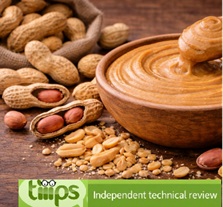
Peanut paste (Arachis hypogaea)
Definition
Peanut paste is obtained by grinding peanut seeds (Arachis hypogaea, family Fabaceae), typically roasted, into a creamy mass. It can be “natural” (peanuts only) or formulated with salt, sugar, and/or added oils to adjust taste and stability. It is a high energy-density ingredient characterized by significant lipid and protein content, plus minor compounds typical of oilseed legumes.
Application fields: food (spread, ingredient for sweet/savory products), cosmetics (rare use; purified oils or lipid fractions are more typical), medical/pharmaceutical (indirect use in nutritional plans), industrial use (semi-finished products for snacks, bars, creams, fillings).

Production process
Typical processing includes: peanut selection and cleaning, optional blanching and germ removal per specification, roasting (main driver of aroma profile), cooling, grinding (often multi-stage) to target particle size and viscosity, optional homogenization and degassing. Where required, salt/sugars/emulsifiers or oils are added to control oil separation and spreadability. Packaging follows in barrier containers, with controls on oxidation and contaminants.
Critical supply-chain note: peanuts require stringent controls for aflatoxins and microbiological quality, as well as strict allergen management.
Key constituents
Triglycerides (fatty acids mainly monounsaturated and polyunsaturated); peanut proteins; dietary fiber; carbohydrates at lower levels; mineral salts (magnesium, phosphorus, potassium at representative levels); vitamins (vitamin E and some B vitamins at variable levels); trace phenolics and phytosterols; low residual water. In products that are not “100% peanuts,” salt, sugars, and stabilizers/emulsifiers may be present depending on the label.
Identification data and specifications
| Characteristic | Value | Note |
|---|
| Ingredient name | Peanut paste | 100% peanuts or formulated |
| Botanical name | Arachis hypogaea | Family: Fabaceae |
| Plant part | Seeds | Oilseed legume |
| Nature | Lipid–protein paste | Concentrated dispersion/emulsion |
| Key parameters | Fat, protein, moisture, peroxide/oxidation, particle size | Drive quality and shelf-life |
| Allergen | Peanuts | Major allergen |
| Caloric value | Typically ~580–650 kcal/100 g | Depends on recipe and fat content |
Physicochemical properties (indicative)
| Characteristic | Indicative value | Note |
|---|
| Physical state | Viscous paste | Smooth to crunchy |
| Color | Beige → light brown | Roasting-dependent |
| Odor | Roasted peanut | Oxidation-sensitive |
| Water solubility | Not soluble | Partial dispersion; true emulsification needs processing/additives |
| Stability | Variable | Oil separation can occur without stabilizers |
| Oxidative stability | Moderate | Improved by barrier packaging and natural antioxidants (e.g., tocopherols) |
| Typical criticalities | Rancidity, oil separation, viscosity increase | Driven by oxygen, temperature, formulation |
Main uses
Food
Spread for bread and snacks; ingredient in bars, creams, fillings, biscuits, ice cream, and sauces (e.g., satay-style or dressings). In formulation it provides fats, proteins, body, and aroma. In sweet goods it can partially replace fats or flours, but it changes structure and water management.
Serving note
A typical spread serving is often 15–30 g. Caloric impact is high; portion and frequency are key in dietary plans.
Safety (allergens, food)
Contains the peanut allergen (high risk for allergic individuals). Strict allergen management and correct labelling are essential. Aflatoxin controls and raw material quality management are critical.
Storage and shelf-life
Store away from heat and light. After opening, reseal tightly to limit oxygen exposure. Oil separation is common in “natural” versions and does not necessarily indicate spoilage, but it must be distinguished from rancid odors or off-notes.
Labelling
Clearly declare peanuts and any added ingredients (salt, sugars, oils, emulsifiers). Claims (no added sugar, 100% peanuts) must align with the recipe and applicable rules.
Industrial use
Semi-finished base for snacks and bars, focusing on oxidative stability, aromatic reproducibility, and contaminant control (aflatoxins) and allergens.
Functional role and use rationale
Peanut paste provides a combination of lipids and proteins that increases satiety and body, plus an aroma profile driven by roasting and volatile compounds. Technologically, it is a concentrated dispersion: stability depends on the balance between the oil phase and solid fraction; without stabilizers, oil may separate, while oxidation can lead to rancidity.
Formulation compatibility
In water-containing products (creams, sauces), stable emulsification requires adequate shear and sometimes emulsifiers; salt and pH can affect texture. In bakery, lipids can reduce gluten development and modify structure. In ice cream, it contributes fats and solids, affecting overrun and melt. Compatibility with flavors and cocoa is generally good, but oxidation control remains critical.
Pros and cons
Pros
High nutritional density (proteins and fats) with a strong sensory profile.
Versatile in sweet and savory applications; useful as an aromatic and structuring base.
Clean-label options are possible (100% peanuts) with a simple ingredient list.
Cons
Major allergen (peanuts) requiring strict management.
Oxidation risk (rancidity) and oil separation in natural versions.
Contaminant control (aflatoxins) and raw material quality are critical drivers.
Safety, regulatory, and environment
Allergen
Yes: peanuts (major allergen).
Contraindications
Contraindicated for individuals allergic to peanuts. In hypocaloric or lipid-controlled regimens, portion and frequency are central. In specific clinical conditions, positioning should be evaluated within the overall dietary plan.
Regulatory/quality note
GMP/HACCP management with focus on allergens, contaminants (aflatoxins), and oxidative stability. Clear, complete labelling is essential for consumer safety.
Storage and shelf-life
Shelf-life depends on oxygen, temperature, and packaging. Barrier containers and reduced headspace help preserve aroma and prevent rancidity. Stabilized versions may reduce oil separation, but they do not remove the need for oxidation control.
Conclusion
Peanut paste (Arachis hypogaea) is a lipid–protein ingredient with high energy density, valued for aroma and functionality across many food applications. The main drivers for quality and reproducibility are supply-chain control (aflatoxins), management of the peanut allergen, oxidative stability, and the choice of formulation (100% vs stabilized) based on shelf-life and end use.
Mini-glossary
Aflatoxins: mycotoxins produced by Aspergillus molds that can contaminate peanuts; they require rigorous controls.
Lipid oxidation: fat degradation leading to rancidity; accelerated by oxygen, light, and heat.
Tocopherols: antioxidant compounds (vitamin E) that support fat stability.
GMP/HACCP: good manufacturing practices and a food safety management system for food safety and contamination prevention.