

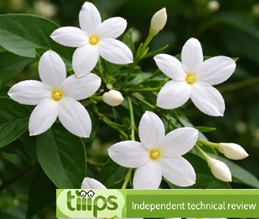
Jasmine - Jasminum officinale
Framework and general description
Jasminum officinale, known as common jasmine, is a climbing or scrambling species in the Oleaceae family, cultivated for a long time for its intensely fragrant flowers. It is widely used as an ornamental plant (for pergolas, trellises, and fences) and, through aromatic derivatives, in perfumery and in certain cosmetic applications. The plant is also appreciated for its strong ability to adapt to different garden settings, provided adequate light and drainage are ensured.

Table 1. Identification data and specifications (indicative)
| Characteristic | Data |
|---|
| Common names | Common jasmine, jasmine |
| Botanical name | Jasminum officinale |
| Botanical family | Oleaceae |
| Genus | Jasminum |
| Species | J. officinale |
| Botanical type | Climbing / scrambling shrub, often trained on supports |
| Typical height | Variable; in cultivation it may reach about 3–6 m with support (pruning is decisive) |
| Flowers | White (sometimes creamy white), highly fragrant, in inflorescences |
| Flowering period | Typically from late spring to summer (variable depending on climate) |
| Parts of interest | Flowers (aroma), leaves (secondary extractive uses), green parts (ornamental) |
| CAS / EC number | Not applicable as a botanical species; depends on any commercial extract or oil/absolute |
| Molecular formula | Not applicable (complex natural matrix) |
| Molecular weight | Not applicable (mixture of constituents) |
Plant characteristics
Habit: vigorous growth, with flexible stems that require support to climb; it can be managed as a shrub through pruning.
Leaves: generally compound (often pinnate), medium to deep green; they contribute to canopy density and ornamental coverage.
Flowers: small, white, gathered in clusters; the key feature is the production of a sweet-floral scent that can be noticeable at a distance in mild hours.
Fruit: dark berries (usually not relevant for typical ornamental use).
Cultivation
Exposure: prefers full sun or bright partial shade; good light promotes flowering and balanced growth.
Soil: prefers well-drained soils; it tolerates different substrates but suffers from prolonged waterlogging.
Management: regular pruning helps control size and shape and stimulates new flowering shoots. In colder areas it may benefit from a sheltered position and winter protection, especially in case of severe frost.
Table 2. Key constituents and chemical profile (indicative)
| Characteristic | Data |
|---|
| General evidence | The chemical profile is mainly linked to aromatic derivatives of the flowers (absolute/extracts); composition is influenced by cultivar, climate, and extraction process |
| Typical odorants (floral derivatives) | Aromatic esters and alcohols (e.g., benzyl acetate, linalool), plus nitrogen-containing trace compounds (e.g., indole) contributing to the olfactory “signature” |
| Molecules associated with the “jasmine” note | Jasmonate-related compounds (e.g., methyl jasmonate) and related constituents responsible for floral and green facets |
| Polyphenols | Possible presence of flavonoids (more typical of leaves/leaf extracts) associated with antioxidant activity |
| Application implications | Profile consistent with fragrance uses and, in cosmetics, with functions related to skin feel and sensorial perception (to be verified for the specific raw material) |
Main uses
Ornamental: primary use in gardens and terraces for vertical coverage, pergolas, and fences; high value due to the combination of flowering and fragrance.
Perfumery: aromatic flower derivatives (especially concentrated extracts) are used as floral notes in fragrance compositions; also used to add roundness and persistence to accords.
Cosmetics: use of extracts/derivatives as a fragrance component and, depending on the raw material, to support skin comfort feel in leave-on products (e.g., creams, lotions) or rinse-off products (e.g., cleansers), always depending on dosage and compliance with IFRA/internal guidelines.
Aromatic: used in home and personal fragranced products (e.g., diffusers, candles), with sensorial aims linked to perceived relaxation and well-being.
Cosmetics - INCI functions.
Fragrance. It plays a very important role in the formulation of cosmetic products as it provides the possibility of enhancing, masking or adding fragrance to the final product, increasing its marketability. It is able to create a perceptible pleasant odour, masking a bad smell. The consumer always expects to find a pleasant or distinctive scent in a cosmetic product.
Moisturizing. This ingredient is responsible for preventing the evaporation of moisture from the skin and improving cellular activity. When exposed to cold or hot air currents, the skin absorbs water from its inner layer to compensate for the evaporated water. If the draught phenomenon persists, the stratum corneum is dry and, if at all, damaged.
Skin conditioning agent. It is the mainstay of topical skin treatment as it has the function of restoring, increasing or improving skin tolerance to external factors, including melanocyte tolerance. The most important function of the conditioning agent is to prevent skin dehydration, but the subject is rather complex and involves emollients and humectants that can be added in the formulation.
Soothing. Ingredient with the task of restoring moisture to the skin, helping in the healing process of irritation, inflammation and skin disorders.
Perfuming. Unlike fragrance, which can also contain slightly less pleasant or characteristic odours, the term perfume indicates only very pleasant fragrances. Used for perfumes and aromatic raw materials.
CAS: 90045-94-6 EC number 289-960-1
Environmental and safety considerations
Environmental impact: a widely cultivated species; sustainability is mainly linked to responsible cultivation practices (efficient irrigation, limited phytosanitary inputs, proper pruning). In ornamental cultivation it can support micro-habitats and local biodiversity (e.g., pollinators) during flowering.
Safety: the plant is generally considered safe in ornamental use. For fragrance-grade cosmetic derivatives (oil/absolute/extracts), it is advisable to consider the sensitization potential typical of aromatic raw materials, especially at higher dosages or on reactive skin. For predisposed individuals, it is prudent to limit direct exposure and follow the safety indications provided by the raw material supplier.