

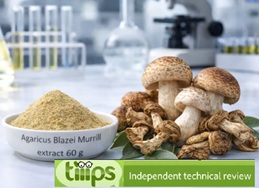
Agaricus Blazei extract
Rating : 7
| Evaluation | N. Experts | Evaluation | N. Experts |
|---|---|---|---|
| 1 | 6 | ||
| 2 | 7 | ||
| 3 | 8 | ||
| 4 | 9 | ||
| 5 | 10 |
0 pts from Al222
| Sign up to vote this object, vote his reviews and to contribute to Tiiips.Evaluate | Where is this found? |
| "Descrizione" about Agaricus Blazei extract by Al222 (24120 pt) | 2026-Jan-30 20:04 |
| Read the full Tiiip | (Send your comment) |
Agaricus blazei Murrill extract: properties, uses, pros, cons, safety
(Agaricaceae)
Extract of Agaricus blazei Murrill (often indicated as ABM) is a preparation obtained from fungal material (in practice: fruiting body and/or mycelium, depending on the manufacturer) through aqueous or hydroalcoholic extraction, followed by concentration and drying. In the food sector it is mainly used in dietary supplements positioned as “functional”, where the key technical aspects are standardization, contaminant control, and batch-to-batch repeatability.

Operational taxonomic note: in the market, “Agaricus blazei” is often used to refer to strains also marketed as Agaricus subrufescens (synonymy and usage are not always consistent). Practically, for a robust dossier what matters is what is declared in the technical sheet/SDS, including the part used and strain traceability.
Definition
It is a variable-composition mixture: not a single molecule, but a set of constituents extracted from the fungal matrix. Final composition depends on:
Part of the fungus used (fruiting body vs mycelium).
Extraction system (water, hydroalcoholic, temperature/time conditions).
Raw material/solvent ratio and concentration/drying process.
Any standardization to markers (e.g., total polysaccharides or β-glucans, where declared).
Operationally, performance in a formula depends mainly on the commercial grade: flowability (powders), solubility/haze (liquids), colour/odour, and microbiological limits.
Main uses
Food.
Used as an ingredient for dietary supplements (powders, capsules, tablets, liquid extracts) with a “mushroom/functional” positioning, often associated with polysaccharides and mushroom fractions. Technical robustness requires marker definition and specifications for contaminants (metals, pesticides where applicable, mycotoxins where relevant for the supply chain) and microbiology.
Cosmetics - INCI Functions.
Skin conditioning agent. It is the mainstay of topical skin treatment as it has the function of restoring, increasing or improving skin tolerance to external factors, including melanocyte tolerance. The most important function of the conditioning agent is to prevent skin dehydration, but the subject is rather complex and involves emollients and humectants that can be added in the formulation.
Key constituents
Composition is process-dependent. In practical terms, constituents most often cited for Agaricus extracts include:
Cell-wall polysaccharides (including β-glucans and related fractions).
Lipid/sterol components (e.g., ergosterol and derivatives, depending on material and process).
Proteins/peptides and minor phenolic fractions, grade-dependent.
For formulators, the main operational focus is: declared markers (if present), moisture profile, flowability, and contaminant controls.
Nutritional use note and bioactive compounds
In the supplement context, interest is linked to structural mushroom components (polysaccharides/β-glucans) and minor fractions, but variability is high. For a technically defensible positioning, over-generalization should be avoided: what matters is actual dose, standardization, and coherence of finished-product documentation.
Energy (calories)
At typical supplement use levels (mg to low g/day), the energy contribution is generally negligible and is not an operational primary parameter compared with quality, purity, and contaminant control.
Identification data and specifications
| Caratteristica | Valore |
|---|---|
| Name (common use) | Extract of Agaricus blazei Murrill (ABM) |
| Family | Agaricaceae |
| Raw material (typical) | Fruiting body and/or mycelium (grade-dependent) |
| Substance type | Variable-composition extract (mixture) |
| Standardization (possible) | Total polysaccharides and/or β-glucans, if declared by the manufacturer |
| Molecular formula | Not applicable (mixture) |
| Molecular weight | Not applicable as a single value (mixture) |
| Taxonomic note | In commerce it may be associated with strains also labelled as Agaricus subrufescens; verify technical sheet/SDS |
Indicative physico-chemical properties
| Caratteristica | Valore indicativo | Nota |
|---|---|---|
| Appearance | Powder / liquid extract | Depends on carrier and process |
| Solubility | Variable | In water, hazy/colloidal systems are common; verify technical sheet |
| Hygroscopicity | Possible | Impacts flow and caking; barrier packaging can help |
| Light/oxygen stability | Variable | Possible organoleptic drift; accelerated tests recommended |
| Thermal stability | Sensitive to prolonged stress | Validate if used in thermal processes or beverages |
| Critical parameters | Moisture, microbiology, markers (if present), contaminants | Main drivers of quality and repeatability |
Functional role and practical mechanism of action
In supplements, the role is that of a “functional mushroom” ingredient where perceived performance and technical defensibility depend on standardization and quality. From a formulation standpoint, the main impact concerns matrix behaviour (solubility/haze), stability, and per-serving dose consistency.
Formulation compatibility
In powders and tablets, key issues are flowability, blend uniformity, and moisture control. In liquids, haze, sedimentation, and time stability become central; it is often useful to define an appearance target (clarity vs opalescence) and validate it in real packaging. In all cases, supplier variability makes a specification with markers and acceptance criteria essential.
Use guidelines
Dose depends on grade and product positioning. Good practice includes: defining markers and specifications, controlling microbiology and contaminants, validating accelerated stability and final packaging performance, and setting organoleptic (odour/colour) and physical (flowability or suspension behaviour) acceptance criteria.
Quality, grades, and specifications
Variability across grades can be significant. Robust control includes: identity and traceability of the raw material (species/part/strain), standardization (if intended), microbiological limits consistent with dosage form, and contaminant control (heavy metals; agricultural residues where applicable; targeted evaluation of supply-chain risks). Adoption of GMP (good manufacturing practice; benefit: reduces variability and contamination) and HACCP (hazard analysis and critical control points; benefit: identifies and controls food-safety risks) supports traceability and repeatability.
Safety, regulatory, and environment
Safety must be assessed on the finished product considering dose, duration of use, and target population. For mushroom extracts, practical topics include: microbiological quality, contaminants, and compositional variability. In the EU, regulatory status may depend on the part used (e.g., mycelium vs fruiting body) and the history of consumption; for some preparations, public documents consider them novel food when a significant history of consumption before 15 May 1997 is not demonstrated.
Allergen.
Not typically classified as a labelling allergen, but individual allergic reactions to mushrooms or to process residues are possible.
Contraindications (brief).
Use caution in individuals with liver disease or on therapies with potential hepatotoxicity: case reports of severe liver injury have been described in oncology patients taking Agaricus extracts in complex therapy contexts; causality is not always unequivocal, but warrants prudence. Prudence is also appropriate in immunosuppression or chronic therapies, with professional evaluation for continuous use.
Formulation troubleshooting
Haze/sedimentation in liquids.
Action: define an appearance target, optimize dispersion and viscosity, evaluate a grade with different particle size or extraction process, and validate with accelerated stability testing.
Powder caking and poor flowability.
Action: control moisture, use barrier packaging, optimize particle size and storage conditions.
Perceptible batch-to-batch variability.
Action: strengthen marker and contaminant specifications, introduce incoming controls, and qualify suppliers with more standardized processes.
Conclusion
Extract of Agaricus blazei Murrill (ABM) is a variable-composition raw material mainly used in supplements. Robust use depends on: clear raw material identity (species/part/strain), standardization (if intended), contaminant and microbiology control, and stability validation in the finished formula. The safety section warrants a prudent approach, including a concise note on individual allergenicity and attention to liver-related concerns reported in specific literature contexts.
Mini-glossary
β-glucans. Polysaccharides of the fungal cell wall often used as standardization markers, with variability linked to species and process.
Novel food. Food/ingredient without a significant history of consumption in the EU before 15 May 1997, subject to an authorization procedure.
GMP. Good manufacturing practice; benefit: reduces variability and contamination through controlled manufacturing practices.
HACCP. Hazard analysis and critical control points; benefit: systematic prevention and control of food-safety hazards through critical control points.
References__________________________________________________________________________
Yu R, Li X, Yi P, Wen P, Wang S, Liao C, Song X, Wu H, He Z, Li C. Isolation and Identification of Chemical Compounds from Agaricus blazei Murrill and Their In Vitro Antifungal Activities. Molecules. 2023 Oct 28;28(21):7321. doi: 10.3390/molecules28217321.
Abstract. This study explores the antifungal properties of Agaricus blazei Murrill, a valuable medicinal and edible fungus. Six compounds (1-6) were first isolated from A. blazei using various isolation techniques and identified using spectroscopic methods. These compounds include linoleic acid, 1,1'-oxybis(2,4-di-tert-butylbenzene), glycerol monolinoleate, volemolide (17R)-17-methylincisterol, (24s)-ergosta-7-en-3-ol, and dibutyl phthalate. This study also assesses the antifungal activities of these compounds against Trichophyton mentagrophology, Trichophyton rubrum, Candida albicans, and Cryptococcus neoformans. The results demonstrate varied sensitivities against these pathogenic fungi, with compound 2 showing significant inhibition against T. mentagrophology, compound 3 showing significant inhibition against T. rubrum, and compound 6 showing significant inhibition against C. albicans. This study underscores the medicinal potential of A. blazei as an antifungal agent and sheds light on its valuable research implications.
Taofiq O , Rodrigues F , Barros L , Peralta RM , Barreiro MF , Ferreira ICFR , Oliveira MBPP . Agaricus blazei Murrill from Brazil: an ingredient for nutraceutical and cosmeceutical applications. Food Funct. 2019 Feb 20;10(2):565-572. doi: 10.1039/c8fo02461h.
Abstract. Operations for sorting mushrooms at the industrial level usually generate large amounts of bio-residues not conforming to strict morphological criteria for commercial purposes, even though their biological content is not compromised. In this context, the present work aimed at evaluating the potential for reutilizing industrially discarded Agaricus blazei Murill (ABM). Thus, the content of essential nutrients and the chemical composition were determined, and MTT and LDH assays were used to evaluate the viability and cell death of Caco-2 and HT29 cell lines of an ethanolic extract prepared from ABM (preliminary safety tests for nutraceutical applications). The extract was incorporated into a semi-solid base cosmetic cream and cell viability effects of the extract, and of the final cream formulation, on a keratinocyte cell line (HaCaT) were studied (preliminary safety tests for cosmeceutical applications). Essential nutrients, such as proteins and carbohydrates, and a low fat content were determined for ABM. Twenty-two fatty acids were detected, with polyunsaturated fatty acids (PUFA) (∼53%) being the most abundant fraction. The cell viabilities of Caco-2 and HT29 cells were maintained up to 100 μg mL-1. After incorporation into the base cream, a formulation with a pale yellow colour and favourable pH was obtained. The cell viability of HaCaT cells in the presence of the extract and the final cream formulation was maintained in a concentration dependent manner, which indicates the safety of this extract for cosmeceutical applications. The results suggest that ABM residues can be used as an inexpensive and sustainable source of nutraceutical and cosmeceutical ingredients.
Ogasawara A, Doi H, Matsui T, Tokunaga E, Amakawa M, Akiyama H. Agaritine derived from Agaricus blazei Murrill induces apoptosis via mitochondrial membrane depolarization in hematological tumor cell lines. Fujita Med J. 2023 May;9(2):147-153. doi: 10.20407/fmj.2022-021.
Abstract. Objectives: Agaritine (AGT) is a hydrazine-containing compound derived from the mushroom Agaricus blazei Murill. We previously reported the antitumor effect of AGT on hematological tumor cell lines and suggested that AGT induces apoptosis in U937 cells via caspase activation. However, the antitumor mechanism of AGT has not been fully understood. Methods: Four hematological tumor cell lines (K562, HL60, THP-1, H929) were used in this study. The cells were incubated in the presence of 50 μM AGT for 24 h and analyzed for cell viability, annexin V positivity, caspase-3/7 activity, mitochondrial membrane depolarization, cell cycle, DNA fragmentation, and the expression of mitochondrial membrane-associated proteins (Bax and cytochrome c). Results: In HL60, K562, and H929 cells, AGT reduced cell viability and increased annexin V- and dead cell-positive rates; however, it did not affect THP-1 cells. In K562 and HL60 cells, caspase-3/7 activity, mitochondrial membrane depolarization, and expression of mitochondrial membrane proteins, Bax and cytochrome c, were all increased by AGT. Cell cycle analysis showed that only K562 exhibited an increase in the proportion of cells in G2/M phase after the addition of AGT. DNA fragmentation was also observed after the addition of AGT. Conclusions: These results indicate that AGT induces apoptosis in K562 and HL60 cells, like U937 reported previously, but showed no effect on THP-1 cells. It was suggested that AGT-induced apoptosis involves the expression of Bax and cytochrome c via mitochondrial membrane depolarization.
Wang H, Fu Z, Han C. The Medicinal Values of Culinary-Medicinal Royal Sun Mushroom (Agaricus blazei Murrill). Evid Based Complement Alternat Med. 2013;2013:842619. doi: 10.1155/2013/842619.
Abstract. Agaricus blazei Murrill (ABM), a mushroom native to Brazil, is a basidiomycete brown fungus, which is popularly known as "Cogumelo do Sol" in Brazil or "Himematsutake" in Japan, and there has been a prominent increase in the use of ABM for therapeutic and medicinal purposes. ABM is useful against a variety of diseases like cancer, tumor, chronic hepatitis, diabetes, atherosclerosis, hypercholesterolemia, and so on. In this review, we demonstrated various pharmacological effects of ABM, so that we can use different effects of ABM against different diseases and provide reference for the study of ABM in the future.
| Sign up to vote this object, vote his reviews and to contribute to Tiiips.EvaluateClose | (0 comments) |
Read other Tiiips about this object in __Italiano (1)
Content:   Last update:   2026-01-30 20:07:46 | Kcal/100g:   Family:   Threat factors:   |

