

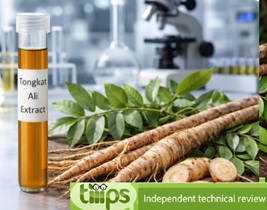
Tongkat ali extract
Rating : 4
| Evaluation | N. Experts | Evaluation | N. Experts |
|---|---|---|---|
| 1 | 6 | ||
| 2 | 7 | ||
| 3 | 8 | ||
| 4 | 9 | ||
| 5 | 10 |
0 pts from Al222
| Sign up to vote this object, vote his reviews and to contribute to Tiiips.Evaluate | Where is this found? |
| "Descrizione" about Tongkat ali extract by Al222 (24120 pt) | 2026-Jan-30 18:31 |
| Read the full Tiiip | (Send your comment) |
Tongkat ali extract: properties, uses, pros, cons, safety, alternatives
Tongkat ali (Eurycoma longifolia Jack), also known as “long jack” or “Malaysian ginseng,” is a slow-growing evergreen tree in the Simaroubaceae family, native to Southeast Asia. The most used part is the root, traditionally prepared as decoctions or aqueous extracts and, in modern practice, as standardised extracts in supplements.

Botanical framework
Kingdom: plantae
Order: sapindales
Family: simaroubaceae
Genus: eurycoma
Species: eurycoma longifolia
Plant characteristics
Habit: small tree or large shrub, evergreen, slow-growing.
Key plant part: woody, bitter roots used as the main raw material for extracts.
Habitat: tropical forests and tropical environments in Southeast Asia, often on well-drained soils.
Technical note: commercial products most commonly use dried aqueous extracts in powder form, frequently standardised to specific markers.
Chemical composition and structure
Tongkat ali phytochemistry is complex and varies with botanical origin, plant part, and extraction process. The most relevant classes include quassinoids, alkaloids, and polar glycosaponin-rich fractions.
Quassinoids: eurycomanone, eurycomalactone, eurycomanols, eurycomalactones, chaparrinone, 13-α-21-epoxyeurycomanone.
Canthin-6-one alkaloids: canthin-6-one, 9-methoxycanthin-6-one, 9-hydroxycanthin-6-one, canthin-6-one-9-O-β-D-glucopyranoside.
β-carboline alkaloids: 7-hydroxy-β-carboline-1-propionic acid, β-carboline-1-propionic acid, 1-methoxymethyl-β-carboline, 7-methoxy-β-carboline-1-propionic acid.
Coumarins: scopoletin, isoscopoletin.
Glycosaponins and polar fractions: a glycosaponin-rich fraction is often described as prominent in standardised extracts; polysaccharides and proteins are also reported in aqueous extracts.
Triterpenes: triterpenes described as squalene-type and tirucallane-type have been reported in root/extract profiling.
Uses and benefits
Traditional use: root use is traditionally associated with support for vitality, male well-being, and broader ethnomedicinal uses in different contexts.
Modern supplement use: products are often marketed for supporting testosterone and physical performance; available clinical studies report variable effects depending on preparation and standardisation.
Quality and standardisation: industrial extracts are frequently standardised to eurycomanone and to a glycosaponin fraction.
Applications
Dietary supplements: root extracts in capsules or powders, often standardised to chemical markers.
Phytochemical research: isolation and quantification of quassinoids and alkaloids for quality control and biological activity research.
Cosmetics: occasional use as a botanical extract in formulations, more as a “botanical” ingredient than as a regulatorily consolidated active.
Cultivation
Environment: tropical climate, grown in open field or agroforestry systems in Southeast Asia.
Soil and management: preference for well-drained soils; slow growth with long timelines to obtain roots suitable for processing.
Raw material variability: root quality can vary with origin, plant age, and harvesting practices.
Environmental and safety considerations
Regulatory safety in the EU: an EFSA assessment on a specific standardised aqueous extract proposed as a novel food identified genotoxicity concerns and concluded that safety was not established under the assessed conditions of use.
Liver: isolated cases of liver injury have been reported in association with tongkat ali products; causality may be complicated by multi-ingredient products and co-exposures.
Dose and tolerability: at “traditional” doses, adverse effects are described as uncommon, while market products may use higher doses; possible gastrointestinal discomfort, headache, and rash have been reported.
Interactions: potential effects on drug-metabolising enzymes have been investigated, with possible relevance for interactions in individuals on chronic therapy.
Good practice: prefer products with analytical controls and traceability; avoid use during pregnancy and breastfeeding; caution in liver disease or when taking medications.
Alternatives
| Option | Product type | Why it can be an alternative |
|---|---|---|
| Panax ginseng | Herbal “adaptogen” | Commonly used to support perceived energy and performance; broad traditional use (watch for interactions with anticoagulants/stimulants). |
| Withania somnifera (ashwagandha) | Adaptogen / stress-support | More stress-and-recovery oriented; may support well-being and vitality in some people (caution with thyroid issues, sedatives, pregnancy). |
| Lepidium meyenii (maca) | Food-like root | Often used for libido and general wellness; generally well tolerated (consider caution in hormone-sensitive conditions). |
Synonyms
tongkat ali
long jack
Malaysian ginseng
eurycoma longifolia Jack
References__________________________________________________________________________
(1) EFSA Panel on Nutrition, Novel Foods and Food Allergens (NDA); Turck D, Bohn T, Castenmiller J, De Henauw S, Hirsch-Ernst KI, Maciuk A, Mangelsdorf I, McArdle HJ, Naska A, Pelaez C, Pentieva K, Siani A, Thies F, Tsabouri S, Vinceti M, Cubadda F, Frenzel T, Heinonen M, Maradona MP, Marchelli R, Neuhäeuser-Berthold M, Poulsen M, Schlatter JR, van Loveren H, Matijević L, Knutsen HK. Safety of Eurycoma longifolia (Tongkat Ali) root extract as a novel food pursuant to Regulation (EU) 2015/2283. EFSA J. 2021 Dec 22;19(12):e06937. doi: 10.2903/j.efsa.2021.6937. PMID: 34987621; PMCID: PMC8693240.
Rehman SU, Choe K, Yoo HH. Review on a Traditional Herbal Medicine, Eurycoma longifolia Jack (Tongkat Ali): Its Traditional Uses, Chemistry, Evidence-Based Pharmacology and Toxicology. Molecules. 2016 Mar 10;21(3):331. doi: 10.3390/molecules21030331.
Abstract. Eurycoma longifolia Jack (known as tongkat ali), a popular traditional herbal medicine, is a flowering plant of the family Simaroubaceae, native to Indonesia, Malaysia, Vietnam and also Cambodia, Myanmar, Laos and Thailand. E. longifolia, is one of the well-known folk medicines for aphrodisiac effects as well as intermittent fever (malaria) in Asia. Decoctions of E. longifolia leaves are used for washing itches, while its fruits are used in curing dysentery. Its bark is mostly used as a vermifuge, while the taproots are used to treat high blood pressure, and the root bark is used for the treatment of diarrhea and fever. Mostly, the roots extract of E. longifolia are used as folk medicine for sexual dysfunction, aging, malaria, cancer, diabetes, anxiety, aches, constipation, exercise recovery, fever, increased energy, increased strength, leukemia, osteoporosis, stress, syphilis and glandular swelling. The roots are also used as an aphrodisiac, antibiotic, appetite stimulant and health supplement. The plant is reported to be rich in various classes of bioactive compounds such as quassinoids, canthin-6-one alkaloids, β-carboline alkaloids, triterpene tirucallane type, squalene derivatives and biphenyl neolignan, eurycolactone, laurycolactone, and eurycomalactone, and bioactive steroids. Among these phytoconstituents, quassinoids account for a major portion of the E. longifolia root phytochemicals. An acute toxicity study has found that the oral Lethal Dose 50 (LD50) of the alcoholic extract of E. longifolia in mice is between 1500-2000 mg/kg, while the oral LD50 of the aqueous extract form is more than 3000 mg/kg. Liver and renal function tests showed no adverse changes at normal daily dose and chronic use of E. longifolia. Based on established literature on health benefits of E. longifolia, it is important to focus attention on its more active constituents and the constituents' identification, determination, further development and most importantly, the standardization. Besides the available data, more evidence is required regarding its therapeutic efficacy and safety, so it can be considered a rich herbal source of new drug candidates. It is very important to conserve this valuable medicinal plant for the health benefit of future generations.
LiverTox: Clinical and Research Information on Drug-Induced Liver Injury . Bethesda (MD): National Institute of Diabetes and Digestive and Kidney Diseases; 2012–.
Abstract. Tongkat ali (Eurycoma longifolia Jack), also known as “Long Jack”, is a flowering, shrubby, slow growing tree native to Southeast Asia, the leaves, roots, and bark of which have been used extensively in traditional medicine for many conditions including diabetes, arthritis, liver diseases, malaria, dysentery, and erectile dysfunction. It has recently become a popular herbal supplement in the United States, as extracts of tongkat ali roots have been promoted as increasing testosterone levels and improving athletic performance. Reports of clinically apparent liver injury attributed to tongkat ali in body builders have recently appeared.
Leitão AE, Vieira MCS, Pelegrini A, da Silva EL, Guimarães ACA. A 6-month, double-blind, placebo-controlled, randomized trial to evaluate the effect of Eurycoma longifolia (Tongkat Ali) and concurrent training on erectile function and testosterone levels in androgen deficiency of aging males (ADAM). Maturitas. 2021 Mar;145:78-85. doi: 10.1016/j.maturitas.2020.12.002. Epub 2020 Dec 10. PMID: 33541567.
Kaliounji A, Shadid G, Saba H, Ahlawat S. A Rare Case of Tongkat Ali-Induced Liver Injury: A Case Report. Cureus. 2024 Mar 21;16(3):e56639. doi: 10.7759/cureus.56639. PMID: 38646387; PMCID: PMC11032125.
| Sign up to vote this object, vote his reviews and to contribute to Tiiips.EvaluateClose | (0 comments) |
Read other Tiiips about this object in __Italiano (1)
Content:   Last update:   2026-01-30 18:25:55 | Kcal/100g:   Family:   Threat factors:   |

