

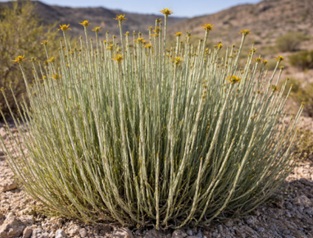
Candelilla (Euphorbia cerifera)
Candelilla is a semi-succulent shrub of the genus Euphorbia (family Euphorbiaceae), typical of arid and semi-arid regions between northern Mexico and the south-western United States. In modern taxonomy, Euphorbia cerifera is commonly treated as a synonym of Euphorbia antisyphilitica; in industrial and commercial contexts, both names are used in connection with candelilla wax, a hard vegetable wax that coats stems and aerial parts and functions as a protective barrier against dehydration.

Botanical framework
Plant characteristics
Habit: shrub or subshrub with thin, erect, densely tufted stems; a “nearly leafless” appearance (leaves reduced or scarcely visible for much of the growth cycle).
Waxy surface: stems and aerial parts are covered by a conspicuous wax layer produced as a physical barrier against evaporation and environmental stress.
Habitat: arid environments, poor and well-drained soils, high solar radiation, and marked temperature swings.
Reproduction and growth: slow to moderate growth under desert conditions; wax production is favoured by water stress and high irradiance.
Chemical composition and structure
“Candelilla wax” is a complex mixture of high-molecular-weight lipid fractions. Composition varies with collection area, season, plant age, and degree of refining.
Linear hydrocarbons (n-alkanes): typically the dominant fraction; characteristic chains C29–C33.
Representative n-alkanes: nonacosane (C29), n-hentriacontane (C31) often reported as a major component, tritriacontane (C33).
High-molecular-weight wax esters: esters of long-chain fatty alcohols and fatty acids, contributing to hardness and film cohesion.
Free fatty acids: an acidic fraction influencing rheology and interactions with oils and butters in formulations.
Free fatty alcohols: long-chain alcohols contributing to the crystalline structure of the wax.
Resins and triterpenoid fraction: a resinous portion associated with triterpene esters and pentacyclic triterpenes, contributing to adhesiveness, gloss, and tack.
Indicative distribution: commonly described as a predominance of hydrocarbons, followed by esters, resin fraction, and smaller amounts of free acids and alcohols; exact values depend on the standard and refining level.
Uses and benefits
Technological function: a hard vegetable wax used to increase consistency, working melting range, thermal stability, and gloss in lipid systems.
Plant-based alternative: often used as an alternative to, or in combination with, beeswax and other natural waxes in “vegan” formulations.
Barrier properties: forms a continuous film with a protective effect and reduced water loss in cosmetic matrices and in certain food applications.
Applications
Cosmetics: lipsticks, sticks, lip balms, mascara, anhydrous products and W/O systems, hair waxes, solid balms; used for structure, glide, shine, and stability.
Food: coating and glazing agent; used as additive E902 in specific glazing applications.
Pharmaceutical and dermocosmetic: wax bases and sticks, protective coatings, semi-solid systems where strong structuring is required.
Industrial: polishes, protective waxes, and formulations where a hard wax with good blend compatibility is useful.
Cultivation
Environment: cultivation/management is typical of arid areas with full sun and strong drainage.
Soil and water: prefers poor, well-drained soils; minimal irrigation, avoiding waterlogging.
Biomass management: wax yield is linked to environmental conditions and harvesting/management practices for aerial parts, with attention to plant regeneration.
Environmental and safety considerations
Plant (latex): like many Euphorbia species, it may produce an irritating latex; contact with skin and especially eyes can cause significant irritation.
Candelilla wax: generally regarded as suitable for cosmetic and food uses under applicable standards; in sensitive individuals it may still contribute to contact irritation in high-percentage formulations or on reactive skin.
Allergens and sensitisation: it is not typically classified as a primary allergen, but individual reactions are possible; in cosmetics this is managed via good formulation practice and finished-product safety assessment.
Environmental aspects: supply chains based on harvesting in desert areas require responsible resource management and collection practices that avoid local depletion.
References__________________________________________________________________________
Ekakitie, E. (2024). EUPHORBIA CERIFERA CERA (CANDELILA) EMOLLIENT PROPERTIES, USES AND EFFECTIVENESS IN SKINCARE PRODUCTS. Journal of Knowledge Learning and Science Technology ISSN: 2959-6386 (online), 3(3), 225-234.
Abstract. Candelila wax, derived from Euphorbia cerifera cera, is a natural and sustainable component that has a wide range of uses in cosmetic products. This review article explores the chemical composition, extraction techniques, and attributes of Candelila wax, with a focus on its distinctive qualities that make it highly useful in the cosmetic business. Candelila wax has been extensively studied and researched, and these studies have shown that it is highly useful in skincare. It has been found to provide significant benefits in terms of moisturizing the skin, protecting it, and improving the function of the skin barrier. The emollient and moisturizing qualities of this substance enhance skin hydration, while its film-forming capacity creates a protective barrier against environmental stresses. In addition, the non-comedogenic properties and potential anti-inflammatory effects of Candelila wax make it highly suitable for a range of skin types, including those that are sensitive or prone to acne. The future outlook for Candelila wax in cosmetics entails investigating the potential benefits of combining it with other natural substances, creating new and advanced methods of delivering it, and embracing sustainable methods of sourcing and processing. By conducting meticulously planned clinical trials, the effectiveness and safety of the substance may be verified, thereby establishing robust scientific proof for its use in skincare products. By recognizing the possibilities of Candelila wax, we may explore environmentally responsible and skin-conscious cosmetic procedures that align with the changing tastes of mindful customers. By utilizing the potent properties of this natural substance, the cosmetic industry can lead the path towards a more environmentally friendly and enduring future in the field of skincare products.
Hong, X., Zhao, Q., Chen, J., Ye, T., Fan, L., & Li, J. (2022). Fabrication and characterization of oleogels and temperature-responsive water-in-oil emulsions based on candelilla (Euphorbia cerifera) wax. Food Chemistry, 397, 133677.
Abstract. Developing novel fats with zero trans and low saturated fatty acids represents a research hotspot in the colloid field today. Herein, natural candelilla (Euphorbia cerifera) wax was used as an oleogelator to construct oleogel systems, and can make strong oleogels at low concentrations (3 wt%). These oleogels were further employed as continuous phases to fabricate surfactant-free W/O emulsions with excellent stability (at least 30 days). Microstructural observation confirmed that the stability of emulsions was attributed to the interface and bulk phase crystallization of wax. All oleogels and emulsions were pseudoplastic fluids whose gel properties could be tuned via regulating oleogelator concentration. Water content also influenced the emulsion rigidity, denoting the droplets acted as “active fillers”. Additionally, the emulsions displayed a temperature-responsive property, beneficial in mimicking the “fat-like” melt-in-the-mouth effect. These findings greatly enrich the formulation of surfactant-free W/O emulsions, providing technical support for the development of novel fats.
Oliver, G., & Kenzie, F. (2024). Euphorbia Cerifera and Candelilla Wax: Natural Emollients with Moisturizing Effects and Skin Barrier Protection in Skincare Products.
Abstract. Euphorbia Cerifera, commonly known as the Candelilla plant, is a key source of Candelilla wax, a natural emollient widely used in skincare formulations. Candelilla wax, derived from the leaves of Euphorbia Cerifera, is renowned for its exceptional moisturizing properties and its ability to enhance skin barrier function. This wax is composed of long-chain hydrocarbons, fatty acids, and esters, which contribute to its emollient and film-forming characteristics. These properties make it an ideal ingredient for moisturizing creams, lotions, lip balms, and other skincare products. The primary mechanism through which Candelilla wax exerts its moisturizing effect is by forming a protective barrier on the skin's surface. This barrier helps to prevent transepidermal water loss (TEWL), thereby maintaining skin hydration. Additionally, Candelilla wax is known for its stability and high melting point, which enhances the texture and longevity of skincare products. Unlike synthetic emollients, Candelilla wax is non-comedogenic and hypoallergenic, making it suitable for sensitive skin types. Moreover, the natural origin and eco-friendly nature of Candelilla wax have contributed to its popularity in the clean beauty industry. As consumers increasingly seek sustainable and environmentally friendly skincare options, Candelilla wax offers a plant-based alternative that aligns with these values. Research has also indicated that Candelilla wax may have potential antioxidant properties, further contributing to its protective effects on the skin.