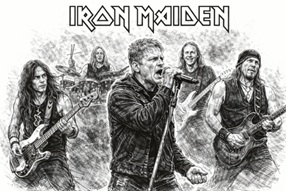
Iron Maiden, complete biography, British heavy metal, artistic identity and full discography
Profile
Iron Maiden Iron Maiden are a British heavy metal band founded in London in 1975 by bassist Steve Harris. Regarded as one of the most influential and long-running bands in metal history, Iron Maiden are among the leading protagonists of the new wave of british heavy metal (NWOBHM) and played a decisive role in shaping an artistic model that combines musical power, narrative imagery, and a high degree of productive autonomy.

Origins and context (1975–1979)
The band emerged in mid-1970s London, in a climate marked by the crisis of classic rock and the rise of punk. Steve Harris conceived Iron Maiden as an alternative response: hard and fast music, yet technically structured and open to progressive influences.
After numerous lineup changes, the group began to gain recognition in the London pub circuit, building a reputation on intense live shows and a repertoire already notable for rhythmic and melodic complexity.
Establishing themselves with the NWOBHM (1980–1981)
The recording debuts “Iron Maiden” (1980) and “Killers” (1981) placed the band at the heart of the new British heavy metal scene. In this phase, vocals were handled by Paul Di’Anno, whose approach was rougher and more punk-oriented.
The songs combine speed, sharp riffs, and a dominant rhythm section, laying the foundations for a style that would evolve rapidly in the years that followed.
The Bruce Dickinson era and the definition of the style (1980s)
With Bruce Dickinson joining in 1981, Iron Maiden made a decisive leap. Dickinson’s powerful, theatrical voice expanded the expressive range and helped introduce historical, literary, and mythological themes.
Albums such as “The Number of the Beast,” “Piece of Mind,” and “Powerslave” consolidated a formula based on:
prominent melodic bass lines;
harmonized twin guitars;
long, articulated structures;
narrative and conceptual lyrics.
This period also saw the rise of Eddie, the band’s mascot, which became a central element of their visual identity.
Experimentation and maturity (late 1980s)
Between the late 1980s and early 1990s, Iron Maiden explored more complex, progressive solutions. “Seventh Son of a Seventh Son” introduced a unified conceptual structure, while “Somewhere in Time” experimented with guitar synthesizers.
This phase shows a band capable of evolving without losing recognizability.
Transition and the 1990s
In the 1990s the group went through a period of instability, marked by Bruce Dickinson’s temporary departure and the arrival of vocalist Blaze Bayley. The albums of this era adopt a darker, more introspective approach, receiving more mixed critical and commercial responses.
Despite this, the band maintained a strong live presence and preserved its underlying identity.
Reunion and creative resurgence (2000–2010)
The return of Bruce Dickinson and guitarist Adrian Smith opened a new phase of stability and success. Albums such as “Brave New World” and “A Matter of Life and Death” demonstrated renewed inspiration, with long songs, complex structures, and a modern production approach that still respected the classic sound.
In parallel, Iron Maiden strengthened control over their career, becoming a model of independence within the music industry.
Recent phase and continuity (2010–today)
In more recent years the band has continued to release albums and undertake major worldwide tours. “The Book of Souls” and “Senjutsu” confirm their interest in historical narratives and epic atmospheres, with an approach increasingly focused on the album format rather than the single.
Live activity remains central, with concerts conceived as spectacular, narrative events.
Musical style and artistic identity
Some defining traits of Iron Maiden:
Bass at the center: complex, recognizable melodic lines.
Harmonized guitars: constant dialogue between lead parts.
Narration: lyrics inspired by history, literature, war, philosophy, and mythology.
Visual imagery: Eddie as a narrative extension of the music.
Live ethic: the concert as a total experience, not reducible to reproducing the record.
Full discography
Studio albums
1980 – Iron Maiden
1981 – Killers
1982 – The Number of the Beast
1983 – Piece of Mind
1984 – Powerslave
1986 – Somewhere in Time
1988 – Seventh Son of a Seventh Son
1990 – No Prayer for the Dying
1992 – Fear of the Dark
1995 – The X Factor
1996 – Virtual XI
2000 – Brave New World
2003 – Dance of Death
2006 – A Matter of Life and Death
2010 – The Final Frontier
2015 – The Book of Souls
2021 – Senjutsu
Live albums
Compilations and special releases
Critical reading: Iron Maiden’s role in heavy metal
Iron Maiden represent one of the strongest cases of artistic continuity in rock music. They showed that heavy metal can be technical, narrative, and popular at the same time, without abandoning complexity.
Their contribution goes beyond the music itself: they built a cultural model in which sound, image, and a fan community form parts of a single coherent system capable of spanning generations without losing relevance.



 Iron Maiden