

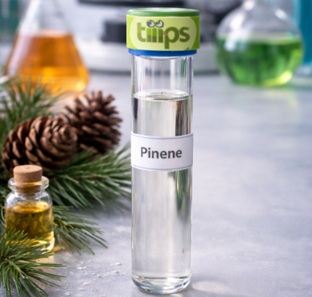
Pinene
Rating : 8
| Evaluation | N. Experts | Evaluation | N. Experts |
|---|---|---|---|
| 1 | 6 | ||
| 2 | 7 | ||
| 3 | 8 | ||
| 4 | 9 | ||
| 5 | 10 |
Pros:
Anti-inflammatory (1) Possible anti-cancer (1)0 pts from Al222
| Sign up to vote this object, vote his reviews and to contribute to Tiiips.Evaluate | Where is this found? |
| "Descrizione" about Pinene by Al222 (23811 pt) | 2026-Jan-04 19:41 |
| Read the full Tiiip | (Send your comment) |
Pinene
Synonyms: pinene, α-pinene, β-pinene (isomers); “pin-2(3)-ene” (regulatory denomination for specific isomers)
INCI / functions: antifoaming, fragrance (perfuming component)
Definition
Pinene is a monoterpene (terpene hydrocarbon) that may be supplied as a single isomer (e.g., α-pinene) or as an isomeric mixture (mainly α- and β-pinene) depending on origin and commercial specification. From a compositional standpoint, the ingredient consists primarily of pinene isomers (C₁₀H₁₆), with possible controlled trace levels of other terpenes or supply-chain related impurities (within grade specifications). In formulation it is used mainly as an odorant component (resinous/balsamic note) and, in certain systems, as a technical antifoaming aid or as a solvent/functional ingredient in industrial applications.
Food: potential use as a flavor/technical component in specific contexts (typically at trace levels, depending on category and applicable requirements).
Cosmetics: fragrance (pine/resin profile) and, where relevant, antifoaming contribution in specific systems.
Medicine: the most prominent effects of α- and β-pinene, namely their cytogenetic, gastroprotective, anxiolytic, cytoprotective, anticonvulsant, anticancer, neuroprotective.
Pharmaceutical: possible use as a technical component in non-sterile preparations or as an intermediate/auxiliary, only with appropriate grades and dossiers.
Industrial use: use as a solvent, component in technical perfumery, and intermediate for terpene derivatives/resins (sector specification-dependent).

Calories (energy value)
| Metric | Value |
|---|---|
| Energy value (100 g) | ~900 kcal (indicative estimate for terpene hydrocarbons; not a “nutritional” use parameter) |
| Technical note | In practice it is used at very low levels (aromatic/technical function), therefore the energy impact on the finished product is negligible |
Identification data and specifications
| Parameter | Value |
|---|---|
| INCI name (CosIng) | Pinene |
| Molecular formula | C₁₀H₁₆ |
| Molar mass | 136.24 g/mol (reference for pinene isomers) |
| CAS number (Pinene / α-pinene, commonly reported) | 80-56-8 |
| EC number (associated) | 201-291-9 |
| Note on grades and isomerism | Detail |
|---|---|
| β-pinene (often sold as a specific substance) | CAS 127-91-3; EC 204-872-5 |
| Practical approach | in purchasing and documentation, always verify whether the material is α-pinene, β-pinene, or an isomeric mixture (“pinene”), because purity, odor profile, and SDS can differ |
Key constituents
| Class | Main components | Technical note |
|---|---|---|
| Monoterpenes (C₁₀H₁₆) | α-pinene and/or β-pinene | primary driver of odor and physical behavior |
| Minor components (grade-dependent) | other terpenes in traces | can influence odor profile and oxidation stability |
| Controlled traces | process/supply-chain impurities within specification | relevant for QC and safety, not for the primary function |
Physicochemical and safety-relevant properties (practical focus)
| Property | Indicative value |
|---|---|
| Physical state | liquid |
| Flammability | flammable liquid (flammable vapors) |
| Solubility | practically insoluble in water; soluble in many organic solvents |
| Reactivity | can react with strong oxidizers; tends to oxidize in air over time (grade-dependent) |
Functional role in formulation
| Function | What it does in the formula | Operational notes |
|---|---|---|
| Fragrance | contributes a resinous/balsamic note | check compatibility with the fragrance base and oxidation stability |
| Antifoaming (certain systems) | may reduce foam in specific matrices | effect is highly matrix- and concentration-dependent; dedicated antifoams may be more efficient |
Formulation compatibility
| System / variable | Compatibility | Control notes |
|---|---|---|
| Emulsions and surfactant systems | to be assessed | may affect odor, haze, and stability (depends on solubilization) |
| Polymers/gels | to be verified | can impact viscosity and transparency if not properly solubilized |
| Packaging | caution | terpenes may interact with some plastics/seals: run compatibility testing |
| Oxidation | critical | air/light exposure may alter odor and generate oxidative by-products (manage with antioxidants and appropriate storage) |
Use guidelines (indicative)
| Context | Typical range | Technical note |
|---|---|---|
| Cosmetics (as fragrance component, within a fragrance compound) | trace – 0.1% (order of magnitude) | actual dose depends on the fragrance concentrate and desired profile |
| Technical/industrial applications | variable | define per specification, process safety, and VOC/flammability requirements |
Quality, grades and specifications
| Parameter | Detail |
|---|---|
| Typical grades | technical/industrial; perfumery; sometimes tighter specs for regulated uses |
| Recommended controls | purity/isomer ratio, GC profile, peroxides/oxidation markers (if applicable), trace metals, water, color/odor |
| Documentation | up-to-date CoA and SDS are essential for safety and batch-to-batch repeatability |
Safety, regulation and environment
| Aspect | Operational guidance |
|---|---|
| Main hazards | flammable, possible skin irritation, possible skin sensitization, aspiration hazard if swallowed; may be very toxic to aquatic life (grade-dependent) |
| PPE and vapor management | ensure suitable ventilation; avoid ignition sources; gloves/eye protection according to risk assessment |
| Storage | tightly closed containers, cool place, away from heat/flames; minimize air/light exposure to reduce oxidation |
| Environment | avoid release; manage residues as hazardous waste according to classification and local regulation |
Formulation troubleshooting
| Issue | Possible cause | Corrective actions |
|---|---|---|
| Odor drift / “oxidized” note | terpene oxidation | reduce headspace oxygen, use compatible antioxidants, barrier packaging, cool/dark storage |
| Haze in aqueous formulas | insufficient solubilization | use suitable solubilizers, pre-dilute, optimize addition order and temperature |
| Packaging attack | polymer incompatibility | accelerated testing, switch material (e.g., glass or compatible plastics), reduce concentration |
| Insufficient antifoam performance | non-optimal ingredient choice | evaluate dedicated antifoams (silicone/non-silicone) and optimize dose/mode of use |
Conclusion
Pinene is a monoterpene used mainly as a fragrance component (and,িৱ in some cases, as an antifoaming aid), supplied either as a specific isomer or as an isomeric mixture. Robust use depends primarily on correct safety management (flammability, vapors) and stability control (oxidation, packaging compatibility), together with careful grade selection (α, β, or mixture) supported by CoA and SDS.
References__________________________________________________________________________
Salehi B, Upadhyay S, Erdogan Orhan I, Kumar Jugran A, L D Jayaweera S, A Dias D, Sharopov F, Taheri Y, Martins N, Baghalpour N, Cho WC, Sharifi-Rad J. Therapeutic Potential of α- and β-Pinene: A Miracle Gift of Nature. Biomolecules. 2019 Nov 14;9(11):738. doi: 10.3390/biom9110738.
Abstract. α- and β-pinene are well-known representatives of the monoterpenes group, and are found in many plants' essential oils. A wide range of pharmacological activities have been reported, including antibiotic resistance modulation, anticoagulant, antitumor, antimicrobial, antimalarial, antioxidant, anti-inflammatory, anti-Leishmania, and analgesic effects. This article aims to summarize the most prominent effects of α- and β-pinene, namely their cytogenetic, gastroprotective, anxiolytic, cytoprotective, anticonvulsant, and neuroprotective effects, as well as their effects against H2O2-stimulated oxidative stress, pancreatitis, stress-stimulated hyperthermia, and pulpal pain. Finally, we will also discuss the bioavailability, administration, as well as their biological activity and clinical applications.
Han EJ, Choi EY, Jeon SJ, Moon JM, Lee SW, Lee JH, Jung GH, Han SH, Jung SH, Yang MS, Jung JY. Anticancer Effects of α-Pinene in AGS Gastric Cancer Cells. J Med Food. 2024 Apr;27(4):330-338. doi: 10.1089/jmf.2023.K.0267.
Abstract. Gastric cancer is the fifth most common cancer globally and the third leading cause of cancer-related mortality. Existing treatment strategies for gastric cancer often present numerous side effects. Consequently, recent studies have shifted toward devising new treatments grounded in safer natural substances. α-Pinene, a natural terpene found in the essential oils of various plants, such as Lavender angustifolia and Satureja myrtifolia, displays antioxidant, antibiotic, and anticancer properties. Yet, its impact on gastric cancer remains unexplored. This research assessed the effects of α-pinene in vitro using a human gastric adenocarcinoma cell-line (AGS) human gastric cancer cells and in vivo via a xenograft mouse model. The survival rate of AGS cells treated with α-pinene was notably lower than that of the control group, as revealed by the 3-(4,5-dimethylthiazol-2-yl)-2,5 diphenyltetrazolium bromide assay. This decline in cell viability was linked to apoptosis, as verified by 4',6-diamidino-2-phenylindole and annexin V/propidium iodide staining. The α-pinene-treated group exhibited elevated cleaved-poly (ADP-ribose) polymerase and B cell lymphoma 2 (Bcl-2)-associated X (Bax) levels and reduced Bcl-2 levels compared with the control levels. Moreover, α-pinene triggered the activation of extracellular signal-regulated kinase, c-Jun N-terminal kinase, and p38 within the mitogen-activated protein kinase (MAPK) pathway. In the xenograft mouse model, α-pinene induced apoptosis through the MAPK pathway, devoid of toxicity. These findings position α-pinene as a promising natural therapeutic for gastric cancer.
Sarria S, Wong B, García Martín H, Keasling JD, Peralta-Yahya P. Microbial synthesis of pinene. ACS Synth Biol. 2014 Jul 18;3(7):466-75. doi: 10.1021/sb4001382.
Abstract. The volumetric heating values of today's biofuels are too low to power energy-intensive aircraft, rockets, and missiles. Recently, pinene dimers were shown to have a volumetric heating value similar to that of the tactical fuel JP-10. To provide a sustainable source of pinene, we engineered Escherichia coli for pinene production. We combinatorially expressed three pinene synthases (PS) and three geranyl diphosphate synthases (GPPS), with the best combination achieving ~28 mg/L of pinene. We speculated that pinene toxicity was limiting production; however, toxicity should not be limiting at current titers. Because GPPS is inhibited by geranyl diphosphate (GPP) and to increase flux through the pathway, we combinatorially constructed GPPS-PS protein fusions. The Abies grandis GPPS-PS fusion produced 32 mg/L of pinene, a 6-fold improvement over the highest titer previously reported in engineered E. coli. Finally, we investigated the pinene isomer ratio of our pinene-producing microbe and discovered that the isomer profile is determined not only by the identity of the PS used but also by the identity of the GPPS with which the PS is paired. We demonstrated that the GPP concentration available to PS for cyclization alters the pinene isomer ratio.
Hou J, Zhang Y, Zhu Y, Zhou B, Ren C, Liang S, Guo Y. α-Pinene Induces Apoptotic Cell Death via Caspase Activation in Human Ovarian Cancer Cells. Med Sci Monit. 2019 Sep 4;25:6631-6638. doi: 10.12659/MSM.916419.
Abstract. Background. The plant-derived terpenoid, alpha-pinene is a bicyclic monoterpene potentially useful for the treatment of various diseases which also includes cancer and its types. The present investigation is about finding the anticancer activity of the alpha-pinene extracted from the leaves of Boswellia dalzielii over the PA-1 cancer cells of the human ovary. MATERIAL AND METHODS The cytotoxic activity of the alpha-pinene was evaluated using MTT and LDH assays which indicated that alpha-pinene could induce cytotoxicity in cancer-causing cells in the ovary. The consequences of alpha-pinene on the cell sequence regulation were determined by the staining technique using propidium iodide (PI) followed with flow cytometry. RESULTS The cell cycle distribution analysis showed that alpha-pinene inhibit the cycle progression from G₂ to M phase. In addition, apoptosis analysis is done through the double staining investigation using Annexin V-FITC/PI to analyze the controlled growth of alpha-pinene which is associated with the apoptosis. Caspase-3 a crucial enzyme involved in apoptosis was markedly increased in the a-pinene treated PA-1 cells. The apoptosis results reveal, that the cancer cells at the human ovary with alpha-pinene induces the significant populations of apoptotic cells. CONCLUSIONS Overall, alpha-pinene may exert anticancer effects in PA-1 cells by promoting cytotoxicity, suppression of cell sequence progression along with the programmed cell death.
| Sign up to vote this object, vote his reviews and to contribute to Tiiips.EvaluateClose | (0 comments) |
Read other Tiiips about this object in __Italiano (1)
Component type:   Natural Main substances:   Last update:   2026-01-04 19:36:05 | Chemical Risk:   |

