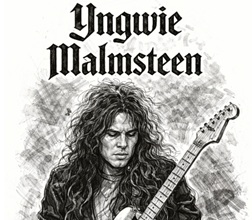
Yngwie Malmsteen, complete biography, neoclassical guitar, shred style and full discography
Profile
Yngwie Johan Malmsteen (Stockholm, June 30, 1963) is a Swedish guitarist, composer, and bandleader, widely recognized as one of the leading architects of neoclassical guitar applied to heavy metal. He is closely associated with the development of the shred guitar style, characterized by extreme speed, technical precision, and the systematic use of elements drawn from European classical music.

Origins and formation (Sweden, early years)
Malmsteen grew up in Stockholm in a cultural environment open to both classical music and rock. A decisive event in his development was discovering Jimi Hendrix as a teenager, which pushed him to devote himself seriously to the guitar. In parallel, he studied Bach, Paganini, Vivaldi, and other Baroque and Romantic composers, absorbing harmonic frameworks and melodic solutions that would become central to his language.
From his earliest years he developed a highly disciplined approach to the instrument, built on modal scales, extended arpeggios, and rigorous right- and left-hand technique.
Move to the United States and early projects (early 1980s)
In the early 1980s Malmsteen moved to the United States, where he quickly connected with the hard rock and metal scene. His first significant exposure came with Steeler, followed by his entry into Alcatrazz, a band that helped him gain international visibility.
In this phase his identity became unmistakable: long, structured solos; systematic use of the harmonic minor scale; and a lead-guitar concept closer to the classical concerto than to traditional blues.
Establishing himself as a solo artist: the birth of neoclassical metal (1980s)
His solo debut “Rising Force” (1984) represents a historic turning point for rock guitar. The album codified a new paradigm: the guitarist as the absolute protagonist, composition built around technique, and the explicit integration of classical idioms within a metal context.
In the years that followed, Malmsteen consolidated his role through intense output, alternating instrumental releases and singer-fronted albums, while keeping the guitar as the primary “voice.”
Guitar style and musical language
Key elements of Yngwie Malmsteen’s style include:
Neoclassicism: extensive use of harmonic minor, diminished scales, and classically derived arpeggios.
Speed and precision: extreme alternate picking as a defining technical signature.
Centrality of the soloist: the guitar as a modern equivalent of virtuoso violin.
Compositional structure: songs often built like movements or suites rather than conventional rock songs.
Rejection of canonical blues: a conscious departure from rock’s blues roots in favor of a European aesthetic.
1990s–2000s: continuity and artistic independence
In the 1990s Malmsteen continued releasing albums regularly, maintaining near-total creative control over his work. Even as the musical landscape changed (the rise of grunge and alternative), he remained faithful to his language, strengthening a direct relationship with an audience focused on virtuoso guitar.
From a production standpoint, he increasingly took on the roles of producer and arranger, further emphasizing artistic autonomy.
Recent phase and live activity
In more recent years, Malmsteen has sustained an intensive international live schedule, sometimes accompanied by orchestras or expanded ensembles, and he continues to release studio and live albums.
The concert remains a key space for reaffirming virtuosity: long solos, reworkings of classic repertoire, and a show approach heavily centered on the guitar.
Influence and critical reception
Yngwie Malmsteen has exerted a profound influence on generations of metal guitarists and instrumental rock players. His figure is often debated critically: celebrated for technical innovation and stylistic consistency, he is sometimes criticized for a degree of compositional self-referentiality.
In any case, his contribution to defining the modern guitar language remains structural and difficult to bypass.
Full discography
Studio albums
Live albums
Compilations and special works
1997 – The Best of Yngwie Malmsteen
2001 – The Concerto Suite for Electric Guitar and Orchestra
2016 – World on Fire Tour: Live in Mexico City
Critical reading: Yngwie Malmsteen’s role in rock and metal
Yngwie Malmsteen is a key figure in transforming the electric guitar into an absolute virtuoso instrument, detached from the blues paradigm. His work redefined the boundaries between European art music and heavy metal, opening a path that strongly influenced shred, power metal, and instrumental rock.
More than “just” a guitarist, Malmsteen can be understood as a language author, capable of imposing a technical and stylistic grammar that continues to be studied, imitated, and debated.



 Yngwie Malmsteen