

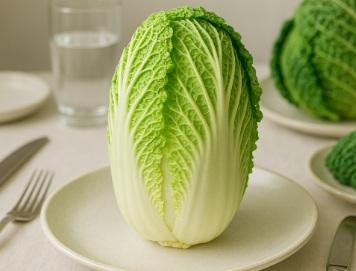
Chinese cabbage
Rating : 7
| Evaluation | N. Experts | Evaluation | N. Experts |
|---|---|---|---|
| 1 | 6 | ||
| 2 | 7 | ||
| 3 | 8 | ||
| 4 | 9 | ||
| 5 | 10 |
0 pts from Al222
| Sign up to vote this object, vote his reviews and to contribute to Tiiips.Evaluate | Where is this found? |
| "Descrizione" about Chinese cabbage by Al222 (24136 pt) | 2025-Nov-25 10:20 |
| Read the full Tiiip | (Send your comment) |
(From Brassica rapa subsp. pekinensis (Napa cabbage) and Brassica rapa subsp. chinensis (bok choy/pak choi), family Brassicaceae)
Note: The term “Chinese cabbage” commonly refers to both Napa cabbage and bok choy/pak choi. This sheet covers both, specifying differences where relevant.
Chinese cabbage includes several Asian varieties of Brassica rapa, mainly:
Napa cabbage (pekinensis) – elongated head, pale green leaves, tender and juicy with a crisp white midrib.
Bok choy / Pak choi (chinensis) – open rosette shape, dark green leaves with thick white stalks.
Flavour is mild, sweet-vegetal, less pungent, with very low sulphur intensity compared to European cabbages.
It is widely used raw, stir-fried, steamed, braised, in soups, and fermented (e.g., kimchi).

(raw Chinese cabbage – average values)
Energy: 12–20 kcal
Carbohydrates: 2–4 g
sugars: 1–2 g
Fibre: 1–2 g
Protein: 1–1.5 g
Lipids: 0.1–0.3 g
SFA (first occurrence – saturated fatty acids): <0.05 g (excess SFA intake is associated with cardiovascular risk, though Chinese cabbage contains negligible amounts)
MUFA: traces
PUFA: traces
TFA: not present naturally
Vitamins: vitamin C, vitamin K, folate; vitamin A notably high in bok choy
Minerals: calcium, potassium, magnesium; small amounts of iron
Glucosinolates (Brassicaceae-specific)
Vitamins: C, K, A, folate
Carotenoids: lutein, beta-carotene (higher in bok choy)
Dietary fibre
Phenolic compounds and flavonoids
Minerals: Ca, K, Mg
Cultivation
Fast-growing cool-season crop (45–70 days).
Widely cultivated in East Asia and increasingly in Europe.
Harvesting
Cut at the base.
Napa: harvested as a full head.
Bok choy: harvested as individual bunches or baby plants.
Sorting & washing
Removal of damaged outer leaves, washing with potable water.
Cutting / processing
Whole, halved, shredded, chopped.
Fresh-cut (IV range): washed, dried, packed in MAP.
Industrial processing
Freezing: blanch → cool → IQF → pack.
Fermentation: kimchi and similar products.
Pasteurisation: used in ready meals and soups.
Packaging
Whole heads in crates.
Cut product in MAP bags or trays.
All operations under GMP/HACCP.
Napa: soft, pale green leaves with juicy white ribs.
Bok choy: dark green blades with thick, crunchy stalks.
Moisture: 93–95%.
Texture: crisp raw, tender after brief cooking.
Flavour: delicate, sweet, mild, non-sulphurous.
Aroma: light, fresh, lightly vegetal.
Technological behaviour:
excellent for quick cooking (stir-fry, steam, wok);
ideal for soups and broths;
highly suitable for fermentation (kimchi);
low tendency to develop strong odours;
retains good texture if not overcooked.
Asian cuisine: stir-fries, ramen, dumpling fillings, bao, hotpots, kimchi.
Western cuisine: salads, slaws, steamed side dishes, soups.
Industrial use: frozen mixes, ready meals, light soups, health-oriented dishes.
Fermented products: kimchi, pickled vegetable blends.
Very low calorie content.
High in vitamin C, vitamin K, folate, and vitamin A (especially bok choy).
Provides glucosinolates, characteristic of Brassicaceae.
Contains essential minerals (Ca, K, Mg).
Supports light, nutrient-dense diets.
May cause mild digestive discomfort in individuals sensitive to FODMAPs or sulphur compounds (generally milder than other cabbages).
Typical cooked serving: 80–100 g.
Stir-fries and soups: often 50–70 g per serving.
Not a major allergen.
Possible cross-reactions in individuals allergic to Brassicaceae.
May cause symptoms in FODMAP-sensitive individuals.
Whole fresh: 7–14 days at 0–4 °C (high humidity).
Fresh-cut (MAP): 3–6 days.
Frozen: 12–24 months at –18 °C.
Kimchi:
unpasteurised: 3–6 months refrigerated;
pasteurised: 6–12 months.
Checks on:
pesticide residues,
heavy metals,
pathogens (Listeria, Salmonella, STEC) in fresh-cut products.
Fermented products require monitoring of pH, salinity and lactic flora.
Production compliant with GMP/HACCP.
Common labels:
“Chinese cabbage”
“Napa cabbage”
“bok choy / pak choi”
Additional ingredients (salt, acids, spices) must be declared.
Listed in descending order of weight in multi-ingredient mixes.
Wilting / water-soaked spots: inadequate refrigeration → store at 0–4 °C with high humidity.
Unpleasant odour: microbial spoilage → ensure strict hygiene and cold chain.
Rib browning: oxidation → minimise air exposure, use MAP.
Loss of crispness: excessive condensation → optimise packaging and drainage.
Fast-growing crop with generally lower resource input than European cabbages.
Good agricultural efficiency (high yield per hectare).
Environmental considerations: irrigation, plant protection products.
Processing residues usable for compost, animal feed or biomass.
Effluent management monitored via BOD/COD.
(as “Brassica Rapa Leaf Extract” or “Brassica Rapa Root Extract”)
Antioxidant
Skin conditioning
Mild soothing and purifying effect
Used in botanical or natural-themed cosmetics.
Chinese cabbage is a versatile, mild, nutrient-rich vegetable ingredient, widely used in both Asian and Western cuisines.
Its high moisture content, gentle flavour and good processing behaviour make it suitable for fresh, cooked, fermented and industrial applications.
Under well-managed GMP/HACCP supply chains, it represents a safe, stable and high-quality ingredient for foodservice, industry and home use.
SFA – Saturated Fatty Acids: dietary fats to moderate; present in minimal amounts in Chinese cabbage.
MUFA – Monounsaturated fatty acids: present only in traces.
PUFA – Polyunsaturated fatty acids: present in traces.
TFA – Trans fatty acids: not naturally occurring in Chinese cabbage.
GMP/HACCP – Good Manufacturing Practices / Hazard Analysis and Critical Control Points.
BOD/COD – Biological / Chemical Oxygen Demand, wastewater impact indicators.
FODMAPs – fermentable carbohydrates that can cause symptoms in sensitive individuals.
References__________________________________________________________________________
Shim, J. Y., Kim, D. G., Park, J. T., Kandpal, L. M., Hong, S. J., Cho, B. K., & Lee, W. H. (2016). Physicochemical quality changes in Chinese cabbage with storage period and temperature: A review. Journal of Biosystems Engineering, 41(4), 373-388.
Abstract. Background: Recent inquiries into high-quality foods have discussed the importance of the functional aspects of foods, in addition to traditional quality indicators such as color, firmness, weight, trimming loss, respiration rate, texture, and soluble solid content. Recently, functional Chinese cabbage, which makes up a large portion of the vegetables consumed in Korea, has been identified as an anticancer treatment. However, the investigation of practical issues, such as the effects of storage conditions on quality indicators (including functional compounds), is still limited. Purpose: We reviewed various studies on variations in the quality indicators and functional compounds of Chinese cabbage in response to different storage environments, focusing on storage temperature and storage period. In particular, we emphasized the effect of storage temperature and storage period on glucosinolate (GSL) levels, in order to provide guidelines for optimizing storage environments to maximize GSLs. Additionally, we used response surface methodology to propose experimental designs for future studies exploring the optimal storage conditions for enhancing GSL contents. Review: Large variations in quality indicators were observed depending on the cultivar, the type of storage, the storage conditions, and the harvest time. In particular, GSL content varied with storage conditions, indicating that either low temperatures or adequate air composition by controlled atmospheric storage may preserve GSL levels, as well as prolonging shelf life. Even though genetic and biochemical approaches are preferred for developing functional Chinese cabbage, it is important to establish a practical method for preserving quality for marketability; a prospective study into optimal storage conditions for preserving functional compounds (which can be applied in farms), is required. This may be achievable with the comprehensive meta-analysis of currently published data introduced in this review, or by conducting newly designed experiments investigating the relationship between storage conditions and the levels of functional compounds.
Pokluda, R. (2008). Nutritional quality of Chinese cabbage from integrated culture. Horticultural Science, 35(4), 145-150.
Abstract. The evaluation of nutritional quality of Chinese cabbage and the effects of cultivar, weed incidence, plant density and growing season were observed in integrated cultivation system. Mean contents of analysed compounds were as follows: 6% of dry matter, 10% of crude fibre, (in mg/kg of f.m.): 2,199 mg K, 289 mg Ca, 146 mg Mg, 111 mg Na, and 316 mg of vitamin C. Mean content of nitrates reached the value of 647 mg/kg. A significant effect of cultivar on the content of all observed substances in cabbage heads excluding magnesium was thus confirmed; however, a decrease of nitrates was found in the treatment with higher plant density. Weed cultivation caused slightly (insignificantly) higher nitrates content in cabbage heads by 100 mg/kg. Growing season showed a significant effect on content of some evaluated compounds. Integrated cultivation of Chinese cabbage could be an adequate approach to ensure nutritionally valuable products with low nitrates content.
Seong, G. U., Hwang, I. W., & Chung, S. K. (2016). Antioxidant capacities and polyphenolics of Chinese cabbage (Brassica rapa L. ssp. Pekinensis) leaves. Food Chemistry, 199, 612-618.
Abstract. Chinese cabbage (Brassica rapa L. ssp. Pekinensis) is a green leafy vegetable used mainly in kimchi, salted and fermented dishes. Consumer preference for the leaf portion differs according to the type of dishes. In this study, Chinese cabbage was divided into three parts, and their antioxidant activities were investigated through in vitro assays. The total phenolic contents (TPC), total flavonoid contents (TFC), and vitamin C contents were also determined as indicators of antioxidant contents. The phenolic acids and flavonoids were separated and identified using high performance liquid chromatography (HPLC) and liquid chromatography/mass spectrometry (LC/MS). The outer leaf had the strongest antioxidant activity with the maximum antioxidant contents, followed by the mid- and inner leaves. Principal component analysis (PCA) revealed that outer leaf is positively related to caffeic acid, p-coumaric acid, ferulic acid, and myricetin contents, whereas the mid- and inner leaves are negatively related to sinapic acid contents.
Gupta, R. K., Khurana, D. S., & Singh, H. (2017). Chinese cabbage. Vegetable crop science (pp. 299-310). CRC Press.
Abstract. Chinese cabbage is closely related to turnip and swede than cabbage. It is grown for its edible leaves on large scale in Southeast Asia. Chinese cabbage is rich source of vitamins containing vitamin C content higher than lettuce. Chinese cabbage is a leafy green or purple biennial plant, grown as an annual vegetable crop for its dense leaved heads. Chinese cabbage containing high calcium and potassium and low sodium content regulates blood pressure and blood sugar, supports cardiovascular system and healthy brain function and relieves hypertension. Chinese cabbage is a shallow-rooted crop. Most of the roots remain in top 30 cm soil layer, while some penetrate to the depth of 60-70 cm. High quality Saag can be prepared from leafy type Chinese cabbage due to its tender and succulent leaves. The yield of Chinese cabbage is influenced by several factors such as variety, soil type, soil fertility, growing conditions and the cultural practices followed during the course of cultivation.
Shi, L., Zheng, W., Lei, T., Liu, X., & Hui, M. (2021). The effect of different soil amendments on soil properties and on the morphological and physiological characteristics of Chinese cabbage. Journal of Soil Science and Plant Nutrition, 21(2), 1500-1510.
Abstract. Excessive fertilization is one of the major challenges in Chinese cabbage production. Although various soil ameliorants have been widely applied in agricultural production, their underlying mechanisms of action remain unknown. Five fertilization treatments were tested under field conditions, including chemical fertilization (CK) and reduced chemical fertilization applied in combination with biochar (T1), microbial agents (T2), organic fertilizer (T3) and silicon-calcium-magnesium-potassium (SiCaMgK) fertilizer (T4). The growth, yield, root properties and physiological quality of two varieties of Chinese cabbage and their rhizosphere soil properties were measured to determine the effect of each amendment. Although biochar and other amendments had no significant impact on cabbage yield, the physiological analyses revealed that compared with CK, biochar application enhanced the vitamin c (VC) contents and soil urease and invertase activities by 25.34%–49.58%, 3.75%–10.08%, 42.71%–103.19% and respectively, in the two varieties of Chinese cabbage. Compared with CK, organic fertilizer application significantly increased peroxidase (POD) activity and soluble sugar and soluble protein accumulation and decreased the malondialdehyde (MDA) content in the two varieties of Chinese cabbage. The yield of Chinese cabbage was affected mainly by soil urease activity, superoxide dismutase (SOD) activity and MDA content. The VC content may have been regulated by the soil invertase activity and the root morphological parameters of the plants. We conclude that biochar and organic fertilizer can improve root development and soil urease, invertase and SOD activities and decrease MDA content, which are factors related to cabbage yield and quality.
Lee, Min-Ki, et al. Variation of glucosinolates in 62 varieties of Chinese cabbage (Brassica rapa L. ssp. pekinensis) and their antioxidant activity. LWT-Food Science and Technology 58.1 (2014): 93-101.
Abstract. Glucosinolate (GSL) and antioxidant activity in 62 varieties of Chinese cabbage (Brassica rapa L. ssp. pekinensis) were determined by HPLC and DPPH, HRSA, and FRAP assays. Five aliphatic GSLs: progoitrin, sinigrin, glucoalyssin, gluconapin, and glucobrassicanapin; four indolyl GSLs: 4-hydroxyglucobrassicin, glucobrassicin, 4-methoxyglucobrassicin, and neoglucobrassicin; one aromatic GSL: gluconasturtiin were identified. Glucobrassicanapin and gluconapin documented the most abundant (average 4.52 and 3.72 μmol/g DW, respectively). The contents of total GSLs varied extensively among 62 varieties (range from 2.83 to 48.53 μmol/g DW). Comprehensive differences in total and individual GSL contents have also been observed among different varieties. Indolyl and aromatic GSL together accounted 26% of the total GSLs; but there are few differences among varieties. FC7 and FI17 could be good candidates for future breeding programs since they had a high quantity of glucobrassicin (2.10 and 1.66 μmol/g DW, respectively). Most of the Chinese cabbage varieties showed significant antioxidant activities when compare with positive control. However, three antioxidant assays were not significantly correlated with total GSLs. The presence of significant quantities of glucobrassicin in some varieties should be studied more extensively, since GSL is the precursor of indole-3-carbinol, a potent anticancer isothiocyanate.
| Sign up to vote this object, vote his reviews and to contribute to Tiiips.EvaluateClose | (0 comments) |
Read other Tiiips about this object in __Italiano (1)
Content:  
Last update:   2025-11-24 20:03:54 | Kcal/100g:   20 Family:   Threat factors:   |

