

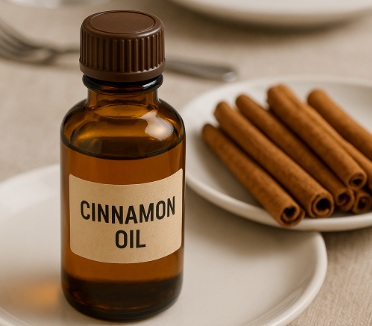
Cinnamon Oil
Rating : 7
| Evaluation | N. Experts | Evaluation | N. Experts |
|---|---|---|---|
| 1 | 6 | ||
| 2 | 7 | ||
| 3 | 8 | ||
| 4 | 9 | ||
| 5 | 10 |
0 pts from Al222
| Sign up to vote this object, vote his reviews and to contribute to Tiiips.Evaluate | Where is this found? |
| "Descrizione" about Cinnamon Oil by Al222 (23259 pt) | 2025-Nov-23 12:54 |
| Read the full Tiiip | (Send your comment) |
(Essential oil from Cinnamomum verum or Cinnamomum cassia)
Cinnamon oil is the essential oil obtained from the bark or leaves of Cinnamomum species, mainly Cinnamomum verum (Ceylon cinnamon) and Cinnamomum cassia (Cassia).
It is an intensely aromatic, highly concentrated flavouring ingredient with a warm, sweet, spicy profile dominated by cinnamaldehyde.
Two primary commercial types exist:
Cinnamon bark oil – sweeter, richer, more complex; higher cinnamaldehyde.
Cinnamon leaf oil – more herbaceous, with higher eugenol content.
Both forms are used in food flavourings, beverages, confectionery and bakery, as well as in cosmetics and oral-care applications.

(values dependent on purity; essential oils are used at extremely low doses)
Energy: 800–900 kcal
Protein: 0 g
Carbohydrates: 0 g
Lipids: 95–100 g (entirely essential-oil fraction)
SFA (first occurrence): minor fraction of total fatty material
MUFA: variable
PUFA: variable
TFA: not expected
Fibre: 0 g
Vitamins/minerals: negligible
Nutritional impact is negligible due to extremely small usage levels (0.005–0.2%).
Cinnamaldehyde (major component in bark oil; key warm-spicy cinnamon note)
Eugenol (higher in leaf oil; clove-like nuance)
Cinnamyl acetate
Linalool
β-Caryophyllene
Trans-cinnamic acid derivatives
Traces of coumarin (species-dependent; Cassia typically higher)
Harvesting of bark or leaves from Cinnamomum trees.
Cleaning and preparation of raw botanical material.
Steam distillation of bark or leaves to separate essential oil.
Fractionation/rectification (optional) to adjust aroma profile.
Filtration to remove residual plant particles.
Standardisation to ensure consistent cinnamaldehyde/eugenol content.
Packaging in light-resistant, oxygen-barrier containers.
Full compliance with GMP/HACCP and flavour-ingredient regulations.
Appearance: clear to pale yellow liquid (leaf oil slightly darker).
Aroma: warm, sweet, spicy, characteristic cinnamon.
Taste: hot, spicy, pungent, sweet-aromatic.
Specific gravity: typically 1.00–1.05 g/mL (varies with composition).
Solubility:
insoluble in water;
soluble in alcohol, fats, and flavour solvents.
Stability: sensitive to oxidation, heat and UV light; antioxidants may be added.
Provides strong warm-spicy aroma at low dosages.
Enhances sweetness perception and pairs well with sugar, honey, chocolate and fruits.
Useful for top notes in bakery and confectionery.
Leaf oil provides a more clove-like and herbaceous character.
Highly volatile—must be protected from heat and prolonged exposure to air.
Can act as a mild natural antimicrobial in certain food matrices (dosage-dependent).
Beverages: chai, herbal teas, mulled drinks, syrups, holiday beverages.
Confectionery: chewing gum, hard candies, fondants, chocolate.
Bakery: cinnamon rolls, cakes, cookies, spice blends.
Savory foods: curries, sauces, marinades, Middle Eastern dishes.
Processed foods: cereals, bars, spice premixes, flavoured syrups.
Natural flavour formulations: emulsified flavours, encapsulated powders.
Contains phenolic compounds (cinnamaldehyde, eugenol) associated with antioxidant activity in vitro.
Traditionally linked to digestive comfort and warming effects, but such effects cannot be used as food health claims without authorisation.
Essential oils are highly concentrated and must be used within regulated limits.
Cassia-derived oil may contain more coumarin, which can be problematic at very high intakes; typical flavour levels remain well within safe limits.
Typical inclusion levels:
0.005–0.2% in finished product (depending on matrix and intensity required).
In beverages: 0.01–0.05%.
In confectionery and gums: 0.05–0.2%.
Over-dosage can result in harsh, hot, or medicinal notes.
Cinnamon oil is not a major allergen, but may cause irritation (skin, mucosa) at high concentration.
Some individuals may have sensitivity to cinnamaldehyde or eugenol.
Naturally gluten-free and lactose-free.
Check carriers in formulated flavours for potential allergens.
Store in airtight, light-protected containers.
Ideal temperature: 10–20 °C.
Shelf-life typically 24–36 months (shorter once opened).
Main degradation:
oxidation → loss of freshness, formation of off-notes;
evaporation of key volatiles;
colour darkening.
Regulated as a natural flavouring (e.g., EU Reg. 1334/2008).
Subject to limits for:
residual solvents (if used in extraction),
pesticide residues,
heavy metals,
cinnamaldehyde content,
coumarin content (Cassia-derived raw material).
Must comply with GMP/HACCP and national/international flavour safety frameworks (e.g., FEMA/GRAS listings where applicable).
Possible declarations:
“natural cinnamon oil”
“cinnamon bark oil” / “cinnamon leaf oil”
“natural flavour (cinnamon)”
Listed in ingredient statements as “natural flavour” or “cinnamon oil”, depending on local rules.
Harsh, burning taste: dosage too high → reduce concentration.
Weak aroma: oil oxidised or old → use fresh or stabilised oil.
Phase separation in beverages: use emulsified or encapsulated cinnamon flavour.
Darkening of oil: indication of oxidation → improve storage conditions.
Mainly sourced from Sri Lanka, Indonesia, Vietnam and China.
Sustainability considerations include:
responsible harvesting of bark to avoid over-stripping,
reduced pesticide use,
energy-efficient distillation,
wastewater treatment (monitored through BOD/COD indicators).
Organic and fair-trade options are available.
(as “Cinnamomum Zeylanicum Bark Oil”, “Cinnamomum Cassia Leaf Oil”, etc.)
Fragrance component (warm, spicy note)
Warming and toning sensory effect in topical products
Used in perfumes, soaps, massage oils, oral-care, and warming balms
Requires controlled dosage due to potential irritation
Cinnamon oil is a high-impact natural flavouring with strong warm-spicy character. Its concentrated aromatic profile makes it valuable for bakery, confectionery, beverages and spice blends. When sourced responsibly, processed according to GMP/HACCP, and dosed correctly, it offers a safe, stable and aromatic ingredient suitable for both industrial and artisanal food applications.
SFA – Saturated fatty acids: present only in very small proportions; intake from cinnamon oil is negligible.
MUFA – Monounsaturated fatty acids: minor components of the oil matrix.
PUFA – Polyunsaturated fatty acids: oxidation-prone; present at low levels.
TFA – Trans fatty acids: not present naturally in essential oils.
GMP/HACCP – Systems ensuring hygienic, safe and controlled food production.
BOD/COD – Environmental indicators for wastewater pollution.
Cinnamaldehyde – Primary aromatic component responsible for cinnamon’s characteristic warm, spicy flavour.
Studi
La corteccia di questa pianta viene utilizzata per fare la cannella di spezie ed è stata da tempo utilizzata come medicina tradizionale a base di erbe cinesi per varie condizioni patologiche (1).
Recenti studi hanno individuato l'estratto di Cannella come un potenziale trattamento per l'iperplasia prostatica benigna (2) e di alcune tipologie di tumori (3).
Alcuni studi hanno dimostrato che la cannella è stata anche usata tradizionalmente nei disturbi cerebrali correlati all'età (4).
Tra i componenti utili dell'olio essenziale di Cannella figurano la transcinnamaldeide (72,81%), l'alcol benzilico (12,5%) e l'eugenolo (6,57%) (5).
Sicurezza
Occorre prestare attenzione alla quantità che non deve essere eccessiva.
Bibliografia_______________________________________________________________________
(1) Yang SM, Tsai KD, Wong HY, Liu YH, Chen TW, Cherng J, Hsu KC, Ang YU, Cherng JM. Molecular Mechanism of Cinnamomum verum Component Cuminaldehyde Inhibits Cell Growth and Induces Cell Death in Human Lung Squamous Cell Carcinoma NCI-H520 Cells In Vitro and In Vivo. J Cancer. 2016 Jan 5;7(3):251-61. doi: 10.7150/jca.13689. PMID: 26918037; PMCID: PMC4747878.
Abstract. Cinnamomum verum is used to make the spice cinnamon and has been used as a traditional Chinese herbal medicine. We evaluated the effects and the molecular mechanisms of cuminaldehyde (CuA), a constituent of the bark of Cinnamomum verum, on human lung squamous cell carcinoma NCI-H520 cells. Specifically, cell viability was evaluated by colorimetric assay; cytotoxicity by LDH release; apoptosis was determined by Western blotting, and morphological analysis with, acridine orange and neutral red stainings and comet assay; topoisomerase I activity was assessed using assay based upon DNA relaxation and topoisomerase II by DNA relaxation plus decatentation of kinetoplast DNA; lysosomal vacuolation and volume of acidic compartments (VAC) were evaluated with neutral red staining. The results show that CuA suppressed proliferation and induced apoptosis as indicated by an up-regulation of pro-apoptotic bax and bak genes and a down-regulation of anti-apoptotic bcl-2 and bcl-XL genes, mitochondrial membrane potential loss, cytochrome c release, activation of caspase 3 and 9, and morphological characteristics of apoptosis, including blebbing of the plasma membrane, nuclear condensation, fragmentation, apoptotic body formation, and comet with elevated tail intensity and moment. In addition, CuA also induced lysosomal vacuolation with increased VAC, cytotoxicity, as well as suppressions of both topoisomerase I and II activities in a dose-dependent manner. Further study revealed the growth-inhibitory effect of CuA was also evident in a nude mice model. Taken together, the data suggest that the growth-inhibitory effect of CuA against NCI-H520 cells is accompanied by downregulations of proliferative control involving apoptosis and both topoisomerase I and II activities, and upregulation of lysosomal with increased VAC and cytotoxicity. Similar effects were found in other cell lines, including human lung adenocarcinoma A549 cells and colorectal adenocarcinoma COLO 205 (results not shown). Our data suggest that CuA could be a potential agent for anticancer therapy.
(2) Choi HM, Jung Y, Park J, Kim HL, Youn DH, Kang J, Jeong MY, Lee JH, Yang WM, Lee SG, Ahn KS, Um JY. Cinnamomi Cortex (Cinnamomum verum) Suppresses Testosterone-induced Benign Prostatic Hyperplasia by Regulating 5α-reductase. Sci Rep. 2016 Aug 23;6:31906. doi: 10.1038/srep31906.
Abstract. Cinnamomi cortex (dried bark of Cinnamomum verum) is an important drug in Traditional Korean Medicine used to improve blood circulation and Yang Qi. Benign prostatic hyperplasia (BPH) is a common chronic disease in aging men. This study was conducted to determine the effect of Cinnamomi cortex water extract (CC) on BPH. BPH was induced by a pre-4-week daily injection of testosterone propionate (TP). Six weeks of further injection with (a) vehicle, (b) TP, (c) TP + CC, (d) TP + finasteride (Fi) was carried on. As a result, the prostate weight and prostatic index of the CC treatment group were reduced. Histological changes including epithelial thickness and lumen area were recovered as normal by CC treatment. The protein expressions of prostate specific antigen, estrogen receptor α (ERα), androgen receptor (AR), 5α-reductase (5AR), and steroid receptor coactivator 1 were suppressed by treatment of CC. Immunohistochemical assays supported the western blot results, as the expressions of AR and ERα were down-regulated by CC treatment as well. Further in vitro experiments showed CC was able to inhibit proliferation of RWPE-1 cells by suppressing 5AR and AR. These results all together suggest CC as a potential treatment for BPH.
(3) Perng DS, Tsai YH, Cherng J, Wang JS, Chou KS, Shih CW, Cherng JM. Discovery of a novel anticancer agent with both anti-topoisomerase I and II activities in hepatocellular carcinoma SK-Hep-1 cells in vitro and in vivo: Cinnamomum verum component 2-methoxycinnamaldehyde. Drug Des Devel Ther. 2016 Jan 5;10:141-53. doi: 10.2147/DDDT.S93599.
Abstract. Cinnamomum verum is used to make the spice cinnamon and has been used as a traditional Chinese herbal medicine for various applications. We evaluated the anticancer effect of 2-methoxycinnamaldehyde (2-MCA), a constituent of the bark of the plant, and its underlying molecular biomarkers associated with carcinogenesis in human hepatocellular carcinoma SK-Hep-1 cell line. The results show that 2-MCA suppressed proliferation and induced apoptosis as indicated by mitochondrial membrane potential loss, activation of caspase-3 and caspase-9, increase in the DNA content in sub-G1, and morphological characteristics of apoptosis, including blebbing of plasma membrane, nuclear condensation, fragmentation, apoptotic body formation, and long comet tail. In addition, 2-MCA also induced lysosomal vacuolation with increased volume of acidic compartments, suppressions of nuclear transcription factors NF-κB, cyclooxygenase-2, prostaglandin E2 (PGE2), and both topoisomerase I and II activities in a dose-dependent manner. Further study reveals the growth-inhibitory effect of 2-MCA was also evident in a nude mice model. Taken together, the data suggest that the growth-inhibitory effect of 2-MCA against SK-Hep-1 cells is accompanied by downregulations of NF-κB-binding activity, inflammatory responses involving cyclooxygenase-2 and PGE2, and proliferative control involving apoptosis, both topoisomerase I and II activities, together with an upregulation of lysosomal vacuolation and volume of acidic compartments. Similar effects (including all of the above-mentioned effects) were found in other tested cell lines, including human hepatocellular carcinoma Hep 3B, lung adenocarcinoma A549, squamous cell carcinoma NCI-H520, colorectal adenocarcinoma COLO 205, and T-lymphoblastic MOLT-3 (results not shown). Our data suggest that 2-MCA could be a potential agent for anticancer therapy.
(4) Peterson DW, George RC, Scaramozzino F, LaPointe NE, Anderson RA, Graves DJ, Lew J. Cinnamon extract inhibits tau aggregation associated with Alzheimer's disease in vitro. J Alzheimers Dis. 2009;17(3):585-97. doi: 10.3233/JAD-2009-1083.
Abstract. An aqueous extract of Ceylon cinnamon (C. zeylanicum) is found to inhibit tau aggregation and filament formation, hallmarks of Alzheimer's disease (AD). The extract can also promote complete disassembly of recombinant tau filaments and cause substantial alteration of the morphology of paired-helical filaments isolated from AD brain. Cinnamon extract (CE) was not deleterious to the normal cellular function of tau, namely the assembly of free tubulin into microtubules. An A-linked proanthocyanidin trimer molecule was purified from the extract and shown to contain a significant proportion of the inhibitory activity. Treatment with polyvinylpyrolidone effectively depleted all proanthocyanidins from the extract solution and removed the majority, but not all, of the inhibitory activity. The remainder inhibitory activity could be attributed to cinnamaldehyde. This work shows that compounds endogenous to cinnamon may be beneficial to AD themselves or may guide the discovery of other potential therapeutics if their mechanisms of action can be discerned.
(5) Yap PS, Krishnan T, Chan KG, Lim SH. Antibacterial Mode of Action of Cinnamomum verum Bark Essential Oil, Alone and in Combination with Piperacillin, Against a Multi-Drug-Resistant Escherichia coli Strain. J Microbiol Biotechnol. 2015 Aug;25(8):1299-306. doi: 10.4014/jmb.1407.07054.
| Sign up to vote this object, vote his reviews and to contribute to Tiiips.EvaluateClose | (0 comments) |
Read other Tiiips about this object in __Italiano (1)
Content:  
Last update:   2025-11-23 12:48:31 | Kcal/100g:   850 |

