

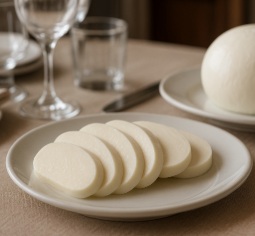
Part-skim mozzarella cheese
Description
Part-skim mozzarella cheese is a semi-soft, stretched-curd cheese made from partially skimmed cow’s milk (reduced fat vs whole-milk mozzarella).
It maintains the characteristic mild, milky flavour and elastic, stringy texture of mozzarella, with lower fat content and slightly firmer body.
Commonly used as a pizza cheese and in baked dishes thanks to its excellent meltability and browning behaviour.
Available as blocks, loaves, shredded, diced, or pre-sliced.

Indicative nutritional values per 100 g
(Typical part-skim mozzarella; values vary by brand and moisture/fat level)
Energy: 250–290 kcal
Protein: 24–27 g
Carbohydrates: 2–4 g
Lipids: 15–20 g
Calcium: 500–800 mg
Sodium: 500–800 mg (higher in pizza cheese styles)
Other minerals: phosphorus, potassium
Vitamins: A, B2 (riboflavin), B12
Key constituents
Casein micelles and other milk proteins (major structural component).
Milk fat in reduced amount vs whole-milk mozzarella.
Lactose (low residual content in matured cheese).
Minerals: calcium and phosphorus in bioavailable forms.
Salt (NaCl) for flavour and preservation.
Water (moisture level typically 45–52% depending on style).
Production process
Standardisation of milk: adjustment of fat content to “part-skim” level.
Pasteurisation of the milk.
Addition of starter cultures (lactic acid bacteria) to acidify the milk.
Coagulation:
Cutting and healing of curd:
Cooking and whey drainage.
Pasta filata (stretching) step:
Shaping: blocks, loaves, balls, or other formats.
Cooling and salting (in brine or dry salt).
Packaging and storage under refrigeration.
Produced under GMP/HACCP with controls on pH, moisture, fat, and microbiology.
Physical properties
Appearance: white to pale cream; smooth surface.
Texture: elastic, sliceable, with characteristic “stretch” when melted.
Moisture: generally medium (semi-soft).
Melting behaviour: good melt and flow; slightly less oily surface than whole-milk mozzarella.
pH: typically around 5.0–5.4.
Sensory and technological properties
Flavour: mild, milky, slightly tangy; less rich/buttery than whole-milk mozzarella.
Meltability: excellent; forms uniform melt on pizzas and baked dishes.
Stretchability: good string formation when hot.
Browning: controlled browning and blistering in pizza ovens; fat reduction tends to reduce surface oiling.
Functional roles:
structure and binding in toppings and fillings
texture and mouthfeel enhancement
flavour carrier for herbs, sauces, and other ingredients.
Food applications
Pizza toppings (fresh or pre-shredded).
Lasagne, baked pasta, casseroles.
Stuffed products: calzone, stromboli, stuffed crusts.
Salads: shredded in cold or warm salads (with tomatoes, vegetables, grains).
Sandwiches, panini, wraps.
Ready meals: frozen pizzas, prepared pasta dishes, snacks.
Nutrition & health
Provides high-quality complete protein with all essential amino acids.
Good source of calcium and phosphorus, important for bone health.
Contains vitamin B12 and other B-vitamins.
Part-skim formulation offers reduced fat and energy compared to whole-milk mozzarella, still with good functionality.
Contains significant saturated fat and sodium; portion control is important in cardiovascular and hypertension-focused diets.
Suitable for low-carb and high-protein dietary patterns, within overall fat/salt limits.
Portion note
Typical serving as part of a meal: 30–40 g (1–2 slices or a small handful of shreds).
On pizza: 50–80 g per individual serving, depending on style and coverage.
In salads or sandwiches: 20–40 g per portion.
Allergens and intolerances
Contains MILK, a major allergen (proteins and lactose).
Not suitable for individuals with cow’s milk protein allergy.
May be tolerated in moderate amounts by some lactose-intolerant consumers, but lactose is not absent.
Gluten-free by nature; gluten only present if contaminated or combined with gluten-containing ingredients in mixed products.
Storage and shelf-life
Safety & regulatory
Must comply with regulations for pasteurised dairy products.
Produced under GMP/HACCP with controls on:
pasteurisation parameters
starter culture performance and pH
microbiological quality (Listeria, Salmonella, coliforms)
contaminants (antibiotic residues, heavy metals).
Standards may define minimum fat in dry matter and maximum moisture for part-skim mozzarella.
Labeling
Troubleshooting
Poor melt / rubbery texture:
Excessive browning or burning on pizza:
Surface oiling too low:
Slice breakage / crumbling:
Mould growth in pack:
Sustainability & supply chain
Environmental impact linked mainly to dairy farming (feed production, methane emissions, water use).
Improvements via:
sustainable milk sourcing
energy-efficient processing
waste and whey management with BOD/COD monitoring.
Packaging optimisation (lightweight, recyclable materials) can reduce overall footprint.
By-products (whey) can be valorised in whey protein and other dairy ingredients.
Main INCI functions (cosmetics)
(When used as derivatives such as “Hydrolyzed Milk Protein”, not commonly as “mozzarella” itself)
Skin-conditioning and hair-conditioning agent.
Moisturising/humectant effects in some formulations.
Primarily of conceptual/marketing interest (“dairy-based actives”) rather than as standard mozzarella-derived ingredients.
Conclusion
Part-skim mozzarella cheese is a highly functional stretched-curd cheese offering a balance between good meltability and reduced fat content. It is a cornerstone ingredient in pizza and baked dishes, delivering desirable stretch, browning, and mild dairy flavour. Nutritionally, it provides high-quality protein and calcium while lowering fat compared to whole-milk variants. When produced under robust quality and safety systems, part-skim mozzarella is a reliable and versatile component in both industrial and culinary applications.
Mini-glossary
SFA – Saturated fatty acids: predominant in dairy fat; excessive intake should be moderated.
MUFA – Monounsaturated fatty acids: generally considered neutral-to-beneficial for cardiovascular health.
PUFA – Polyunsaturated fatty acids: include essential fatty acids, present at lower levels in cheese.
TFA – Trans fatty acids: naturally present only in small amounts in ruminant fats; industrial TFA should be avoided.
GMP/HACCP – Good Manufacturing Practices / Hazard Analysis and Critical Control Points: structured systems to ensure hygiene, safety, and quality in food production.
BOD/COD – Biological oxygen demand / Chemical oxygen demand: measures used to evaluate the environmental impact of processing wastewater.