

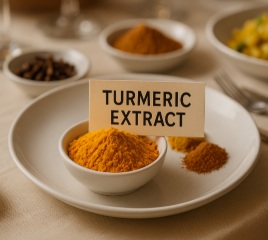
Turmeric extract
Rating : 7
| Evaluation | N. Experts | Evaluation | N. Experts |
|---|---|---|---|
| 1 | 6 | ||
| 2 | 7 | ||
| 3 | 8 | ||
| 4 | 9 | ||
| 5 | 10 |
Cons:
To be taken in controlled quantity (1)0 pts from Al222
| Sign up to vote this object, vote his reviews and to contribute to Tiiips.Evaluate | Where is this found? |
| "Descrizione" about Turmeric extract by Al222 (23420 pt) | 2025-Nov-19 10:12 |
| Read the full Tiiip | (Send your comment) |
Turmeric extract
Description
Turmeric extract is obtained from the rhizome of Curcuma longa, a spice belonging to the Zingiberaceae family.
It is a concentrated preparation of active compounds, mainly curcuminoids, and may be supplied as a liquid, paste, powder, or standardized curcumin extract.
It is used as a functional ingredient, a natural yellow–orange colorant, and a flavoring in a variety of foods and beverages.

Indicative nutritional values per 100 g
(Generic values for non–highly purified dry turmeric extract; actual values vary widely depending on concentration and standardization.)
Energy: 250–350 kcal
Total carbohydrates: 40–65 g
Sugars: 2–5 g
Fiber: 5–15 g (depending on residual plant matter)
Proteins: 5–10 g
Total lipids: 3–10 g
SFA (first occurrence): moderate fraction (mainly medium-chain saturated fatty acids)
MUFA: present in low–moderate amounts
PUFA: present in low–moderate amounts
TFA: negligible
Minerals: potassium, iron, manganese, with smaller amounts of magnesium and phosphorus
(In highly purified curcuminoid extracts, macronutrients are much lower, and the main component is the curcuminoid fraction.)
Key constituents
Curcuminoids: curcumin, demethoxycurcumin, bisdemethoxycurcumin (responsible for color and many biological properties).
Essential oil: turmerone, atlantone, zingiberene and other sesquiterpenes.
Polysaccharides: mainly starches and fibers.
Minerals: potassium, iron, manganese.
Other phenolic and antioxidant compounds in minor amounts.
Production process
Raw material: dried and milled rhizomes of Curcuma longa.
Extraction:
Solvent extraction with hydroalcoholic mixtures or other food-grade solvents (e.g., ethanol).
Alternatively, CO₂ supercritical extraction for selected essential oil fractions.
Concentration: solvent removal and concentration of the phytocomplex; optional standardization in curcuminoids (e.g., 95%).
Drying: to obtain a flowable powder (spray drying or vacuum drying).
Homogenization and blending: to ensure uniform curcuminoid content.
Quality control: curcuminoid assay, solvent residue checks, microbiological purity, and contaminant monitoring, in accordance with GMP/HACCP protocols.
Physical properties
Appearance: powder from bright yellow to orange–brown; in liquid form, a yellow/orange viscous solution.
Solubility:
Curcuminoids are poorly soluble in water; good solubility in fats and organic solvents.
“Water-dispersible” or “water-soluble” forms are available through carriers, encapsulation, or complexation systems.
Stability: sensitive to light, extreme pH (especially highly alkaline), and oxidation; more stable in slightly acidic–neutral environments and when protected from light.
Odor: spicy, warm, slightly earthy.
Sensory and technological properties
Color: very intense yellow–orange; strong coloring power even at low dosage.
Taste: slightly bitter, spicy, with earthy notes.
Aroma: warm, spicy, characteristic of turmeric.
Technological roles:
Natural colorant for beverages, sauces, snacks, bakery products, and ready meals.
“Active” ingredient for functional foods and dietary supplements.
Potential antioxidant effect in the food matrix, helping stabilize some lipid-containing products.
Food applications
Spice blends and curry powders.
Savory bakery products and extruded snacks.
Sauces, dressings, marinades, and dips.
Functional beverages, “golden milk,” shots, and plant-based drinks.
Ethnic ready meals, soups, rice and vegetable dishes.
Dietary supplements (capsules, tablets, powders, liquid shots) as a functional ingredient.
Nutrition & health
Turmeric extract is valued primarily for its curcuminoid content, to which the following potential effects are often attributed:
antioxidant support
modulation of inflammatory processes
support for joint and digestive function
The bioavailability of curcumin is naturally low; it is often combined with piperine, phospholipids, or specific delivery systems to enhance absorption.
It contributes color and a “natural” positioning in products aiming to reduce or replace synthetic colorants.
High doses or uncontrolled use are not recommended in people with specific hepatobiliary conditions or those on particular medications (medical evaluation required).
Portion note
In conventional foods: typically 10–200 mg of extract per serving, depending on curcuminoid content and color/functional target.
In supplements: the daily serving is set by the manufacturer in accordance with regulations and safety guidelines.
Allergens and intolerances
Turmeric extract is not among the major mandatory allergens.
Rare individual hypersensitivity reactions may occur.
Check for excipients or carriers (e.g., starches, maltodextrin, soy derivatives) that may introduce allergens.
Generally gluten-free and lactose-free, except in cases of cross-contamination or specific carrier systems.
Storage and shelf-life
Powder:
Store in tightly closed containers, protected from light, heat, and moisture.
Typical shelf-life: 24–36 months, depending on supplier specifications.
Liquid extracts:
Avoid prolonged exposure to high temperatures and light.
Once opened, use within the recommended time and store as indicated (often refrigerated).
Limiting exposure to oxygen is important to reduce oxidation of curcuminoids.
Safety and regulatory
Turmeric extract for food use may be regulated as an ingredient or as a color additive (E100 – Curcumin), depending on the preparation type and market.
Specific limits for purity, curcuminoid content, and dosage are defined by regional and international regulations.
Production must comply with GMP/HACCP, including controls on:
contaminants (heavy metals, pesticides, mycotoxins)
solvent residues
microbiological quality
Labeling
Possible ingredient declarations:
“turmeric extract”
“Curcuma longa extract”
when used as a colorant: “curcumin” or “E100”, depending on applicable regulations.
In functional foods or supplements, the curcuminoid content is often declared (e.g., “turmeric dry extract standardized to 95% curcuminoids”).
Any allergens deriving from excipients must be clearly indicated on the label.
Troubleshooting
Color loss in the final product:
May be caused by excessive light exposure, non-optimal pH, or prolonged high-temperature treatment.
Corrective actions: optimize pH (preferably slightly acidic–neutral), reduce processing time/temperature, improve packaging (opaque or light-barrier).
Sedimentation or phase separation in beverages:
Due to poor dispersion or solubility; may require use of dispersible forms or suitable emulsifiers.
Excessive bitterness:
Often linked to overdose or synergy with other bitter ingredients; adjust dosage or balance with other flavor notes.
Sustainability and supply chain
Turmeric is mainly cultivated in tropical regions (e.g., India, Southeast Asia).
Key sustainability aspects:
responsible agricultural practices (crop rotation, moderate pesticide use)
efficient post-harvest drying to reduce losses
sustainable management of extraction effluents, with monitoring of indicators such as BOD/COD
Residual plant biomass after extraction can be valorized as animal feed or organic soil amendment.
Main INCI functions (cosmetics)
(When used as “Curcuma Longa (Turmeric) Root Extract” or similar)
Antioxidant agent.
Potentially soothing and brightening component for the skin (in leave-on or rinse-off products).
Skin-conditioning ingredient, sometimes used in products targeting blemish-prone or stressed skin.
May impart a slight yellowish hue to creams, masks, and cleansers.
Conclusion
Turmeric extract is a high-value ingredient for the food and supplement industries thanks to its combination of natural coloring power, characteristic flavor profile, and curcuminoid content. When properly dosed, stabilized, and protected, it enables the development of products that meet consumer demand for more “natural” colorants and functional foods. Careful design of the production process, formulation, and packaging is essential to preserve color, activity, and safety throughout the shelf-life.
Mini-glossary
SFA – Saturated fatty acids: in excess, they may increase LDL cholesterol; in turmeric extract they are present in moderate amounts, but actual intake depends on use level in the final product.
MUFA – Monounsaturated fatty acids: generally associated with a more favorable cardiovascular lipid profile.
PUFA – Polyunsaturated fatty acids: include omega-3 and omega-6 families, important for inflammation, brain function, and cardiovascular health.
TFA – Trans fatty acids: industrial forms are detrimental to health; in turmeric extracts they are negligible.
GMP/HACCP – Good Manufacturing Practices / Hazard Analysis and Critical Control Points: management systems ensuring hygiene, safety, and traceability in production.
BOD/COD – Biological oxygen demand / chemical oxygen demand: indicators used to assess the organic and chemical load of effluents and their potential environmental impact.
Studies
It has anti-inflammatory, antioxidant and anti-apoptotic pharmacological properties. It can be used in the control of the aging process involving oxidative stress, inflammation and apoptosis. Recently, several reports have suggested that there are several nutraceuticals that have an effect on aging, such as Ginkgo Biloba, Resveratrol and Turmeric.
For its anti-inflammatory and antioxidant properties, Turmeric is used to treat an incredible number of diseases (for review see Kumar et al, 2011;. Gupta et al, 2013; Chin, 2016). Oxidative stress and inflammatory processes have been involved in the pathogenesis of several disorders such as senile dementia and therefore Turmeric extract is considered a drug. Recent studies have focused on the effect that Turmeric has on the aging process (to review see Trujillo et al., 2014), with a focus on the brain. The neural aging process produces a reduction in memory and learning due to anatomical changes such as the reduction in the size of the prefrontal cortex and hippocampus (for a review see Flores et al., 2016a, c) (1).
Inside, we find Curcumin, a polyphenol that has the ability to inhibit the peroxidation of lipids and that can eliminate harmful free radicals (2).
Some species of Turmeric that have healthy aspects similar to the Curcuma longa:
Safety
Turmeric is generally used as a safe dietary supplement, however the literature cites several cases of turmeric-induced hepatitis (3).
References____________________________________________
(1) Curcuma longa L. extract improves the cortical neural connectivity during the aging process.
Flores G.
Neural Regen Res. 2017 Jun;12(6):875-880. doi: 10.4103/1673-5374.208542. Review.
(2) Motterlini R, Foresti R, Bassi R, et al. Curcumin, an antioxidant and anti-inflammatory agent, induces heme oxygenase-1 and protects endothelial cells against oxidative stress. Free Radical Bio Med. 2000;28:1303–1312.
(3) Turmeric Induced Liver Injury: A Report of Two Cases. Luber RP, Rentsch C, Lontos S, Pope JD, Aung AK, Schneider HG, Kemp W, Roberts SK, Majeed A. Case Reports Hepatol. 2019 Apr 28;2019:6741213. doi: 10.1155/2019/6741213
Abstract. Turmeric is a commonly used oral herbal supplement with purported anti-inflammatory and antineoplastic properties. It is promoted as safe, with limited reports of severe adverse effects directly related to oral turmeric thus far in the literature. Herein we report two cases of turmeric supplement induced severe hepatitis. These cases highlight the need for physicians to be aware of patients taking this common supplement and the potential risks that exist.
| Sign up to vote this object, vote his reviews and to contribute to Tiiips.EvaluateClose | (0 comments) |
Read other Tiiips about this object in __Italiano (1)
Content:   Family:   Last update:   2025-11-19 10:06:44 | Kcal/100g:   350 Threat factors:   |

